











 Secure payments
Standard refund policy
Trade Assurance
Secure payments
Standard refund policy
Trade Assurance
| Product Type | Memory Module |
|---|---|
| Memory Capacity | 4 GB |
| Memory Technology | DDR4 |
| Product Voltage | 1.2V |
| RAM Speed | 2133MHz |
| RAM Standard | DDR4-2133/PC4-17000 |
| Error Identifying | ECC |
| Signal Type | Unbuffered |
| Column Access Strobe (CAS) | CL15 |
| Rank | Single Rank x8 |
| Quantity of Pins | 288-pin |
| RAM Genre | UDIMM |
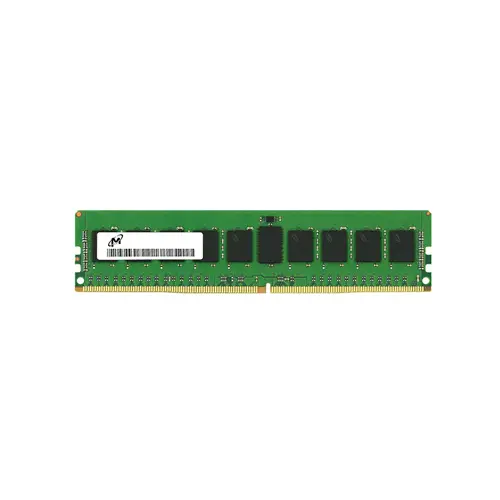
This DDR4-2133 ECC UDIMM is tailored for entry-level server or professional workstation platforms requiring data integrity, making it ideal for light virtualization, reliable NAS operations, or mission-critical small business applications. Its unbuffered single-rank x8 design with ECC ensures stable signal integrity and real-time error correction, while the CL15 latency and 1.2V low-voltage operation deliver responsive, energy-efficient performance in compatible single-socket Intel Xeon E3 or AMD Ryzen Pro systems.
1. ECC actively detects and corrects single-bit errors in real time, preserving data integrity for virtualization hosts and long-running financial transactions where silent corruption is simply unacceptable.
2. Unbuffered architecture strips away register latency, granting entry-level server and edge appliances faster memory access critical for low-latency caching and lightweight container orchestration.
3. Single-rank x8 organization minimizes electrical loading on the memory bus, letting every populated DIMM slot maintain clean signal margins under full-channel configurations in compact 1U nodes.
4. 1.2V operation substantially cuts power draw and exhaust heat, enabling denser server clusters with a smaller cooling budget and improved total cost of ownership over perpetual deployment cycles.
5. DDR4 technology elevates sustainable throughput per watt, directly supporting higher VM density and smoother data analytics pipelines without pushing thermal limits in always-on server rooms.
This Micron DDR4-2133 ECC Unbuffered DIMM is engineered for workstations and entry-level servers where absolute data integrity is paramount, but high-capacity registered memory isn’t required. Its ECC capability is the critical line of defense you need in always-on environments. Consider a virtualized host running multiple guest machines: a single undetected bit flip caused by background radiation can silently corrupt a virtual disk file or crash the hypervisor, leading to cascading service outages. ECC memory instantly corrects these single-bit errors in real time, turning a potential disaster into a non-event and preserving uptime for your entire virtualized cluster. In an in-memory database like Redis or a transaction-heavy SQL cache, your entire working dataset resides in DRAM; a flipped bit here translates directly into a wrong financial calculation or a corrupted user session. With ECC, that silent data corruption is detected and corrected, safeguarding the operational truth of your business. The module’s 1.2V ultra-low voltage reduces thermal stress and power draw in 24/7 installations, while the single-rank x8 configuration places a lighter electrical load on the memory controller, guaranteeing rock-solid compatibility across a wide range of workstation motherboards. For a lean IT setup running vital, data-sensitive workloads, this is the insurance your infrastructure cannot afford to be without.
General Virtualization
Populate all available memory channels with these 4GB ECC UDIMMs to maximize throughput and reliability. For a typical single-socket virtualization host, install four identical modules (16GB total) to run several lightweight virtual machines comfortably. When consolidating more VMs, scale up to eight modules for 32GB of affordable, error-protected capacity.
In-Memory Database
Fill every DIMM slot with matching 4GB ECC UDIMMs to create the largest possible reliable memory pool. Even with 8 or 16 modules, keep the configuration fully symmetric to benefit from memory interleaving and lower latency. While capacity per module is modest, ECC protection is critical for preventing data corruption in memory-resident workloads.
High Performance Computing
Deploy one DIMM per memory channel to achieve peak bandwidth on multi-channel platforms—for a quad-channel HPC node, use four 4GB modules for a balanced 16GB. ECC and single-rank x8 organization help maintain signal integrity during long-running compute tasks. Where absolute capacity is secondary to consistent throughput, this configuration offers predictable, error-free operation.
Strictly tested, compatible with Dell PowerEdge T30/T130, Lenovo ThinkSystem ST50, HPE ProLiant ML10 Gen9, and similar DDR4 ECC UDIMM servers.
Q: Can I mix this MTA9ASF51272AZ-2G1A1ZJ with other memory modules of different brands or speeds?
A: Mixing is not recommended. ECC UDIMMs must match in speed, rank, and organization for reliable server operation. Mismatched modules can cause multi-bit errors or POST failures.
Q: Is this memory compatible with my system?
A: It is compatible with Intel Xeon E3-1200 v5/v6 or AMD Ryzen Pro platforms using C232/C236/C246 chipsets. Verify your motherboard supports 1.2V DDR4 ECC Unbuffered UDIMMs.
Q: What is the recommended DIMM population order for optimal performance?
A: Populate identical modules per memory channel starting from the furthest slot from the CPU. For a single DIMM with this SRx8 module, use slot DIMMA1 to enable balanced channel interleaving.
Q: Does this module support overclocking or XMP profiles?
A: No. As a server-grade ECC UDIMM, it operates at fixed JEDEC DDR4-2133 CL15 timings. Overclocking or XMP is not supported and would compromise data integrity features.
Q: What warranty and typical failure rate can I expect?
A: This Micron module includes a 1-year warranty. Its annualized failure rate (AFR) is typically below 0.2%, reflecting rigorous testing and ECC reliability for 24/7 operation.