











 Secure payments
Standard refund policy
Trade Assurance
Secure payments
Standard refund policy
Trade Assurance
| Product Type | Memory Module |
|---|---|
| Memory Capacity | 32 GB |
| Memory Technology | DDR5 |
| RAM Speed | 4800 MHz |
| RAM Standard | DDR5-4800/PC5-38400 |
| Error Identifying | ECC |
| Signal Type | Registered |
| Column Access Strobe (CAS) | CL40 |
| Rank | Dual Rank |
| Quantity of Pins | 288-pin |
| RAM Genre | RDIMM |
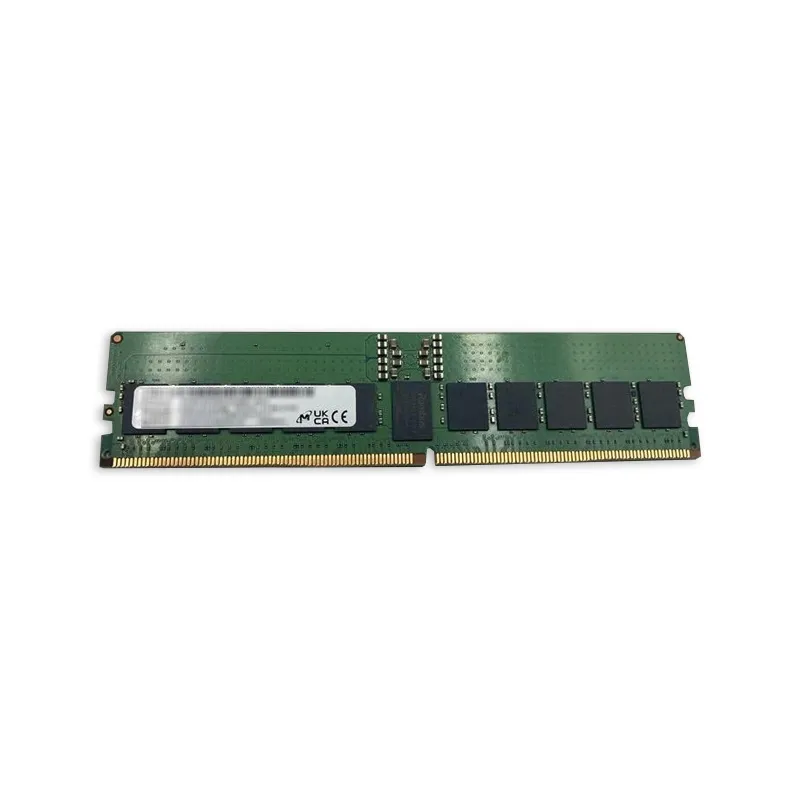
This 32GB DDR5-4800 Registered ECC RDIMM is purpose-built for enterprise servers running memory-intensive workloads such as virtualization, in-memory databases, and transactional analytics, where end-to-end data integrity is non-negotiable. Its dual-rank configuration amplifies bandwidth through bank interleaving, while the registered signaling and ECC jointly provide superior signal stability and real-time error correction across high-capacity deployments.
1. Generous per-DIMM capacity accommodates denser virtual machine consolidation and large in-memory datasets, allowing enterprises to scale workloads without immediate hardware expansion.
2. The migration to DDR5 technology elevates server memory bandwidth and lowers power envelope, fueling real-time analytics and AI inference with improved data throughput.
3. On-chip ECC transparently corrects single-bit errors, ensuring critical transactional integrity and eliminating silent data corruption in high-availability database environments.
4. The registered buffer architecture stabilizes command and address signals across fully loaded memory channels, preserving reliability in multi-socket server deployments with numerous DIMMs.
5. Dual-rank organization interleaves access across independent memory banks, keeping data pipelines continuously fed to the processor and sustaining consistent performance during heavy I/O saturation.
The Micron MTC20F2085S1RC48BA2 is a server-class RDIMM engineered for workloads where data integrity and uptime are non-negotiable. Its ECC technology detects and corrects single-bit memory errors caused by background radiation, a critical safeguard when a flipped bit in a financial database or a virtualized customer relationship management system could corrupt transactions silently. The registered signal buffer decouples the memory controller from the electrical load of driving multiple DIMMs directly, enabling a virtualization host to run dozens of virtual machines on a single server without signal degradation or random crashes even with fully populated memory channels. Dual-rank organization interleaves two sets of DRAM pages on the module, which boosts effective bandwidth by overlapping data accesses between ranks. In a high-frequency trading in-memory database like Redis, this translates into faster query responses under concurrent client loads. Finally, the DDR5-4800 speed and 32 GB capacity provide both the throughput and per-channel density essential for scaling containerized microservices, where every millisecond of latency and every gigabyte of headroom directly impact service reliability and user experience.
General Virtualization
For dense VM consolidation with hypervisors like ESXi or Hyper-V, pair this 32 GB RDIMM in groups of eight across a dual-socket platform to reach 256 GB or 512 GB totals. The registered ECC design ensures data integrity under heavy overcommit, while dual-rank interleaving boosts bandwidth for simultaneous guest workloads. Start with one DIMM per channel (8 modules) and scale linearly as tenant density grows.
In-Memory Database
Memory-resident systems such as SAP HANA or Redis demand absolute reliability and consistent low latency. Populate all channels symmetrically—typically 16 or 24 modules in a dual-socket server—to maximize capacity up to 768 GB or 1 TB. The CL40 timing and dual-rank build deliver the sustained throughput required for real-time analytics, and ECC scrubbing prevents silent data corruption in transaction-heavy environments.
High-Performance Computing
HPC clusters benefit from balanced memory bandwidth per core. Install eight modules in a single-socket node or sixteen across two sockets to saturate eight memory channels per CPU. This RDIMM’s 4800 MT/s speed reduces bottlenecks in MPI-based simulations and large-scale modeling. Configure identical ranks per channel to retain symmetric NUMA access, which is critical for minimizing jitter in tightly coupled parallel jobs.
Rigorously tested server memory, compatible with Dell PowerEdge R760, HPE ProLiant DL380 Gen11, Lenovo ThinkSystem SR650 V3.
Q: Can I mix this MTC20F2085S1RC48BA2 with other memory modules of different brands or speeds?
A: Mixing RDIMMs of different brands, speeds, or ranks is strongly discouraged in server environments. It often leads to signal integrity issues, reduced reliability, and can cause system instability or POST failures.
Q: Is this memory compatible with my server platform?
A: This DDR5-4800 ECC Registered DIMM is compatible with current Intel Xeon Scalable (Sapphire Rapids) and AMD EPYC 9004 series platforms. Verify your motherboard’s memory QVL and support for 32GB Dual Rank RDIMMs.
Q: What is the recommended DIMM population order for optimal performance with this module?
A: Follow the platform-specific memory population guidelines. For most servers, populate identical Dual Rank RDIMMs per channel, filling the farthest slot first. Balanced configurations maximize interleaving and bandwidth.
Q: Does this module support overclocking or XMP profiles?
A: No. This is a JEDEC-compliant server memory module. It operates only at standard DDR5-4800 CL40 timings and does not support XMP, EXPO, or overclocking, ensuring 24/7 mission-critical stability.
Q: What warranty and typical failure rate can I expect?
A: This module includes a 1-year warranty. When operated within specifications, it delivers an industry-standard MTBF exceeding 2 million hours, with annualized failure rates typically below 0.2% in controlled environments.