











 Secure payments
Standard refund policy
Trade Assurance
Secure payments
Standard refund policy
Trade Assurance
| Product Type | Memory Module |
|---|---|
| Memory Capacity | 64 GB |
| Memory Technology | DDR5 |
| Product Voltage | 1.1 V |
| RAM Speed | 6400 MHz |
| RAM Standard | DDR5-6400/PC5-51200 |
| Error Identifying | ECC |
| Signal Type | Registered |
| Column Access Strobe (CAS) | CL52 |
| Rank | Dual Rank x4 |
| Quantity of Pins | 288-pin |
| RAM Genre | RDIMM |
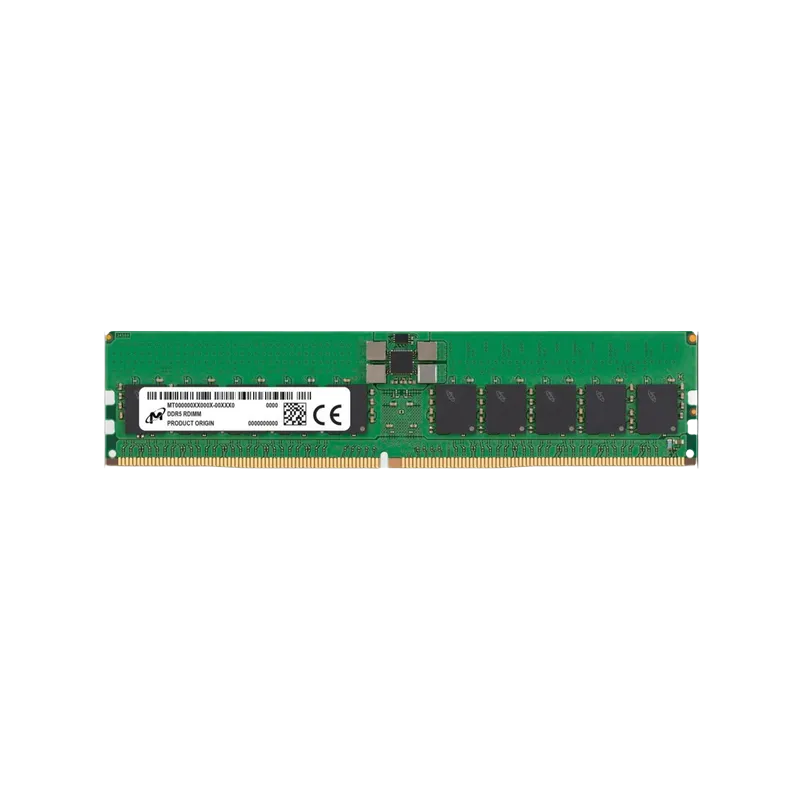
This 64GB DDR5-6400 Registered DIMM with ECC is engineered for enterprise servers and workstations running memory-intensive workloads such as virtualization, in-memory databases, and large-scale data analytics, where its Dual Rank x4 configuration maximizes bank-level parallelism for higher sustained bandwidth. The registered signal type and robust ECC ensure exceptional signal integrity and data reliability under fully populated configurations, while the low 1.1V operating voltage helps manage thermals in dense rack deployments.
1. A dense 64GB capacity per module conserves precious board space in rack-dense servers, allowing operators to push virtual machine density higher without sacrificing memory headroom for each guest.
2. 6400 MT/s throughput accelerates in-memory databases and real-time analytics, translating directly into faster query responses under heavy concurrent user loads.
3. Side-band ECC protection catches and corrects single-bit errors on the fly, preserving data integrity for long-running financial simulations or scientific modeling where silent corruption is unacceptable.
4. Registered signaling buffers clock and command lines, enabling stable multi-DIMM channel configurations that keep large-scale virtualization clusters predictable even as memory channels fill up.
5. Dual Rank x4 interleaving maximizes bank-level parallelism, delivering consistently high bandwidth and lower tail latencies for massive parallel access patterns like machine learning inference serving.
For data center architects, the 64GB Micron MTC40F2046S1RC64BH1 DDR5-6400 RDIMM is engineered to dispel four critical pain points. Its ECC error correction silently remedies single-bit upsets caused by cosmic radiation or electrical noise — an absolute necessity for in-memory databases like Redis, where a flipped bit in a live caching table could cascade into inaccurate analytics that mislead thousands of end users every second. The registered clock driver buffers incoming command and address signals, maintaining signal integrity across fully loaded 12-DIMM channels in dense virtualization clusters; this prevents the subtle electrical degradation that would otherwise destabilize dozens of virtual machines and trigger unplanned outages. Dual-rank x4 organization employs rank interleaving, streaming data by preparing one rank while the other finishes a transfer, which keeps latency low and bandwidth consistent under the heavy simultaneous requests seen in hyperconverged infrastructure. Meanwhile, the 1.1V DDR5 power envelope and 6400MT/s speed deliver 51.2 GB/s throughput with roughly a fifth less energy per DIMM than previous generations, directly lowering cooling and electricity bills at scale. These attributes collectively transform a memory stick into a bulwark of uptime, predictable real-time performance, and operational savings when your revenue hinges on round-the-clock data integrity.
General Virtualization
Deploy four of these 64 GB registered DIMMs across a 4‑channel platform to provide 256 GB, a solid foundation for dense VM consolidation. When scaling, fill all eight channels symmetrically (512 GB) to maintain balanced memory bandwidth and minimize NUMA overhead, which keeps live migrations and snapshot operations responsive.
In‑Memory Database
For memory‑hungry databases like SAP HANA or Redis, install eight modules (512 GB) in a dual‑socket server, distributing four per CPU across all memory channels. The ECC and registered feature set ensures data integrity under aggressive in‑memory caching, while the dual‑rank x4 design delivers the low latency that high‑frequency transactional workloads demand.
High‑Performance Computing
Build a 768 GB pool by populating twelve DIMMs—one per channel—in a modern workstation or server with 12 memory channels (for example, 4th Gen Xeon Scalable). Running the modules at their native DDR5‑6400 speed during massively parallel simulations maximizes throughput; using exactly one dual‑rank DIMM per channel avoids frequency drops and preserves the low CL52 latency required for sustained HPC jobs.
Rigorously tested server memory, compatible with Dell PowerEdge R760, HPE ProLiant DL380 Gen11, Lenovo ThinkSystem SR650 V3.
Q: Can I mix this MTC40F2046S1RC64BH1 with other memory modules of different brands or speeds?
A: Mixing RDIMMs of differing brands, ranks, or speeds is not recommended. It may cause POST failures, instability, or prevent ECC functionality. For reliable operation, populate all channels with identical Micron DDR5-6400 registered modules.
Q: Is this memory compatible with my server? Which platforms are supported?
A: This DDR5-6400 ECC Registered DIMM is designed for 4th/5th Gen Intel Xeon Scalable (Sapphire Rapids/Emerald Rapids) and AMD EPYC 9004/9005 series servers using DDR5 RDIMM slots. Verify your motherboard's qualified vendor list.
Q: What is the recommended DIMM population order for optimal performance?
A: Follow your server’s memory population guide. Install identical dual-rank x4 RDIMMs symmetrically across memory channels, filling 1 DIMM per channel first for balanced interleaving. Always match configurations per CPU socket for NUMA-optimized bandwidth.
Q: Does this module support overclocking or XMP profiles?
A: No. This JEDEC-compliant registered DIMM operates at its fixed 6400 MT/s profile. It does not support XMP or overclocking, as server platforms require strict signal integrity and reliability through validated standard speeds and timings.
Q: What warranty and typical failure rate can I expect?
A: This Micron module includes a 1-year warranty. It is built to enterprise-grade standards with an annualized failure rate well below 0.5%, ensuring high reliability in 24/7 data-center environments when operated within specified conditions.