











 Secure payments
Standard refund policy
Trade Assurance
Secure payments
Standard refund policy
Trade Assurance
| Product Type | Memory Module |
|---|---|
| Memory Capacity | 96 GB |
| Memory Technology | DDR5 |
| Product Voltage | 1.1 V |
| RAM Speed | 4800 MHz |
| RAM Standard | DDR5-4800/PC5-38400 |
| Error Identifying | ECC |
| Signal Type | Registered |
| Column Access Strobe (CAS) | CL4 |
| Rank | Dual Rank x4 |
| Quantity of Pins | 288-pin |
| RAM Genre | RDIMM |
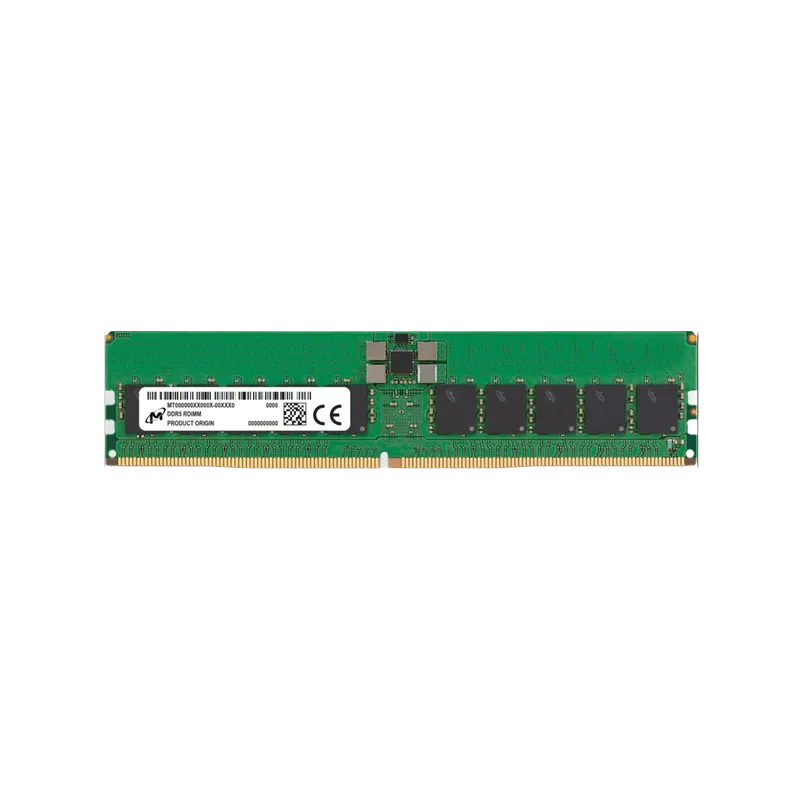
This 96GB DDR5-4800 RDIMM with ECC and registered signalling is engineered for enterprise server platforms running virtualization and memory-intensive database workloads, providing the critical data integrity and stability required for 24/7 operation. Its exceptionally low CL4 column access strobe latency, paired with a dual-rank x4 configuration, maximizes memory interleaving and command efficiency to sustain high throughput under concurrent, multicore access patterns.
1. The ninety-six gigabyte capacity of this module allows a single server to host many more virtual machines, directly increasing consolidation ratios and reducing data center footprint.
2. On‑die ECC and side‑band error correction work together to detect and correct single‑bit errors, preventing silent data corruption in financial transaction databases and long‑running analytical jobs.
3. Registered architecture buffers command and address signals to maintain clean electrical margins across heavily loaded channels, enabling stable operation when all DIMM slots are populated in a multi‑socket server.
4. DDR5 technology doubles the burst length and introduces independent bank groups, delivering the sustained bandwidth needed to feed dozens of CPU cores in memory‑intensive HPC and AI inference nodes.
5. Dual‑rank x4 construction interleaves accesses across two internal ranks per channel, fully saturating the memory bus and ensuring predictable low latency for real‑time telecommunication workloads under continuous load.
Understanding the MTC40F204WS1RC48B begins with recognizing it as an RDIMM—a registered server memory module purpose‑built for data‑center workloads. Its four defining characteristics directly address the pain points of IT architects managing dense virtualization clusters and in‑memory databases.
The 96 GB capacity on a single stick, combined with the registered signal type, means you can populate a 12‑channel server with over a terabyte of RAM while maintaining rock‑solid signal integrity. For a VMware or Kubernetes node running dozens of VMs, this density eliminates the need to compromise on guest memory allocation, preventing the ballooning and swapping that cripple application responsiveness. Meanwhile, the integrated ECC continuously detects and corrects single‑bit errors caused by background radiation or aging silicon. When your Redis or SAP HANA instance processes millions of financial transactions per second, a silent bit‑flip in cache is not just a crash risk—it’s a potential data‑corruption catastrophe. ECC removes that existential threat. Finally, the DDR5‑4800 speed and low 1.1 V operation deliver dual benefits: the 38.4 GB/s bandwidth per channel feeds compute‑hungry database queries with zero wait states, while lower voltage shrinks the power bill in a 24/7 data center. With dual‑rank x4 organization, the module also leverages interleaving to squeeze additional throughput from every clock cycle. In real terms, this memory translates into higher VM density per rack, lower latency for critical OLTP applications, and a infrastructure that can scale without subtle reliability risks—making it a strategic asset for any enterprise that views downtime as unacceptable.
This guide outlines capacity planning for a 96 GB DDR5‑4800 ECC Registered DIMM, ideal for server platforms.
General Virtualization
Start with two 96 GB RDIMMs providing 192 GB in a dual-channel setup for moderate consolidation. For heavier workloads, populate all eight channels with one DIMM per channel for 768 GB, balancing bandwidth and capacity. ECC ensures data integrity across all virtual machines.
In-Memory Database
Maximize capacity by fully populating every memory channel with 96 GB RDIMMs, reaching 1.5 TB or beyond on a dual-socket platform. The dual‑rank x4 organization and 4800 MT/s deliver the low latency required for real‑time analytics and high‑frequency transactions. ECC hardens in‑memory datasets against silent data errors.
High-Performance Computing
For HPC nodes, install exactly one 96 GB DIMM per channel to retain 4800 MT/s speed (1DPC), yielding 768 GB with maximum memory bandwidth for simulation and modeling. Balance capacity by filling all eight channels, enabling superior interleaving. Registered signaling stabilizes large‑scale deployments under continuous computation loads.
Validated server-grade RDIMM, rigorously tested with Dell PowerEdge R760, HPE ProLiant DL380 Gen11, and Lenovo ThinkSystem SR650 V3.
Q: Can I mix this MTC40F204WS1RC48B with other memory modules of different brands or speeds?
A: Mixing modules is not recommended for server environments. This RDIMM requires identical part numbers, speed, rank, and ECC Registered architecture to ensure signal integrity and avoid system instability.
Q: Is this memory compatible with my Intel or AMD server platform?
A: This DDR5-4800 RDIMM is designed for compatible Intel Xeon Scalable and AMD EPYC 9000 series platforms. Please verify your motherboard's qualified vendor list for 96GB ECC Registered DIMMs.
Q: What is the recommended DIMM population order for optimal performance?
A: Follow the server motherboard’s memory population guidelines. Typically, populate identical DIMMs per channel, starting with the farthest slot from the CPU, to maintain balanced interleaving and maximum throughput.
Q: Does this module support overclocking or XMP profiles?
A: No. This is a JEDEC-compliant DDR5-4800 Registered DIMM. Server memory prioritizes stability and data integrity; it does not support overclocking or XMP profiles and runs strictly at standard speed.
Q: What warranty and typical failure rate can I expect?
A: This Micron module includes a one-year warranty. Server-grade ECC RDIMMs exhibit very low annualized failure rates under proper conditions, ensuring reliable operation in mission-critical environments.