











 Secure payments
Standard refund policy
Trade Assurance
Secure payments
Standard refund policy
Trade Assurance
| Product Type | Memory Module |
|---|---|
| Memory Capacity | 16 GB |
| Memory Technology | DDR3 |
| Product Voltage | 1.35V |
| RAM Speed | 1333MHz |
| RAM Standard | DDR3-1333/PC3-10600 |
| Error Identifying | ECC |
| Signal Type | Registered |
| Column Access Strobe (CAS) | CL9 |
| Rank | Dual Rank x4 |
| Quantity of Pins | 240-pin |
| RAM Genre | RDIMM |
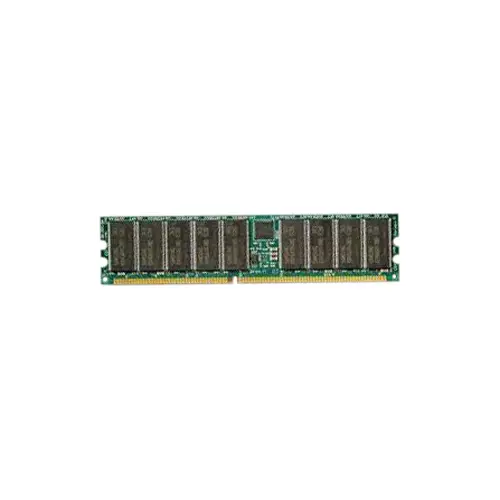
This is a server-class DDR3-1333 Registered ECC memory module optimized for virtualization and in-memory database workloads where data integrity is critical. Its dual-rank x4 configuration and CL9 latency improve interleaved memory access efficiency, while the registered signal buffering ensures stable operation in high-density multi-DIMM server deployments.
1. ECC memory actively detects and corrects single-bit errors in real time, safeguarding transactional data integrity in financial databases and virtualized workloads where even silent corruption is unacceptable.
2. Registered signal buffering stabilizes high-density memory populations, allowing a server to support more DIMMs per channel without compromising electrical signal quality under sustained heavy loads.
3. A 16 GB capacity per module increases the memory ceiling for hypervisors, enabling higher virtual machine density per physical host and reducing the frequency of costly hardware scale-out.
4. Dual Rank x4 organization interleaves accesses across two internal ranks, boosting effective bandwidth and keeping data pipelines full during simultaneous query processing across multiple tenants.
5. Operating at 1.35V reduces overall power draw and thermal stress in densely packed server racks, directly lowering cooling overhead in always-on data center environments.
The MT36KSF2G72PZ-1G4P1KG is a 16GB DDR3-1333 Registered DIMM engineered for server environments, where every calculation carries business consequence. Its four defining characteristics directly address the realities of data center operation.
First, ECC memory proactively detects and corrects single-bit errors caused by background radiation, preventing silent data corruption. In a virtualized cluster hosting dozens of VMs, a flipped bit in a hypervisor page table can cascade into cross-tenant instability; this module stops that fault before it propagates. Second, the registered signal buffer decouples the memory bus from heavy server-grade loads, enabling you to populate all 24 DIMM slots on a dual-socket board without signal collapse—critical for scaling in-memory databases like SAP HANA or Redis, where a terabyte-scale footprint must remain fully addressable. Third, the dual-rank x4 construction interleaves two storage grids, delivering higher sustained bandwidth under concurrent access patterns; during peak transaction processing, that parallelism cuts query latency when the CPU pipeline demands rapid, concurrent data fetches. Finally, operating at 1.35V instead of the standard 1.5V dramatically lowers thermal output per DIMM. In a fully packed 2U server, this voltage reduction translates into meaningful savings on cooling energy and permits higher ambient temperatures, improving your total cost of ownership without sacrificing the reliability those other features enforce.
Server Memory Capacity Planning Guide
This memory module is a DDR3-1333 Registered ECC DIMM (RDIMM) operating at 1.35V, making it exclusively suited for server platforms that require data integrity and sustained reliability under continuous load. The following recommendations address typical server workloads.
General Virtualization
Populate all memory channels with identical 16GB RDIMMs to maximise capacity while preserving balanced NUMA topology. For a dual‑socket system using triple‑channel architecture, install six modules per CPU (96GB total) to comfortably host 20–30 moderate virtual machines. Enable memory interleaving in the BIOS to improve aggregate throughput under mixed‑VM workloads.
In‑Memory Database
Capacity is paramount: fill every DIMM slot with 16GB RDIMMs, prioritising rank interleaving by using dual‑rank x4 modules. A 12‑slot server yields 192GB, sufficient for caching large datasets entirely in RAM. Pair the modules with processors that offer high memory bandwidth ceilings to minimise latency spikes during heavy transactional spikes.
High Performance Computing
Scale out memory bandwidth by installing one DIMM per channel across all populated CPU sockets, leveraging the registered architecture to maintain signal integrity at full population. For cluster nodes, 96–192GB per node using these low‑voltage 16GB sticks strikes an optimal balance between capacity per node and power envelope, letting you keep clock‑synchronous communication overhead low.
Strictly tested, compatible with servers like Dell PowerEdge R720, HP ProLiant DL380p Gen8, and Lenovo ThinkServer RD430.
Q: Can I mix this MT36KSF2G72PZ-1G4P1KG with other memory modules of different brands or speeds?
A: For server environments, mixing brands or speeds is strongly discouraged. Mismatched DIMMs can cause instability, reduced performance, or POST failures. All modules should have identical part numbers for validated compatibility and maximum reliability.
Q: Is this memory compatible with my system?
A: This 16GB DDR3-1333 registered ECC module supports Intel Xeon E5-2400/E5-2600 v1/v2 and AMD Opteron 6300 series platforms with C602/C204 chipsets. Verify your server board’s Qualified Vendor List (QVL) to confirm compatibility with dual-rank x4 RDIMMs.
Q: What is the recommended DIMM population order for optimal performance?
A: For dual-socket servers, populate identical DIMMs per channel, starting with slot 1 (blue) of each memory channel. Balance capacity across both CPUs. Typically, fill channels in sets of three for triple-channel or four for quad-channel architectures to maximize bandwidth.
Q: Does this module support overclocking or XMP profiles?
A: No. This is a JEDEC-compliant registered server module running at 1.35V with CL9 timings. It does not support overclocking or XMP profiles. The module operates only at its rated 1333MHz speed to ensure 24/7 data integrity under ECC error correction.
Q: What warranty and typical failure rate can I expect?
A: This module is backed by a 1-year warranty. With a typical Annualized Failure Rate (AFR) of less than 0.5% under normal server operating conditions, it delivers enterprise-grade reliability when installed in thermally managed, compliant platforms.