











 Secure payments
Standard refund policy
Trade Assurance
Secure payments
Standard refund policy
Trade Assurance
| Product Type | Memory Module |
|---|---|
| Compliance Standards | RoHS |
| Memory Capacity | 16 GB |
| Memory Technology | DDR3 |
| Product Voltage | 1.5V |
| RAM Speed | 1600MHz |
| RAM Standard | DDR3-1600/PC3-12800 |
| Error Identifying | ECC |
| Signal Type | Registered |
| Column Access Strobe (CAS) | CL11 |
| Rank | Dual Rank x4 |
| Quantity of Pins | 240-pin |
| RAM Genre | RDIMM |
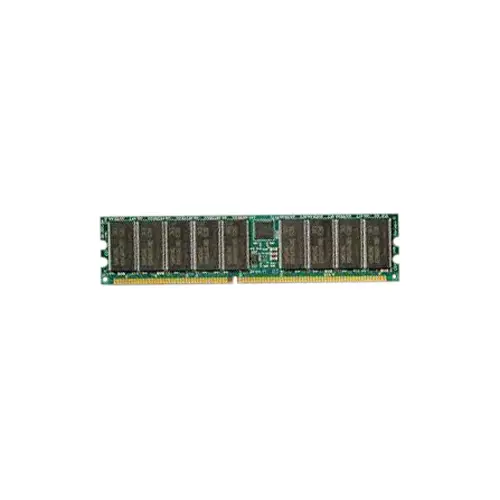
Designed for legacy server infrastructure, this 16GB DDR3-1600 RDIMM with ECC and Registered signaling ensures data integrity and system stability for virtualization, memory-resident databases, and other mission-critical enterprise workloads. Its dual-rank x4 organization improves memory bandwidth efficiency in multi-DIMM configurations, while the registered architecture reduces electrical loading to maintain signal reliability across high-density memory installations.
1. ECC memory detects and corrects single-bit errors in real time, safeguarding transactional data integrity in mission-critical database and virtualization servers.
2. Registered signal buffering stabilizes command and address lines across high-density memory configurations, preventing signal degradation in fully populated server boards.
3. 16 GB capacity per module increases memory headroom for hypervisors, allowing more virtual machines to run simultaneously without swapping to slower storage.
4. Dual Rank x4 organization interleaves access across multiple banks, sustaining high bandwidth utilization essential for consistent throughput in data analytics workloads.
5. 1600 MHz speed delivers ample channel bandwidth to handle concurrent requests from multiple CPU cores, reducing latency spikes under heavy multi-tenant workloads.
In a data center, every bit matters. The Micron MT36JSF2G72PZ-1G6D1 16 GB DDR3-1600 RDIMM is engineered to eliminate the hidden threat of silent data corruption. Its ECC technology detects and corrects single-bit errors in real time—a critical defense when a flipped bit in a memory-resident database like Redis could silently corrupt transactions or crash an in-memory analytics node. The registered signal buffer stabilizes the electrical load on the server’s memory bus, enabling you to populate all 24 DIMM slots without compromising signal integrity; for a VMware ESXi host running twenty virtual machines, that directly translates to higher VM density and steadfast uptime. Meanwhile, the dual-rank x4 organization supports interleaving, which increases effective memory bandwidth under concurrent workloads. When multiple VMs hammer the memory subsystem, this design reduces latency spikes, ensuring that your SAP HANA queries return consistent sub-second response times. This isn’t just a memory stick—it’s the foundation of reliable, high-performance server infrastructure.
General Virtualization
For a typical virtualization host running multiple VMs, populate at least four 16GB RDIMMs (64GB total) in a balanced quad-channel configuration to maximize memory bandwidth and leave room for growth. Leveraging the registered ECC capability ensures data integrity under sustained multi-tenant workloads, and using identical dual-rank x4 modules avoids rank-mixing latency penalties.
In-Memory Database
Low-latency in-memory databases like Redis or Memcached thrive on high capacity and low CAS latency; deploy six or eight of these CL11 16GB modules for 96–128GB total, filling all available channels. The ECC protection is critical here to prevent silent data corruption in cache-intensive operations, and the 1600MHz speed with dual-rank x4 organization delivers a strong balance of throughput and access time.
High-Performance Computing (HPC)
For memory-bandwidth-bound HPC simulations, populate all memory channels symmetrically with one 16GB RDIMM per channel—typically eight modules for 128GB on dual-socket platforms—to sustain peak theoretical bandwidth. Registered DIMMs allow higher population counts without signal degradation, and the proven 1.5V DDR3-1600 specification ensures stable, repeatable performance across long-running parallel jobs.
Stringently tested for Dell PowerEdge R720/R620, HP DL380p Gen8, Lenovo RD430, and compatible servers.
Q: Can I mix this MT36JSF2G72PZ-1G6D1 with other memory modules of different brands or speeds?
A: Mixing RDIMMs of different brands, speeds, or ranks is strongly discouraged in servers. Mismatched timings and electrical loads will likely cause POST failures, stability issues, and data corruption. Always use identical, validated modules.
Q: Is this memory compatible with my system?
A: This DDR3-1600 ECC Registered DIMM is designed for dual-socket Intel Xeon E5-2600 v2/v1 or AMD Opteron 6300/6200 platforms. Verify your server board supports 1.5V, 240-pin RDIMMs with Dual Rank x4 organization and a maximum capacity of 16 GB per slot.
Q: What is the recommended DIMM population order for optimal performance?
A: To maximize memory bandwidth, populate identical modules per channel starting with the farthest slot (typically blue/black slots first). For dual-rank x4 RDIMMs, one DIMM per channel usually yields optimal 1600 MT/s speed. Consult your server's population guide.
Q: Does this module support overclocking or XMP profiles?
A: No. This is a JEDEC-standard DDR3-1600 ECC RDIMM operating at fixed 1.5V and CL11 timings. Server memory does not support XMP or overclocking; it is built for reliability and strictly adheres to specified JEDEC parameters.
Q: What warranty and typical failure rate can I expect?
A: This module includes a one-year warranty. In properly cooled and managed enterprise environments, ECC RDIMMs exhibit an annualized failure rate (AFR) well below 0.5%, ensuring high operational reliability for mission-critical workloads.