











 Secure payments
Standard refund policy
Trade Assurance
Secure payments
Standard refund policy
Trade Assurance
| Model | MT18HTF6472Y-40EB2 |
|---|---|
| Product Type | Memory Module |
| Compliance Standards | RoHS |
| Memory Capacity | 512 MB |
| Memory Technology | DDR2 |
| Product Voltage | 1.8V |
| RAM Speed | 400MHz |
| RAM Standard | DDR2-400/PC2-3200 |
| Error Identifying | ECC |
| Signal Type | Registered |
| Column Access Strobe (CAS) | CL3 |
| Rank | Single Rank x4 |
| Quantity of Pins | 240-pin |
| RAM Genre | RDIMM |
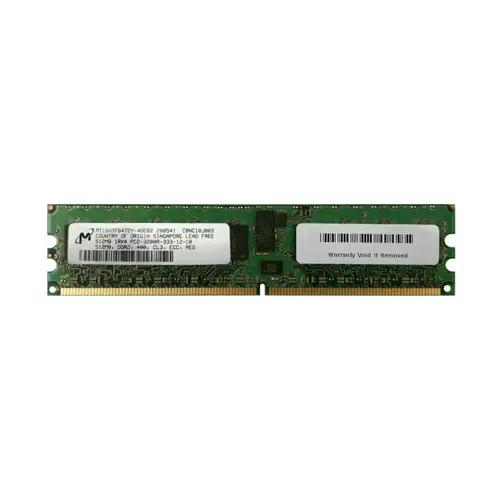
Designed for legacy server platforms requiring reliable memory subsystems, this 512 MB DDR2-400 Registered ECC RDIMM ensures data integrity for virtualization hosts and memory-intensive database applications. Its single-rank x4 configuration with a low CAS latency of 3 cycles combines stable registered signaling with error correction, delivering dependable performance in aging enterprise deployments.
1. ECC single-bit correction and double-bit detection safeguards transactional data integrity in financial or database servers, eliminating silent memory errors.
2. Registered DIMM architecture buffers command and address signals, enabling stable operation even in fully populated multi-rank server configurations.
3. Single Rank x4 organization minimizes bus loading per channel, ensuring consistent signal quality for always-on enterprise workloads.
4. A CAS latency of just three cycles reduces data access delays, improving the performance of latency-sensitive virtualization hosts.
5. Operating at the DDR2-400 speed grade, this module delivers reliable baseline bandwidth for legacy server platforms running lightweight essential services.
The MT18HTF6472Y-40EB2 is a server-grade DDR2 RDIMM built for business-critical reliability. Its ECC actively corrects single-bit errors, preventing a lone memory flip from crashing the hypervisor and taking down all virtual machines in a multi-tenant cluster, ensuring continuous service. The Registered buffer stabilizes the electrical load, enabling you to populate every 240-pin slot without signal degradation. For an in-memory database like SAP HANA or Redis, this stability is non-negotiable—your dataset size directly relies on full slot capacity, and any timing glitch triggers a database restart. Additionally, the Single Rank x4 organization supports chipkill recovery: even if a DRAM chip fails entirely, the system continues serving clean data. In a financial real-time analytics engine, this prevents silent corruption from compromising trades. Operating at 1.8V, the module also reduces thermal stress inside dense racks, extending lifespan and lowering cooling costs in your virtualization farm. This RDIMM delivers the resilience mission-critical systems require.
The MT18HTF6472Y-40EB2 is a server-class 512 MB DDR2-400 Registered ECC RDIMM. Capacity planning with this legacy module must account for its small individual capacity and registered signaling requirements.
General Virtualization
For lightweight hypervisors, install these modules in identical, symmetric groups across all memory channels. A typical dual-socket server populated with four DIMMs per channel yields 8–16 GB of ECC-protected RAM, sufficient for a handful of small VMs or containers. Registered technology stabilizes the electrical load on larger boards.
In-Memory Database
Maximize capacity by filling every available DIMM slot—a 24-slot node provides only 12 GB. Plan to shard the dataset across multiple such servers to meet the working set needed by in-memory engines. Registered ECC is essential to correct bit errors under continuous, intensive access.
High-Performance Computing
HPC loads often prize bandwidth over raw density. Populate all memory channels equally with these single-rank x4 RDIMMs to activate the widest interleave. A dual-socket board carrying 32 modules delivers 16 GB of fault-tolerant memory, enough for many compute-bound MPI simulations while maintaining signal integrity at 400 MHz.
Rigorously tested, seamless compatibility with servers like Dell PowerEdge 2850, HP ProLiant DL380 G4, and IBM eServer x336.
Q: Can I mix this MT18HTF6472Y-40EB2 with other memory modules of different brands or speeds?
A: Mixing is not recommended. Registered ECC DDR2 modules require identical ranks, timings, and organization to maintain signal integrity and avoid POST failures in server platforms.
Q: Is this memory compatible with my system? Which server platforms are supported?
A: This 1.8V DDR2-400 RDIMM fits legacy servers using Intel 5000/5100 chipset, AMD Opteron Socket F, or similar platforms that explicitly support PC2-3200 registered ECC DIMMs. Verify your board’s qualified vendor list.
Q: What is the recommended DIMM population order for optimal performance?
A: Always follow your server manual. Typically, populate channels starting with the farthest slot from the CPU per branch, matching pairs for dual-channel interleaving. Symmetric configurations minimize latency and maximize bandwidth.
Q: Does this module support overclocking or XMP profiles?
A: No. As a server-grade Registered ECC DIMM, it adheres strictly to JEDEC DDR2-400 (PC2-3200) specifications. Overclocking and XMP are unsupported to guarantee 24/7 data integrity and reliability.
Q: What warranty and typical failure rate can I expect?
A: This module carries a 1-year warranty. Enterprise Registered DIMMs demonstrate an annualized failure rate (AFR) well below 0.2%, even for legacy DDR2, due to robust ECC protection and strict binning. Prolonged reliability is expected under normal server conditions.