











 Secure payments
Standard refund policy
Trade Assurance
Secure payments
Standard refund policy
Trade Assurance
| Product Type | Memory Module |
|---|---|
| Compliance Standards | RoHS |
| Memory Capacity | 2 GB |
| Memory Technology | DDR3 |
| Product Voltage | 1.5V |
| RAM Speed | 1066MHz |
| RAM Standard | DDR3-1066/PC3-8500 |
| Error Identifying | ECC |
| Signal Type | Registered |
| Column Access Strobe (CAS) | CL7 |
| Rank | Single Rank x4 |
| Quantity of Pins | 240-pin |
| RAM Genre | RDIMM |
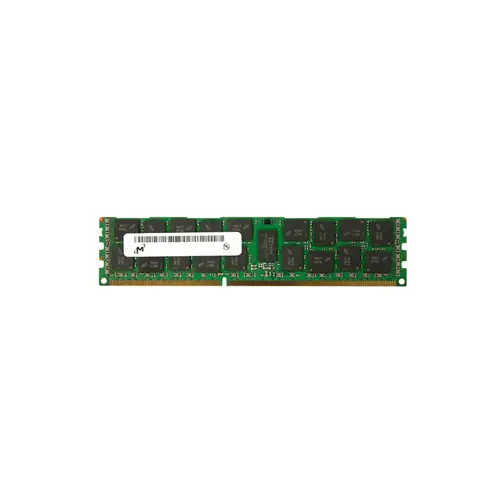
Designed specifically for server platforms requiring high data integrity, this 2GB DDR3-1066 Registered DIMM with ECC is ideal for lightweight virtualization hosts, entry-level database servers, and network appliances. Its single-rank x4 organization and CL7 latency help maintain signal stability in dense memory configurations while the registered interface buffers command and address lines, ensuring reliable operation under sustained transactional workloads.
1. Registered signal type ensures clean command and address signaling across heavily loaded memory channels, allowing sustained operational stability in multi-slot server platforms.
2. ECC error detection and correction silently resolves single-bit memory faults, preserving data integrity essential for transactional databases and long-running virtualization hosts.
3. Single Rank x4 organization minimizes per-rank electrical load, enabling the memory controller to drive higher sustained bandwidth for parallelized enterprise workloads.
4. CL7 low-latency access shortens the gap between data request and delivery, directly accelerating in-memory caching and real-time analytics response in server environments.
5. 1066MHz clock speed guarantees a consistent 8.5GB/s data rate per channel, supporting smooth multi-tenant application delivery and efficient container density.
In enterprise server environments, the MT18JSF25672PY-1G1D1 RDIMM is purpose‑built to solve the real pain points of data integrity and system stability under constant load. Its ECC technology actively detects and corrects single‑bit memory errors—an absolute necessity when a silent bit flip in a virtualized cluster could corrupt a live database or crash multiple guest machines without warning. Combined with the registered signal buffer, this module stabilizes high‑density memory configurations by reducing electrical load on the memory controller, allowing your hypervisor to reliably address expanded RAM pools across dozens of virtual machines during peak provisioning cycles.
In memory‑intensive database applications like in‑memory SQL or Redis caching, the module’s single‑rank x4 organization and 1066MHz speed deliver predictable, consistent bandwidth. The single‑rank design minimizes command bus contention and access latency, ensuring that transactional queries return consistent sub‑millisecond response times even as concurrent user sessions scale. For IT managers, this translates directly to fewer late‑night alerts, higher uptime for business‑critical workloads, and a memory subsystem that upholds data fidelity from power‑on to decommissioning.
This is a server-class memory module: a 2GB DDR3-1066 Registered ECC RDIMM. Capacity planning around this modest density must focus on populating multiple channels and slots to meet modern workload demands.
General Virtualization
Each hypervisor host aggregates memory across many DIMMs. A typical dual-socket server with 12 slots should be fully populated with these 2GB modules to reach 24GB usable RAM—sufficient for 8–10 light VMs. Balance modules evenly across memory channels to exploit interleaving; avoid mixing with unbuffered DIMMs as the platform requires Registered ECC consistency.
In-Memory Database
In-memory datasets demand extreme capacity and low latency. Given the 2GB limit per stick, maximizing throughput means installing identical RDIMMs in all 24 slots of a two-socket system to hit 48GB—a bare minimum for Redis or Memcached instances. For critical persistence, configure identical modules in a mirrored memory mode to protect in-flight transactions.
High Performance Computing
HPC clusters prize bandwidth over raw capacity. Populate one DIMM per channel (e.g., three modules per socket) to achieve triple-channel operation at peak 1066MHz speeds. While 6GB per node seems small, many embarrassingly parallel codes fit in this footprint if you scale out hundreds of such lean, power-efficient nodes.
Rigorously tested, this DDR3 RDIMM is compatible with servers like Dell PowerEdge R710, HP ProLiant DL380 G7, and IBM x3650 M3.
Q: Can I mix this MT18JSF25672PY-1G1D1 with other memory modules of different brands or speeds?
A: Mixing ECC Registered DIMMs of different brands or speeds is not recommended. It may cause system instability, POST failures, or the controller down-clocking all modules to the lowest common speed.
Q: Is this memory compatible with my server, specifically Intel Xeon 5500/5600 or AMD Opteron 6100 platforms?
A: Yes, this DDR3-1066 ECC RDIMM is designed for dual-processor servers using Intel Xeon 5500/5600 series or AMD Opteron 6100/6200 series with 240-pin DDR3 slots. Always verify your motherboard’s qualified vendor list.
Q: What is the recommended DIMM population order for optimal performance on a server board?
A: Populate identical DIMMs in matched banks per channel following your server board’s silkscreen sequence: typically slots A1, B1, C1 first for multi-channel balancing. Refer to the system service guide for specific numbering.
Q: Does this module support overclocking or XMP profiles?
A: No. This is a JEDEC-compliant DDR3-1066 server RDIMM. It does not support overclocking or Intel XMP profiles. It operates at fixed standard timings and 1.5V to ensure 24/7 data integrity.
Q: What warranty and typical failure rate can I expect?
A: This module includes a 1-year warranty. The AFR (annualized failure rate) is typically below 0.3% for genuine Micron components with proper cooling, as it meets strict RoHS and enterprise reliability standards.