











 Secure payments
Standard refund policy
Trade Assurance
Secure payments
Standard refund policy
Trade Assurance
| Product Type | Memory Module |
|---|---|
| Memory Capacity | 128 GB |
| Memory Technology | DDR4 |
| Product Voltage | 1.2V |
| RAM Speed | 2400MHz |
| RAM Standard | DDR4-2400/PC4-19200 |
| Error Identifying | ECC |
| Signal Type | Registered |
| Column Access Strobe (CAS) | CL17 |
| Rank | Octal Rank x4 |
| Quantity of Pins | 288-pin |
| RAM Genre | RDIMM |
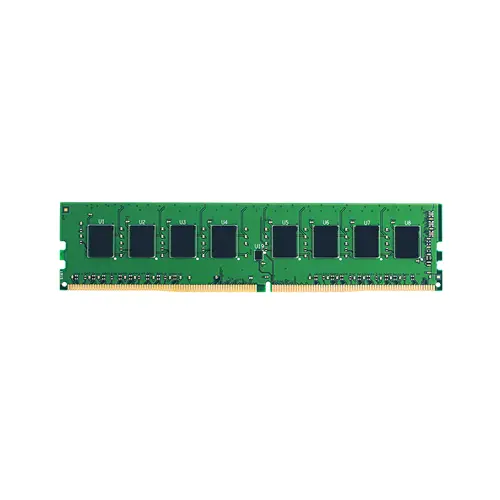
This 128GB DDR4-2400 RDIMM is engineered for enterprise servers and virtualization hosts, where its registered signal type and ECC ensure rock-solid data integrity under heavy, multi-rank memory loads. The octal-rank x4 organization maximizes capacity per channel for large in-memory databases, while the CL17 latency at 1.2V delivers a balanced mix of efficiency and responsiveness in dense server deployments.
1. A dense 128GB capacity per module maximizes memory footprint in limited DIMM slots, allowing massive in-memory databases and hypervisor workloads to run without costly swap access.
2. ECC error correction preserves data integrity by detecting and correcting single-bit errors in real time, a critical defense against silent data corruption in financial and healthcare transaction systems.
3. Registered signal buffering decouples the electrical load from the memory controller, enabling stable operation across dozens of DIMMs per server for large-scale virtualization and consolidation.
4. Octal Rank x4 organization leverages high bank-level parallelism to keep memory channels fully saturated, sustaining predictable throughput under heavy multi-tenant or analytics-driven traffic bursts.
5. DDR4-2400 bandwidth delivers 19.2 GB/s per channel, ensuring modern multi-socket servers can feed cores fast enough to accelerate real-time decision engines and database queries.
The M386AAK40B40-CTC4Q is an RDIMM engineered for enterprise servers, where every compute cycle translates directly into business outcomes. Its registered signal type buffers the command and address bus, allowing a single platform to host 128 GB of memory without compromising electrical stability. In a large‑scale virtualization cluster, this means you can consolidate dozens of active VMs on one node without random lockups or data corruption, turning spare capacity into measurably higher ROI.
The module’s integrated ECC silently corrects single‑bit errors, which is vital for in‑memory databases like SAP HANA that process real‑time financial transactions. A bit flip in an unsettled trade batch could cascade into regulatory exposure; ECC turns that risk into a practical zero. The octal‑rank x4 organization maximizes bandwidth at DDR4‑2400 speeds, keeping throughput high even when every rank is populated, while the 1.2 V operating voltage drives thermal and energy efficiency across dense server farms. Whether you are scaling a hypervisor‑driven private cloud or running an always‑on analytics engine, this memory delivers the quiet reliability your SLA depends on.
General Virtualization
For a dual-socket server, install at least eight of these 128GB RDIMMs across all memory channels to achieve a balanced 1TB footprint, which comfortably supports 50+ moderate VMs. Leverage the Registered ECC design and 2400MHz speed to sustain memory overcommit ratios of 1.5:1 without risking data corruption. Distribute modules evenly per CPU to maintain NUMA locality and consistent latency.
In-Memory Database
Populate every available DIMM slot with these octal-rank 128GB modules to maximize capacity density, aiming for 3TB or more per host to hold entire datasets in RAM. The CL17 CAS latency and 1.2V efficiency keep power and thermal profiles manageable even at full load. Deploy in pairs per channel to utilize independent memory controllers, ensuring high throughput for real-time analytics and Redis-style workloads.
High-Performance Computing
Configure one 128GB RDIMM per channel across all six or eight channels of a modern server platform to deliver peak memory bandwidth under heavy MPI or parallel I/O. The registered signal type stabilizes large clusters during long-running simulations, while low voltage helps aggregate power savings at rack scale. For memory-bound jobs, consider one-to-one DIMM-per-channel population with identical part numbers to avoid performance skew across nodes.
Rigorously tested 128GB DDR4 RDIMM; compatible with Dell R750, R740, HPE DL380 Gen10, Lenovo SR650 V2.
Q: Can I mix this M386AAK40B40-CTC4Q with other memory modules of different brands or speeds?
A: Mixing different brands or speeds in a server is not recommended. This Octal Rank RDIMM requires matched kits per channel to maintain signal integrity and prevent stability issues.
Q: Is this memory compatible with my system?
A: This DDR4-2400 ECC Registered DIMM is validated for Intel Xeon Scalable and AMD EPYC platforms. Please consult your server board's Qualified Vendor List (QVL) for specific support confirmation.
Q: What is the recommended DIMM population order for optimal performance?
A: Follow the server motherboard manual. Generally, populate the furthest slot from the CPU per channel first, then balance identical high-rank DIMMs across all channels for optimal bandwidth.
Q: Does this module support overclocking or XMP profiles?
A: No. This is a server-grade ECC RDIMM adhering strictly to JEDEC DDR4-2400 standards. It does not support overclocking or XMP to ensure mission-critical data integrity.
Q: What warranty and typical failure rate can I expect?
A: It comes with a one-year warranty. The typical Annualized Failure Rate (AFR) for such enterprise memory is very low, usually below 0.5%, ensuring long-term reliable operation.