











 Secure payments
Standard refund policy
Trade Assurance
Secure payments
Standard refund policy
Trade Assurance
| Product Type | Memory Module |
|---|---|
| Memory Capacity | 128 GB |
| Memory Technology | DDR4 |
| Product Voltage | 1.2 V |
| RAM Speed | 2400 MHz |
| RAM Standard | DDR4-2400/PC4-19200 |
| Error Identifying | ECC |
| Signal Type | Registered |
| Column Access Strobe (CAS) | CL17 |
| Rank | Octal Rank x4 |
| Quantity of Pins | 288-pin |
| RAM Genre | RDIMM |
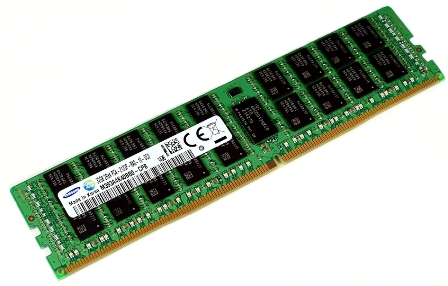
This 128GB DDR4-2400 Registered ECC RDIMM is engineered for enterprise servers running memory-intensive workloads such as virtualization, in-memory databases, and large-scale data analytics where data integrity is paramount. Its octal-rank x4 organization maximizes capacity per channel while the registered buffer and ECC deliver stabilized signal integrity and real-time error correction to ensure reliability under sustained heavy loads.
1. Massive module capacity drives extreme virtual machine density, allowing a single server to host more instances without sacrificing memory per workload.
2. ECC protects against single-bit data corruption, essential for financial transactions and AI inference where absolute data integrity is non-negotiable.
3. The registered buffer stabilizes high-capacity configurations, enabling populated multi-DIMM channels for large-scale in-memory databases.
4. Octal Rank x4 organization maximizes bank-level parallelism, sustaining peak bandwidth for concurrent analytics queries across all memory channels.
5. CL17 latency minimizes transaction response times, directly benefiting high-frequency trading platforms and latency-sensitive caching layers.
The Samsung M386AAK40B40-CUC50 is a 128GB DDR4-2400 RDIMM engineered for enterprise servers where reliability and scale are non-negotiable. Its four defining characteristics directly address the real-world pressures of data centers. First, ECC proactively corrects single-bit errors caused by cosmic radiation or electrical noise, preventing silent data corruption in hypervisor-managed virtual clusters where a flipped bit could bring down dozens of production VMs without warning. Second, the registered signal buffer stabilizes command and address lines, enabling servers to populate all memory channels with massive 128GB modules without signal degradation—this is critical when consolidating hundreds of virtual desktops on a single host. Third, the colossal 128GB capacity per DIMM lets you build a 1.5TB memory footprint using only 12 slots, leaving room for future growth; in-memory databases like SAP HANA can hold entire datasets for real-time analytics without expensive scale-out. Fourth, the octal-rank x4 organization interleaves access across eight independent banks of memory arrays, boosting effective bandwidth under heavy concurrent loads. During a transactional database spike, this architecture ensures smoother commit processing and faster cache retrieval than lower-rank counterparts, turning capacity into genuine throughput. Together, these traits translate into uncompromising uptime, higher VM density, and deterministic performance for workloads ranging from large-scale virtualization to data-intensive AI training pipelines.
General Virtualization
For a 128GB RDIMM, deploy modules in balanced configurations across all memory channels to maximize bandwidth. A typical dual-socket server populated with eight of these DIMMs delivers 1TB of RAM, comfortably hosting 100+ moderate virtual machines while leaving headroom for failover and live migration spikes.
In-Memory Database
Latency-sensitive workloads like Redis or SAP HANA demand the lowest possible access times, making the Registered ECC and octal-rank design essential. Install these DIMMs in symmetric sets—six or eight per host—to sustain over 90% memory utilization without swapping, ensuring real-time query responses even under heavy write contention.
High-Performance Computing (HPC)
HPC clusters profit from the large capacity per module, which reduces the number of DIMMs needed per node and lowers thermal load. Configure each socket with one DIMM per channel (e.g., eight modules for 1TB) to preserve the 2400MT/s speed; this enables memory-bandwidth-bound simulations to saturate the interconnect without throttling due to rank overpopulation.
Validated for server use; rigorously tested with Dell PowerEdge R760, HPE ProLiant DL380 Gen10, Lenovo ThinkSystem SR650, and more.
Q: Can I mix this M386AAK40B40-CUC50 with other memory modules of different brands or speeds?
A: Mixing is not recommended for registered server memory. Mismatched ranks, timings, or vendors can cause signal integrity issues and system instability. Always populate identical modules to ensure reliable 24/7 operation.
Q: Is this memory compatible with my server system?
A: This 128GB DDR4-2400 ECC RDIMM is designed for Intel Xeon Scalable and AMD EPYC platforms using DDR4 registered DIMM slots. Verify your server board supports octal-rank, 288-pin RDIMMs at 1.2V.
Q: What is the recommended DIMM population order for optimal performance?
A: Follow your server motherboard's population guide, typically filling identical DIMMs per channel starting with the farthest slot from the CPU. Balance memory across memory channels to maximize bandwidth with this octal-rank module.
Q: Does this module support overclocking or XMP profiles?
A: No. This is an enterprise-grade registered ECC module operating at JEDEC standard DDR4-2400. It does not support overclocking or XMP profiles, as data integrity and stability are paramount in server environments.
Q: What warranty and typical failure rate can I expect?
A: This module is covered by a one-year warranty. Enterprise RDIMMs like this typically exhibit an annualized failure rate (AFR) well below 0.5%, ensuring excellent long-term reliability under continuous server workloads.