











 Secure payments
Standard refund policy
Trade Assurance
Secure payments
Standard refund policy
Trade Assurance
| Product Type | Memory Module |
|---|---|
| Compliance Standards | |
| Memory Capacity | 128 GB |
| Memory Technology | DDR4 |
| Product Voltage | 1.2 V |
| RAM Speed | 2666 MHz |
| RAM Standard | DDR4-2666/PC4-21300 |
| Error Identifying | ECC |
| Signal Type | Registered |
| Column Access Strobe (CAS) | CL19 |
| Rank | Octal Rank x4 |
| Quantity of Pins | 288-pin |
| RAM Genre | RDIMM |
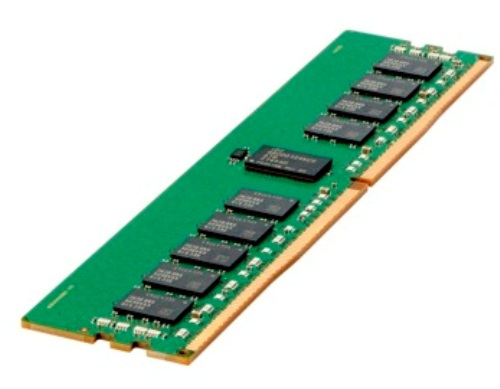
This 128GB DDR4-2666 Registered ECC RDIMM with an octal-rank x4 organization is purpose-built for enterprise servers running virtualization, in-memory databases, and other data-critical workloads, where its ECC and registered signals ensure end-to-end data integrity and robust signal stability even under fully loaded memory channels. The octal-rank design delivers exceptional per-channel density for scale-up platforms while the CL19 latency balances access speed with the elevated reliability demands of 24/7 operation.
1. A massive 128GB capacity per module enables virtualization hosts to pack more VMs per server, shrinking hardware footprint and licensing costs.
2. ECC protection detects and corrects single-bit memory errors on the fly, preserving data integrity for mission-critical databases and preventing silent data corruption.
3. Registered DIMM architecture buffers command and address signals, ensuring rock-solid signal integrity when populating all memory channels at high capacity in scale-out servers.
4. DDR4-2666 throughput delivers 21.3 GB/s per channel, providing the balanced bandwidth needed for memory-intensive analytics and in-memory caches without oversubscribing CPU resources.
5. Octal Rank x4 organization packs eight logical ranks on a single module, maximizing memory density to support large memory footprints while maintaining manageable power and thermal profiles in dense rack servers.
In enterprise environments where every second of downtime and every bit of data integrity carries immense financial weight, the Samsung M386AAK40B40-CWD7Q operates as a foundational safeguard. As a 128GB DDR4-2666 RDIMM engineered with an octal-rank x4 architecture and ECC, it is purpose-built for servers confronting extreme virtualization density and real-time transactional processing.
In a consolidated virtualization cluster, this module’s 128GB capacity sharply elevates your VM-per-host ratio, directly reducing licensing overhead and physical footprint. The Registered interface buffers command and address signals, ensuring that populating every DIMM slot to achieve multi-terabyte memory pools introduces zero signal degradation. This means a single unstable bit during peak multi-tenant load will not cascade into a cluster-wide outage. For in-memory databases powering financial trading or electronic health records, the octal-rank design enables bank interleaving that sustains higher bandwidth for sub-millisecond queries. Most critically, ECC silently detects and corrects single-bit flips caused by cosmic radiation. In these scenarios, a transient, uncorrected error is not just a crash—it is a corrupted trade, a distorted medical image, or an inexplicable data loss. ECC transforms your memory from a silent risk into a verified constant, while the 1.2V efficiency keeps dense, 24/7 configurations thermally sustainable.
Memory Type Identification
This module is a 128GB DDR4-2666 ECC Registered RDIMM with 288 pins, confirming it is designed for servers.
General Virtualization
Deploy at least one DIMM per memory channel to maximize bandwidth for numerous virtual machines. In a dual-socket server with eight channels per CPU, populate all 16 channels with these 128GB modules to achieve 2TB of balanced, reliable capacity while avoiding NUMA imbalances.
In-Memory Database
Fill every channel symmetrically with these high-capacity RDIMMs to provide the massive, fault-tolerant footprint in-memory databases demand. A fully loaded 24‑slot system yields 3TB, enabling entire datasets to reside in RAM for microsecond latency without costly storage tiering.
High Performance Computing
Populate one DIMM per channel to sustain peak 2666 MT/s speed for memory‑bandwidth‑sensitive simulations. Pairing 8 or 16 of these 128GB modules per node delivers ample headroom for large‑scale models, and the Octal Rank x4 organization ensures dense capacity without sacrificing per‑channel throughput.
Rigorously tested server memory, compatible with Dell PowerEdge R760, HPE ProLiant DL380 Gen10, Lenovo ThinkSystem SR650, and more.
Q: Can I mix this M386AAK40B40-CWD7Q with other memory modules of different brands or speeds?
A: Mixing is not recommended. In a registered server environment, identical specs (speed, rank, timing) across all channels are critical to ensure signal integrity and avoid POST issues.
Q: Is this memory compatible with my system?
A: This module suits servers with Intel Xeon Scalable or AMD EPYC platforms supporting DDR4-2666 Registered ECC. Verify your board's Qualified Vendor List for 128GB Octal Rank LRDIMM/RDIMM support.
Q: What is the recommended DIMM population order for optimal performance?
A: For dual-socket servers, populate identical DIMMs per channel following the motherboard's balanced memory guide. Typically, fill all channels symmetrically, starting with the furthest slot from the CPU.
Q: Does this module support overclocking or XMP profiles?
A: No. Registered server memory adheres to JEDEC standards for maximum data integrity; it lacks XMP profiles and is not designed for overclocking to ensure 24/7 reliability.
Q: What warranty and typical failure rate can I expect?
A: It includes a one-year warranty. Annualized failure rate is exceptionally low, typically <0.5%, due to rigorous chip screening and error-correction, crucial for mission-critical enterprise workloads.