











 Secure payments
Standard refund policy
Trade Assurance
Secure payments
Standard refund policy
Trade Assurance
| Product Type | Memory Module |
|---|---|
| Compliance Standards | |
| Memory Capacity | 128 GB |
| Memory Technology | DDR4 |
| Product Voltage | 1.2V |
| RAM Speed | 2666MHz |
| RAM Standard | DDR4-2666/PC4-21300 |
| Error Identifying | ECC |
| Signal Type | Registered |
| Column Access Strobe (CAS) | CL19 |
| Rank | Octal Rank x4 |
| Quantity of Pins | 288-pin |
| RAM Genre | RDIMM |
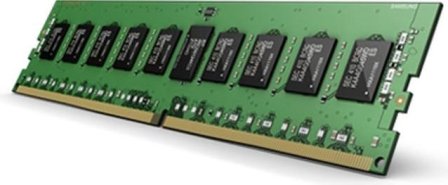
This 128GB DDR4-2666 registered ECC RDIMM is built for dual- and multi-socket server platforms, optimally suited for memory-intensive workloads such as hypervisor virtualization, in-memory databases, and large-scale data analytics where data integrity is critical. The octal-rank x4 organization, combined with the register buffer, maximizes channel density and signal stability, while the onboard ECC engine provides real-time single-bit error correction to sustain 24/7 operational reliability.
1. The 128GB capacity per module allows dense memory configurations in 2U servers, maximizing virtual machine density for enterprise consolidation without sacrificing performance.
2. ECC technology automatically corrects single-bit errors, preventing silent data corruption in financial transactions and critical database operations around the clock.
3. Registered signal buffering stabilizes high-capacity memory channels, enabling fully populated DIMM slots even under heavy multi-CPU workloads common in virtualization hosts.
4. Octal Rank x4 organization pushes per-channel DRAM rank count to the limit, delivering the massive addressable memory essential for large in-memory analytics and SAP HANA environments.
5. 2666MHz operation supplies balanced throughput to feed modern server CPUs efficiently, sustaining real-time data processing pipelines in content delivery and cloud workloads.
When you deploy a dense virtualization cluster or run an in‑memory database like SAP HANA, memory failures translate directly into service outages and data corruption. The Samsung M393AAK40B42‑CWD6Q is a 128 GB DDR4‑2666 Registered DIMM built specifically to eliminate these risks in server environments. Its ECC engine continuously corrects single‑bit errors caused by cosmic radiation or electrical noise, which means financial transaction records and hypervisor state remain intact under 24/7 operation. The Registered architecture buffers command and address signals, allowing you to fully populate 24 DIMM slots per server without signal degradation — a critical capability when consolidating hundreds of virtual machines on a single node. The Octal Rank x4 configuration maximizes the memory channels with heavy interleaving, boosting throughput for latency‑sensitive analytics queries by keeping the memory pipeline saturated. At 1.2 V, the module draws less power per gigabyte than previous generations, directly lowering cooling costs in a rack packed with memory‑hungry workloads. For IT architects managing virtualization platforms or real‑time databases, this DIMM means uninterrupted uptime, predictable latency under load, and the density to scale in‑memory workloads without compromising signal integrity.
Server Memory Identified: The specifications (ECC, Registered, Octal Rank x4, 128GB capacity per module) clearly indicate high-density DDR4 RDIMMs designed for enterprise servers.
General Virtualization
Deploy modules in balanced quantities across all memory channels—typically 8 or 16 identical sticks per host—to maximize bandwidth for numerous virtual machines. A baseline configuration of 256GB to 512GB total RAM using two or four 128GB modules per socket comfortably supports 30–50 moderate VMs, leaving headroom for vMotion and failover.
In-Memory Database
Populate the maximum supported DIMM slots per CPU, maintaining a symmetrical layout to leverage memory interleaving and avoid NUMA penalties. For platforms requiring 1TB or more, four 128GB RDIMMs per channel deliver the low latency and extreme capacity needed by Redis, SAP HANA, or Memcached, while the 2666MHz speed keeps large datasets quickly accessible.
High-Performance Computing (HPC)
Configure memory in a balanced, fully populated arrangement to match the high core counts of modern HPC nodes; six or eight 128GB modules per socket provide optimal bandwidth for MPI workloads. ECC and registered buffering ensure data integrity during long-running simulations, and the 1.2V operation helps maintain thermal stability in dense clusters.
Rigorously tested, compatible with server platforms like Dell PowerEdge R750, HPE ProLiant DL380 Gen10, Lenovo ThinkSystem SR650, and more.
Q: Can I mix this M393AAK40B42-CWD6Q with other memory modules of different brands or speeds?
A: Mixing is not advised in servers. Using identical 128GB DDR4-2666 Registered ECC RDIMMs prevents signal issues, maintains stability, and avoids errors from mismatched ranks or timings.
Q: Is this RDIMM compatible with my Intel Xeon Scalable or AMD EPYC server platform?
A: Yes, this 288-pin DDR4-2666 Registered ECC module fits most servers supporting that standard. Validate against your system’s Qualified Vendor List for Intel Xeon Scalable or AMD EPYC to confirm compatibility.
Q: What is the recommended DIMM population order for optimal performance?
A: Follow your server vendor’s guide. Typically, balance identical DIMMs across channels, populate the highest-capacity or dual-rank modules first, and install in specific slot sequences to maximize bandwidth and interleaving.
Q: Does this module support overclocking or XMP profiles?
A: No. This server-grade Registered ECC RDIMM adheres strictly to JEDEC DDR4-2666 timings. Overclocking and XMP are disabled to guarantee data integrity and reliability in mission-critical, 24/7 environments.
Q: What warranty and typical failure rate can I expect?
A: This module includes a 1-year warranty. The typical annualized failure rate (AFR) for such enterprise RDIMMs is below 0.5%, backed by rigorous component screening and burn-in testing for high availability.