











 Secure payments
Standard refund policy
Trade Assurance
Secure payments
Standard refund policy
Trade Assurance
| Product Type | Memory Module |
|---|---|
| Compliance Standards | |
| Memory Capacity | 128 GB |
| Memory Technology | DDR4 |
| Product Voltage | 1.2V |
| RAM Speed | 2666MHz |
| RAM Standard | DDR4-2666/PC4-21300 |
| Error Identifying | ECC |
| Signal Type | Registered |
| Column Access Strobe (CAS) | CL19 |
| Rank | Octal Rank x4 |
| Quantity of Pins | 288-pin |
| RAM Genre | RDIMM |
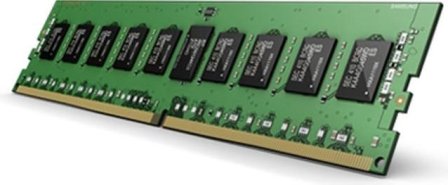
This 128GB DDR4-2666 Registered ECC RDIMM is purpose-built for enterprise servers and memory-intensive workloads such as virtualization and in-memory databases, leveraging its octal-rank x4 configuration to enable superior interleaving and higher overall bandwidth in dual-socket platforms. The registered signaling ensures reliable command/address integrity at high capacity densities, while ECC error correction and a 1.2V operating voltage deliver enhanced data protection and power efficiency for 24/7 mission-critical deployments.
1. ECC protection silently corrects single-bit memory errors in real time, safeguarding transactional databases and long-running analytics workloads from silent data corruption.
2. Octal Rank x4 architecture packs extreme density into a single slot, maximizing memory capacity per server for dense virtualization while preserving precious motherboard real estate.
3. Registered signal buffering stabilizes command and address lines under fully loaded configurations, ensuring reliable operation when all memory channels are populated in large-scale deployments.
4. 128GB capacity empowers a single module to run more virtual machines or larger in-memory datasets, reducing the need for extra physical hosts and lowering software licensing overhead.
5. 2666MHz transfer speed delivers the steady, balanced bandwidth needed to feed multi-core server CPUs, preventing memory bottlenecks during concurrent VM operations and heavy I/O processing.
The M393AAK40B42-CWD7Q is engineered as an RDIMM, making it an enterprise-grade server memory module that transforms how your data center handles risk and performance. In a dense virtualization cluster running dozens of critical VMs, its ECC technology is non-negotiable: it transparently corrects single-bit errors, preventing a random cosmic-ray bit flip from silently corrupting your transaction database or causing a hypervisor fault that cascades into unplanned downtime. Push this module into an in-memory analytics platform like SAP HANA, and the Registered buffer becomes your stability backbone, actively relaying command and address signals so you can deploy its massive 128GB capacity per stick without the electrical loading that triggers boot failures or data integrity alarms. Further, the Octal Rank x4 architecture massively elevates throughput by enabling aggressive bank interleaving, ensuring your parallelized queries never stall waiting for data. The 2666MHz speed at CL19 delivers predictable bandwidth, turning terabytes of collective memory into a rock-solid, low-latency pool where both a hypervisor’s live migration and an analyst’s real-time dashboard respond instantly, free from hesitation or error.
General Virtualization
For dense virtualization hosts running multiple VMs, a balanced memory-to-core ratio is critical. Deploy six to eight of these 128 GB RDIMMs across the server’s memory channels to reach 768 GB to 1 TB total capacity, ensuring headroom for memory overcommitment while maintaining NUMA locality. Populate identically across all CPU sockets and memory controllers to preserve symmetric multiprocessing performance and avoid remote memory access penalties.
In-Memory Database
In-memory databases like SAP HANA or Redis demand the lowest latency and highest reliability. Install a fully populated configuration—typically 12 or 24 modules across all available DIMM slots—to maximize capacity and exploit the octal-rank, x4 organization for superior error correction. ECC and registered architecture safeguard data integrity during sustained, high-throughput operations, while the large 128 GB module size keeps physical footprint economical in 2U appliances.
High-Performance Computing (HPC)
HPC workloads benefit from population schemes that maximize memory bandwidth per node. Use one 128 GB RDIMM per channel across all channels, avoiding mixing capacities, to enable balanced round-robin cache-line interleaving. The DDR4-2666 speed and CL19 CAS latency provide a stable bandwidth baseline for memory-bound simulations, while ECC ensures result reliability during multi-day compute runs. Capacity per node can scale easily to multiple terabytes without sacrificing registered signal integrity.
Rigorously tested for server compatibility. Compatible with Dell PowerEdge R740, HPE ProLiant DL380 Gen10, Lenovo ThinkSystem SR650, and more.
Q: Can I mix this M393AAK40B42-CWD7Q with other memory modules of different brands or speeds?
A: Mixing different brands or speeds is not recommended for registered ECC memory. Mixed modules can cause signal integrity issues, disable ECC functionality, and lead to system instability. Use identical modules for assured reliability.
Q: Is this memory compatible with my system?
A: This 128GB DDR4-2666 ECC RDIMM is designed for server platforms supporting Registered DIMMs, such as Intel Xeon Scalable (Purley/Whitley) or AMD EPYC 7000/7002/7003 series. Verify your motherboard’s qualified vendor list for RDIMM support.
Q: What is the recommended DIMM population order for optimal performance?
A: Follow your server motherboard’s population guide, typically filling identical DIMMs in balanced channel pairs first (e.g., A1+B1). For this octal rank module, populate all memory channels symmetrically to maximize bandwidth and interleaving.
Q: Does this module support overclocking or XMP profiles?
A: No. This is a JEDEC-compliant server RDIMM running at standard 2666MHz. It does not support overclocking or XMP, as server memory prioritizes data integrity and 24/7 stability under ECC operation.
Q: What warranty and typical failure rate can I expect?
A: This module includes a 1-year warranty. Enterprise-grade DDR4 ECC RDIMMs exhibit very low failure rates, typically with an annualized failure rate (AFR) well below 0.5% under proper thermal conditions and nominal voltage.