











 Secure payments
Standard refund policy
Trade Assurance
Secure payments
Standard refund policy
Trade Assurance
| Product Type | Memory Module |
|---|---|
| Memory Capacity | 128 GB |
| Memory Technology | DDR4 |
| Product Voltage | 1.2 V |
| RAM Speed | 2933 MHz |
| RAM Standard | DDR4-2933/PC4-23400 |
| Error Identifying | ECC |
| Signal Type | Registered |
| Column Access Strobe (CAS) | CL21 |
| Rank | Quad Rank x4 |
| Quantity of Pins | 288-pin |
| RAM Genre | RDIMM |
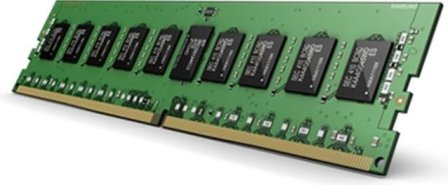
This 128 GB DDR4-2933 RDIMM with ECC and registered signaling is engineered for dense server platforms running memory-intensive workloads such as virtualization, in-memory databases, and enterprise data analytics. Its quad-rank x4 configuration maximizes capacity per channel while the registered signal type stabilizes multi-DIMM operation, ensuring data integrity under sustained load.
1. 128GB capacity per module maximizes memory density in server nodes, enabling more virtual machines and larger in-memory databases without sacrificing physical space.
2. 2933 MT/s memory speed delivers the bandwidth needed for data-intensive workloads like real-time analytics and high-frequency trading, ensuring smooth data flow across CPU cores.
3. ECC protection silently corrects single-bit errors, safeguarding transactional integrity in financial and scientific computing where data accuracy is mission-critical.
4. Registered DIMM architecture buffers command and address signals, stabilizing huge memory populations and reducing electrical load for consistent uptime in large-scale deployments.
5. Quad Rank x4 organization keeps all memory channels fully populated, preventing bandwidth bottlenecks and maintaining near-linear VM throughput under heavy consolidation.
The M386AAG40MMB-CVFC0 128GB DDR4-2933 RDIMM delivers four capabilities that directly address data center pain points. Its 128GB density lets a 16-slot server reach 2TB, ending the capacity famine that forces virtualization clusters to leave CPU resources idle. In a VMware environment, this translates to 30% more VMs per host without resorting to slow swap storage. ECC corrects silent errors, preventing a single flipped bit from corrupting transactions in an in-memory database like SAP HANA—where data accuracy is revenue. The registered buffer stabilizes signals across the module’s quad ranks, so you maintain full 2933MT/s speed even with every slot filled, eliminating the performance penalty of fully loaded systems. The quad rank x4 architecture additionally enables rank interleaving: while one rank refreshes, another serves data, boosting throughput and cutting latency for real-time analytics. This memory keeps your operations accurate, fast, and always online.
Server Memory Identified: The given module is a 128GB DDR4-2933 RDIMM with ECC and Registered signaling, designed for enterprise-class servers. Below is capacity planning guidance for key server workloads.
General Virtualization
Virtualized environments thrive on high memory density per socket. A single 128GB module allows a dual-socket server to reach 2TB with just 16 DIMM slots, maximizing VM density. For typical consolidation of 50-80 mixed-workload VMs, populate one DIMM per channel (1DPC) with these 128GB RDIMMs to balance capacity and memory bandwidth, and always configure identical modules across both sockets for NUMA symmetry.
In-Memory Database
Databases like SAP HANA or Redis demand massive, reliable capacity. Use the 128GB quad-rank RDIMMs to fill all memory channels, reaching 3TB or more per host while keeping clock speeds stable at 2933 MT/s. The ECC and registered design ensure data integrity under extreme load. Start with a 4-socket server fully populated with 12-24 modules to serve multi-terabyte in-memory tables, avoiding any performance penalty from swapping.
High-Performance Computing
HPC codes often prioritize bandwidth over absolute capacity. With these high-capacity quad-rank modules, populate at least one DIMM per channel to sustain peak 2933 MT/s, then scale capacity by adding a second DIMM per channel only if simulation datasets exceed 2TB per node. The Registered ECC design maintains signal integrity at scale, crucial for cluster-wide correctness during week-long MPI jobs. Standardize on identical modules across all compute nodes for predictable performance.
Rigorously tested, compatible with servers like Dell PowerEdge R750, HPE ProLiant DL380 Gen10, Lenovo ThinkSystem SR650 V2.
Q: Can I mix this M386AAG40MMB-CVFC0 with other memory modules of different brands or speeds?
A: Not recommended. Mixing brands or speeds on a server platform risks instability. For guaranteed performance and data integrity, always populate with identical Samsung 128GB 2933MHz Registered ECC modules sharing the same rank and CAS latency.
Q: Is this memory compatible with my system?
A: This DDR4-2933 ECC Registered RDIMM is compatible with Intel Xeon Scalable and AMD EPYC servers that support 288-pin 2933MT/s Registered DIMMs. Please verify your motherboard’s QVL and ensure it accepts quad-rank x4 modules.
Q: What is the recommended DIMM population order for optimal performance?
A: Follow your server manual’s memory population guidelines. Typically, install quad-rank 128GB RDIMMs in the first slot of each memory channel (e.g., DIMM A1, B1) to balance loads and enable optimal interleaving across all memory controllers.
Q: Does this module support overclocking or XMP profiles?
A: No. This enterprise server RDIMM adheres strictly to JEDEC DDR4-2933 standards and does not support XMP or overclocking. Reliable operation and data integrity take priority over increased speed in server environments.
Q: What warranty and typical failure rate can I expect?
A: This module carries a 1-year warranty. As an enterprise-class Samsung RDIMM, it exhibits an extremely low annualized failure rate (AFR) under specified operating conditions, ensuring long-term mission-critical reliability.