











 Secure payments
Standard refund policy
Trade Assurance
Secure payments
Standard refund policy
Trade Assurance
| Product Type | Memory Module |
|---|---|
| Compliance Standards | |
| Memory Capacity | 128 GB |
| Memory Technology | DDR4 |
| Product Voltage | 1.2 V |
| RAM Speed | 3200 MHz |
| RAM Standard | DDR4-3200/PC4-25600 |
| Error Identifying | ECC |
| Signal Type | Registered |
| Column Access Strobe (CAS) | CL22 |
| Rank | Quad Rank x4 |
| Quantity of Pins | 288-pin |
| RAM Genre | RDIMM |
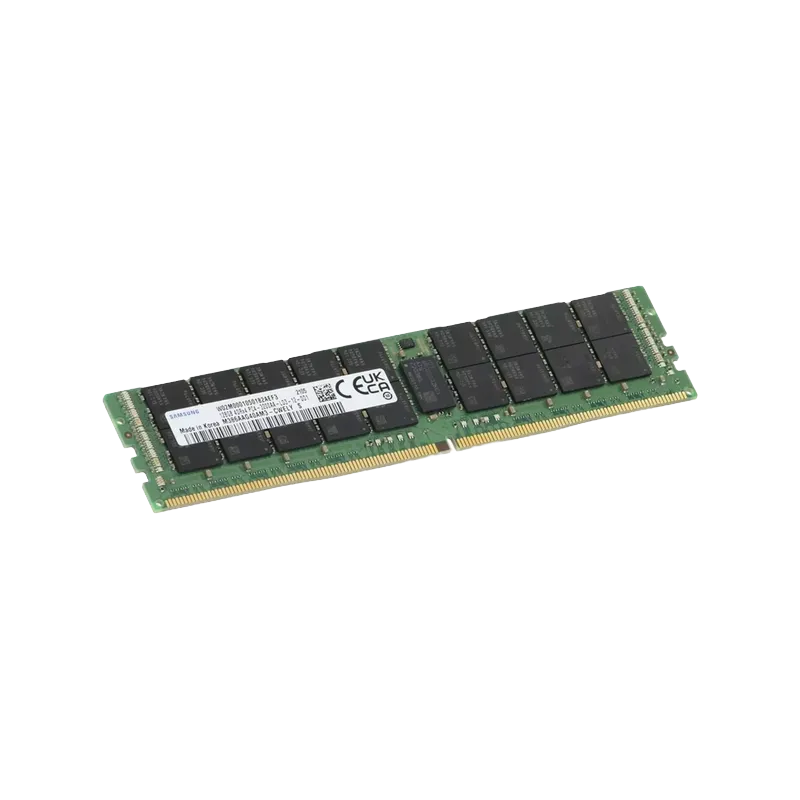
Based on its Registered ECC design and 3200 MT/s DDR4 specification, this 128 GB RDIMM is a server-grade module ideally suited for memory-intensive enterprise workloads such as virtualization, in-memory databases, and large-scale data analytics. Its quad-rank x4 configuration with CL22 latency and full error correction ensures exceptional data integrity and stable signal distribution under sustained multi-DIMM-per-channel operation.
1. A 128GB capacity per module dramatically increases memory density per server node, allowing heavier virtualization workloads and larger in-memory databases without sacrificing rack space.
2. 3200MT/s transfer speed elevates overall memory bandwidth, ensuring smooth data throughput for latency-sensitive enterprise applications like real-time analytics and high-frequency trading.
3. Integrated ECC actively corrects single-bit and detects multi-bit errors, protecting critical workloads from silent data corruption that could compromise financial records or scientific calculations.
4. Registered signal type buffers command and address lines, maintaining signal integrity across fully populated server boards and enabling stable operation with massive memory configurations.
5. Quad Rank x4 organization packs more DRAM banks per channel, sustaining high bandwidth utilization under heavy consolidation where numerous virtual machines contend for memory access.
When deploying mission‑critical server infrastructure, the Samsung M386AAG40AM3‑CWE RDIMM is engineered to eliminate the very failures that keep IT architects awake at night. Its 128 GB capacity per module collapses the memory footprint needed for dense virtualization clusters, allowing you to host far more virtual machines on a single node without crippling swap latency. That enormous density is made reliable by the registered buffer, which re‑drives address and command signals so that the memory controller sees a clean, single load, preventing the signal degradation that destabilizes fully populated servers. In an in‑memory database like SAP HANA or a high‑frequency trading cache, every bit flip is a corrupted transaction; the integrated ECC actively detects and corrects single‑bit errors, preserving data integrity in real time under relentless write pressure. The quad‑rank x4 organization at 3200 MT/s effectively parallelizes data access, saturating memory bandwidth so that complex analytical joins and concurrent VM migrations finish noticeably faster. Together, these four characteristics translate directly into fewer outages, guaranteed consistency for sensitive workloads, and a server platform that scales without compromising performance or data trustworthiness.
General Virtualization
For dense virtualization hosts, this 128GB RDIMM provides the ideal capacity-to-cost ratio. Populating dual-socket servers with eight of these modules (one per channel) delivers 1TB of memory, comfortably supporting over 100 typical virtual machines. Leave half the DIMM slots free to scale to 2TB as workload density grows.
In-Memory Database
In-memory databases like SAP HANA or Redis demand both capacity and data integrity, making this high-capacity ECC RDIMM essential. Configure all memory channels identically with one or two 128GB DIMMs per channel to sustain 1–2TB datasets entirely in RAM. The x4 rank architecture maximizes bank-level parallelism, reducing latency for large analytical queries.
High-Performance Computing
Memory-bandwidth-bound HPC workloads benefit from a balanced configuration using these modules. Install two 128GB RDIMMs per channel on platforms with 8 or 12 memory channels to achieve 2TB total capacity while exploiting interleaving for peak throughput. ECC and registered signaling guarantee error-free operation during multi-day simulation runs where silent data corruption is unacceptable.
This server memory is rigorously tested and compatible with Dell R750, HPE DL380 Gen10+, Lenovo SR650 V2.
Q: Can I mix this M386AAG40AM3-CWE with other memory modules of different brands or speeds?
A: Mixing with different brands or speeds is not recommended. It may force all modules to the lowest common speed or cause stability issues, potentially compromising ECC data integrity in server environments.
Q: Is this memory compatible with my system?
A: This RDIMM is compatible with servers using Intel Xeon Scalable or AMD EPYC platforms supporting DDR4-3200 ECC Registered memory. Verify your board’s QVL and support for 128GB Quad Rank x4 modules.
Q: What is the recommended DIMM population order for optimal performance?
A: Populate identical DIMMs per channel, typically starting with the farthest slot from the CPU. For Quad Rank modules, fill one DIMM per channel first to maximize bandwidth and ensure balanced interleaving.
Q: Does this module support overclocking or XMP profiles?
A: No. As an enterprise-grade ECC Registered DIMM, it operates at JEDEC standard DDR4-3200 with CL22 timing. Overclocking and XMP are not supported to prioritize stability and data reliability.
Q: What warranty and typical failure rate can I expect?
A: This module comes with a 1-year warranty. Enterprise RDIMMs like this demonstrate extremely low failure rates, typically offering an MTBF exceeding 2 million hours under normal operating conditions.