











 Secure payments
Standard refund policy
Trade Assurance
Secure payments
Standard refund policy
Trade Assurance
| Product Type | Memory Module |
|---|---|
| Compliance Standards | |
| Memory Capacity | 128 GB |
| Memory Technology | DDR4 |
| Product Voltage | 1.2 V |
| RAM Speed | 3200 MHz |
| RAM Standard | DDR4-3200/PC4-25600 |
| Error Identifying | ECC |
| Signal Type | Registered |
| Column Access Strobe (CAS) | CL22 |
| Rank | Quad Rank x4 |
| Quantity of Pins | 288-pin |
| RAM Genre | RDIMM |
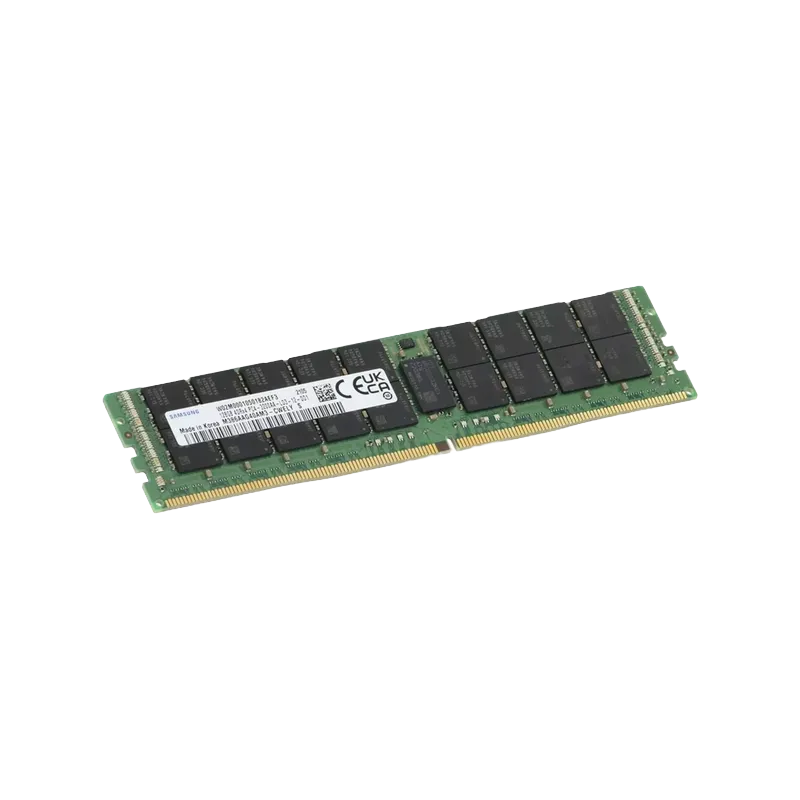
This 128GB DDR4-3200 Registered ECC RDIMM is purpose-built for enterprise servers and memory-intensive workloads such as virtualization, in-memory databases, and large-scale data analytics where data integrity and high capacity are critical. Its quad-rank x4 organization maximizes density per channel while the registered signal type and ECC ensure robust signal integrity and automatic error correction, minimizing downtime in 24/7 mission-critical environments.
1. Registered DIMM architecture buffers command and address signals, ensuring rock-solid signal integrity across fully populated memory channels in multi-socket servers that run always-on enterprise workloads.
2. ECC actively detects and corrects single-bit memory errors in real time, shielding virtualized databases and transactional applications from silent data corruption.
3. A massive 128GB per module capacity dramatically increases memory density per server, enabling heavier VM consolidation and large in-memory datasets without resorting to disk swap.
4. Quad Rank x4 organization interleaves access across multiple internal banks, keeping memory bandwidth saturated under the heavy concurrent query streams typical of analytics and AI inference nodes.
5. DDR4-3200 speed delivers a substantial uplift in peak throughput, cutting data transfer latency for caching layers and real-time financial processing where every microsecond counts.
Presenting the M386AAG40AM3-CWEZY, a 128GB DDR4-3200 Registered ECC module engineered for enterprise server infrastructure where data integrity and relentless uptime are non-negotiable. In a dense virtualization cluster, the ECC engine is your first line of defense against silent data corruption—when background radiation flips a bit inside a guest VM’s memory space, this module corrects the error transparently, safeguarding financial transactions and preventing catastrophic service crashes. The registered clock buffer makes such extreme capacity viable: it re-drives command and address signals, preserving clean signal integrity across all 288 pins even when every server slot is populated with 128GB sticks, which directly allows you to maximize VM density without risking intermittent instability. For an in-memory database like Redis or SAP HANA, the quad-rank x4 organization becomes a strategic accelerator. Four independent ranks let the memory controller interleave accesses, overlapping data bursts to drive higher effective bandwidth and handle thousands of concurrent queries with noticeably lower latency. DDR4-3200 speed pushes throughput to 25.6 GB/s, ensuring real-time analytics dashboards render instantly, while the 1.2V low-power operation reduces energy and cooling costs in always-on deployments. This memory transforms your infrastructure into a resilient, high-density platform where absolute data fidelity and responsive business insight go hand in hand.
General Virtualization
When deploying a hypervisor hosting multiple VMs, memory density and reliability are paramount. Populate the server with an even number of these 128GB Quad Rank RDIMMs—typically starting with 8 modules per CPU—to balance capacity and memory channel bandwidth. The ECC and registered signaling guarantee consistent performance under memory overcommit and reduce downtime from correctable errors.
In-Memory Database
For workloads like SAP HANA or Redis that demand massive, low-latency datasets, install the maximum supported 128GB RDIMMs across all channels. A 1 DIMM per channel (1DPC) configuration at 3200MT/s delivers the highest throughput, though populating 2DPC with these quad-rank DIMMs may require a slight speed reduction to maintain stability. Prioritize total RAM over clock speed, aiming for terabytes of addressable memory.
High-Performance Computing (HPC)
HPC applications benefit from ample memory bandwidth per core. Equip each CPU with 8 or 16 of these modules in a balanced configuration to saturate all memory channels. While Quad Rank x4 parts introduce higher latency, the sheer capacity per socket allows large-scale simulations to fit entirely in RAM, avoiding cluster node spillover. Monitor thermal limits and verify platform support for mixed-rank populations at full 3200MT/s.
Rigorously tested server memory, compatible with Dell PowerEdge R750, HPE ProLiant DL380 Gen10 Plus, and Lenovo ThinkSystem SR650 V2.
Q: Can I mix this M386AAG40AM3-CWEZY with other memory modules of different brands or speeds?
A: We strongly advise against mixing different brands or speeds. Registered ECC memory requires identical ranks, timings, and organization to maintain signal integrity and system stability in server environments.
Q: Is this memory compatible with my system? It is a dual-socket Intel Xeon Scalable server.
A: This DDR4-3200 RDIMM is validated for Intel Xeon Scalable and AMD EPYC platforms. Please verify your motherboard’s QVL and ensure support for 128GB Quad Rank x4 modules at 1.2V.
Q: What is the recommended DIMM population order for optimal performance on a server board?
A: Follow the server board’s memory population guide. Typically, populate identical DIMMs in matched sets per memory channel, starting with the farthest slots from the CPU, to maximize interleaving and bandwidth.
Q: Does this module support overclocking or XMP profiles?
A: No. As a server-grade Registered ECC DIMM, it strictly adheres to JEDEC DDR4-3200 specifications for reliability. Overclocking and XMP are not supported and would compromise data integrity in mission-critical workloads.
Q: What warranty and typical failure rate can I expect for this enterprise memory?
A: This module is covered by a one-year warranty. Its enterprise-grade design, with rigorous testing and ECC, results in an extremely low annualized failure rate, ensuring long-term operational dependability.