











 Secure payments
Standard refund policy
Trade Assurance
Secure payments
Standard refund policy
Trade Assurance
| Product Type | Memory Module |
|---|---|
| Compliance Standards | |
| Memory Capacity | 128 GB |
| Memory Technology | DDR4 |
| Product Voltage | 1.2 V |
| RAM Speed | 3200 MHz |
| RAM Standard | DDR4-3200/PC4-25600 |
| Error Identifying | ECC |
| Signal Type | Registered |
| Column Access Strobe (CAS) | CL22 |
| Rank | Quad Rank x4 |
| Quantity of Pins | 288-pin |
| RAM Genre | RDIMM |
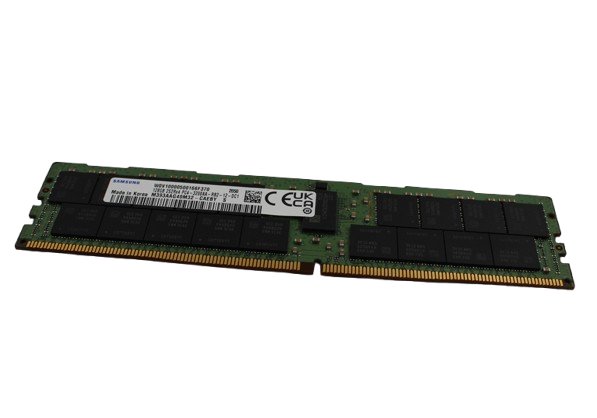
Designed for dual-socket server platforms, this 128GB DDR4-3200 RDIMM leverages ECC and registered signaling to guarantee data integrity in memory-intensive virtualized environments and in-memory databases. Its quad-rank x4 organization maximizes capacity per channel while maintaining a 1.2V power envelope, and the CL22 latency ensures stable, predictable performance under heavy multi-threaded workloads.
1. A 128 GB capacity per module enables dense virtual machine consolidation, allowing a single server to host more tenants without sacrificing dedicated memory headroom.
2. ECC protection silently corrects single-bit memory errors, directly guarding transactional databases and in-memory analytics against silent data corruption.
3. Registered signal technology buffers the command and address lines, stabilizing multi-DIMM topologies essential for maintaining signal integrity in fully populated enterprise servers.
4. Quad Rank x4 organization packs high density while maximizing bank-level parallelism, sustaining throughput in bandwidth-hungry workloads under heavy concurrent access.
5. DDR4-3200 speed delivers 25.6 GB/s peak bandwidth per channel, accelerating real-time data processing and reducing latency in memory-bound HPC and AI inference servers.
When you're running a virtualized cluster or an in-memory database, a single uncorrected data error isn't a nuisance—it's a potential node crash or a corrupted transaction that threatens business continuity. The Samsung M393AAG40M32-CAEBY, a 128GB DDR4-3200 Registered RDIMM, is built specifically to eliminate that risk and turn density into performance. Its ECC circuitry detects and corrects single-bit flips caused by background radiation, which becomes critical as you pack tens of terabytes into a single chassis; without it, silent data corruption can cascade through live VMs. The registered signal buffer on this 288-pin module stabilizes the bus, allowing a single server to host dozens more VMs or container pods without electrical degradation, so your consolidation ratio isn't held back by signal integrity. That 128GB density on a quad-rank x4 design means you can populate a four-socket system with six terabytes of memory using fewer DIMMs, slashing cost per gigabyte while still fueling massive in-memory analytics platforms like SAP HANA. At a well-timed CL22 latency and 3200MT/s bandwidth, the module feeds processors fast enough to keep database joins and hypervisor overhead at full speed. In a financial trading system, that low-latency, high-capacity combination translates into real-time risk calculations completing before the market moves. In a large virtualization host, it means you can overcommit memory with confidence, knowing a single corrupted page won’t bring down a guest, while the registered design guarantees the host remains stable even under full memory load. This isn’t just a stick of RAM; it’s a building block for infrastructure that refuses to fail.
General Virtualization
For dense VM consolidation, this 128GB Quad-Rank RDIMM provides maximum capacity per slot. Deploy one or two modules per server to achieve 128–256GB, comfortably hosting 20–40 virtual machines with balanced memory overcommit. Stick to a symmetrical multi-channel population to preserve memory bandwidth and avoid NUMA penalties.
In-Memory Database
Latency-sensitive databases like Redis or SAP HANA demand large, reliable memory pools. Install a minimum of two modules (256GB) to buffer entire datasets in RAM, reducing storage I/O. The ECC and registered design ensures data integrity under heavy write loads, while CL22 latency delivers consistent response times for real-time analytics.
High-Performance Computing
HPC clusters running MPI or OpenMP benefit from the high capacity and bandwidth of eight modules per dual-socket node (1 TB+). Use a balanced 8-DIMM configuration to saturate all memory channels, boosting throughput for simulation and modeling. Quad-rank x4 organization maximizes density without sacrificing the registered command stability required at 3200MT/s.
Rigorously tested server memory; compatible with Dell PowerEdge R760, HPE ProLiant DL380 Gen11, Lenovo ThinkSystem SR650 V3.
Q: Can I mix this M393AAG40M32-CAEBY with other memory modules of different brands or speeds?
A: Mixing Registered DIMMs of different brands or speeds is not advisable for server environments. It may force all modules to the lowest common speed or cause POST failures, risking system stability and data integrity.
Q: Is this memory compatible with my system?
A: This 128GB DDR4-3200 Registered ECC RDIMM suits Intel Xeon Scalable and AMD EPYC platforms supporting 288-pin DDR4. Verify your server's QVL and ensure BIOS and chipset support 128GB Quad Rank x4 modules.
Q: What is the recommended DIMM population order for optimal performance?
A: Populate identical Quad Rank RDIMMs starting with the farthest slot from the CPU in each memory channel, following your server’s balanced configuration. Always fill all channels symmetrically to maximize interleaving and bandwidth.
Q: Does this module support overclocking or XMP profiles?
A: No. This enterprise-grade ECC Registered memory adheres strictly to JEDEC DDR4-3200 specifications. XMP and manual overclocking are not supported, as they compromise mission-critical error correction and platform stability.
Q: What warranty and typical failure rate can I expect?
A: The module includes a one-year warranty. With rigorous factory testing, enterprise RDIMMs exhibit an extremely low annualized failure rate (AFR) under 0.5% when operated within specified thermal and voltage conditions.