











 Secure payments
Standard refund policy
Trade Assurance
Secure payments
Standard refund policy
Trade Assurance
| Product Type | Memory Module |
|---|---|
| Memory Capacity | 128 GB |
| Memory Technology | DDR5 |
| Product Voltage | 1.1 V |
| RAM Speed | 4800 MHz |
| RAM Standard | DDR5-4800/PC5-38400 |
| Error Identifying | ECC |
| Signal Type | Registered |
| Column Access Strobe (CAS) | CL40 |
| Rank | Quad Rank x4 |
| Quantity of Pins | 288-pin |
| RAM Genre | RDIMM |
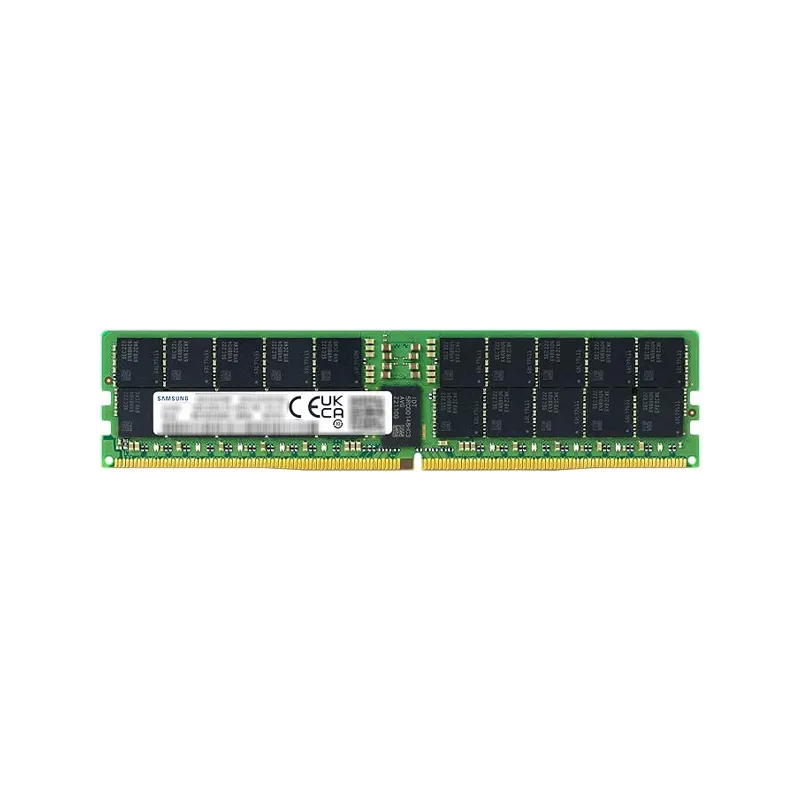
This is a server-grade DDR5-4800 Registered ECC memory module, purpose-built for enterprise platforms running virtualization, in-memory databases, and mission-critical workloads that demand uncompromising data integrity. Its quad-rank x4 organization and registered signal architecture enable dense 128 GB capacity with stable multi-DIMM population, while ECC corrects single-bit errors to prevent silent data corruption in 24/7 operating environments.
1. ECC error correction safeguards data integrity, silently fixing single-bit memory errors that could otherwise corrupt financial transactions or patient records in always-on enterprise servers.
2. Registered signal buffering stabilizes command and address loads across densely populated server boards, allowing platforms to scale to terabyte-class memory without compromising signal quality.
3. Quad Rank x4 organization packs more DRAM banks into a single module, fully saturating each memory channel for consistent low-latency access under heavy virtualization and database workloads.
4. DDR5 technology brings doubled bank groups and on-die ECC, raising sustained throughput for AI inference and real-time analytics that demand constant high-bandwidth memory streams.
5. A single 128GB module dramatically increases memory-per-core ratios in rack servers, empowering IT architects to allocate more virtual machines per node and shrink the overall hardware footprint.
In a data center running dense virtualization clusters and real‑time in‑memory databases, the Samsung M321RAGA0B20‑CWKBJ 128 GB DDR5 RDIMM turns abstract specifications into measurable uptime and performance. Its ECC silently corrects single‑bit errors induced by cosmic radiation or electrical noise, which means a hypervisor hosting dozens of virtual machines avoids silent data corruption that could crash critical workloads without warning. The registered design buffers command and address signals, enabling a server to stably drive this massive quad‑rank module across fully populated memory channels; when you need two terabytes of memory to scale a virtual desktop farm, signal integrity is non‑negotiable. The quad‑rank x4 organization interleaves four independent ranks of memory banks, allowing an in‑memory analytics engine to pipeline operations so that while one rank fulfills a read, the next rank pre‑charges and activates, squeezing real latency down and sustaining DDR5‑4800 bandwidth under heavy concurrency. With a low 1.1 V operating voltage, the module reduces thermal strain in 1U and 2U chassis, directly lowering cooling power draw and extending the service life of every surrounding component in a 24/7 facility. Here, the combination of robust error protection, signal stability, rank‑level parallelism, and power efficiency makes the difference between a service that merely runs and one that delivers predictable, wall‑clock financial or scientific results.
General Virtualization
A single 128GB DDR5-4800 RDIMM provides substantial headroom for dense VM consolidation. Deploy these modules in balanced quantities across all memory channels—typically eight or twelve modules per 2-socket server—to maximize interleaving and bandwidth while maintaining ECC protection for multi-tenant stability.
In-Memory Database
For Redis, SAP HANA, or memcached clusters, low latency and data integrity are paramount. Populate all channels identically with these quad-rank RDIMMs to reach terabyte-scale capacity at 4800 MT/s, allowing entire datasets to reside in DRAM and eliminating storage bottlenecks completely.
High-Performance Computing
HPC workloads demand peak sustained bandwidth. Install one 128GB RDIMM per channel in a fully balanced configuration (e.g., eight modules per CPU) to leverage DDR5’s doubled bank groups. Registered ECC corrects transient errors during week-long simulation runs, while 1.1V operation keeps thermal overhead manageable in dense compute racks.
Rigorously tested and qualified for servers: Dell PowerEdge R760, HPE ProLiant DL380 Gen11, Lenovo ThinkSystem SR650 V3.
Q: Can I mix this M321RAGA0B20-CWKBJ with other memory modules of different brands or speeds?
A: Mixing RDIMMs of different brands or speeds is not recommended. Mismatched registered modules can lead to signal integrity issues, system instability, and even failure to POST. Always populate with identical, validated modules for enterprise reliability.
Q: Is this memory compatible with my system? Which Intel or AMD platforms support it?
A: This 128GB DDR5-4800 RDIMM is intended for servers based on 4th Gen Intel Xeon Scalable (Sapphire Rapids) or AMD EPYC 9004/8004 series processors. Verify compatibility via your server motherboard's qualified vendor list (QVL) for specific firmware requirements.
Q: What is the recommended DIMM population order for optimal performance?
A: For quad-rank RDIMMs, populate one DIMM per channel first, typically starting with the farthest slot from the CPU per channel. Follow your server manufacturer's population guide to balance interleaving and maximize memory bandwidth.
Q: Does this module support overclocking or XMP profiles?
A: No, this is a JEDEC-standard server RDIMM running at DDR5-4800. It does not support XMP profiles or overclocking, as enterprise memory prioritizes stability, data integrity, and ECC functionality over adjustable speed.
Q: What warranty and typical failure rate can I expect?
A: This module is backed by a 1-year warranty. The typical annualized failure rate (AFR) for quality enterprise memory is well below 0.5%, ensuring dependable 24/7 operation with ECC protection. Premature failures are extremely rare.