











 Secure payments
Standard refund policy
Trade Assurance
Secure payments
Standard refund policy
Trade Assurance
| Product Type | Memory Module |
|---|---|
| Memory Capacity | 128 GB |
| Memory Technology | DDR5 |
| Product Voltage | 1.1 V |
| RAM Speed | 4800 MHz |
| RAM Standard | DDR5-4800/PC5-38400 |
| Error Identifying | ECC |
| Signal Type | Registered |
| Column Access Strobe (CAS) | CL40 |
| Rank | Quad Rank x4 |
| Quantity of Pins | 288-pin |
| RAM Genre | RDIMM |
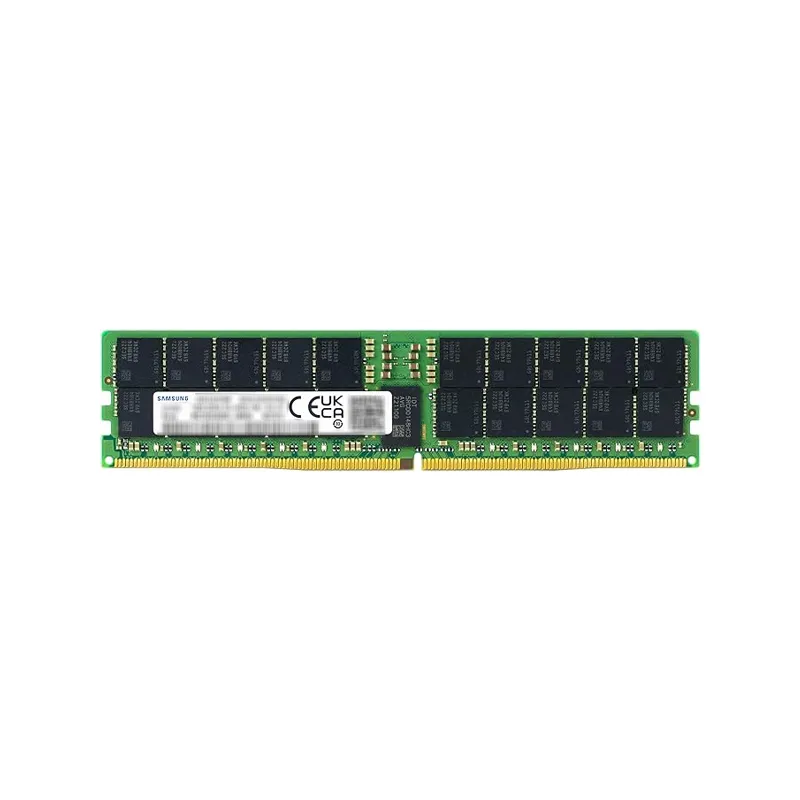
This 128GB DDR5-4800 Registered ECC RDIMM is engineered for enterprise server platforms, excelling in memory-intensive workloads such as large-scale virtualization and in-memory databases where data integrity is critical. Its quad-rank x4 organization maximizes capacity density per channel, while integrated ECC with registered buffering ensures robust signal integrity and reliable error correction under sustained heavy loads.
1. The 128GB capacity per module dramatically increases memory density, allowing expansive virtual machine fleets to run on fewer physical servers while preserving dedicated memory bandwidth for each tenant.
2. DDR5 technology brings a substantial leap in transfer rates and bank groups, feeding modern server CPUs with the sustained throughput required by real-time analytics and large-scale in-memory databases.
3. ECC protection actively corrects single-bit errors and detects multi-bit corruption, preventing silent data degradation in financial transactions, healthcare records, and other integrity-sensitive enterprise workloads.
4. Registered signal buffering stabilizes command and address lines across fully loaded memory channels, ensuring reliable operation when populating all slots in 2U and 4U rack servers under continuous load.
5. Quad Rank x4 organization interleaves multiple rank accesses to keep memory pipes fully utilized, delivering predictable, high bandwidth even under the heavily concurrent access patterns of virtualized infrastructure.
The M321RAGA0B20-CWKZJ is a 128GB DDR5-4800 Registered ECC RDIMM purpose-built for data center servers where uptime and data integrity are non-negotiable. Its four core strengths — massive capacity, ECC error correction, registered clock buffering, and quad-rank throughput — transform how you deploy virtualization clusters and in-memory databases. In a dense VMware or Hyper-V host running dozens of virtual machines, the 128GB density lets you consolidate far more workloads per node, directly lowering licensing and rack space costs. The registered buffer stabilizes command and address signals even when all channels are fully populated, so you avoid signal collapse that could silently crash a hypervisor. Simultaneously, ECC continuously corrects single-bit flips caused by background radiation, which is critical because a single corrupted bit in a database index or a virtual machine’s memory can cascade into application outages or data inconsistencies. For in-memory platforms like SAP HANA or Redis, the quad-rank x4 organization and 4800MT/s bandwidth supply the sustained concurrency needed to merge real-time analytics without latency spikes. Powered at just 1.1V, it also helps reduce thermal load in dense farms. This module means you can scale mission-critical services with absolute confidence in stability and speed.
The given module—128GB DDR5-4800 ECC Registered RDIMM, quad rank, 1.1V—is a server-class memory kit. Its high capacity, error correction, and registered signaling target multi-socket platforms and data‑center workloads.
General Virtualization
Populate at least one DIMM per memory channel for peak bandwidth. On a typical dual‑socket server with eight channels per CPU, start with 8×128 GB (1 TB) to comfortably host 40–60 general‑purpose VMs. Scale up to 16 or 24 DIMMs for dense consolidation, but be aware that quad‑rank DIMMs often drop to 4400 MT/s when two are placed on the same channel.
In‑Memory Database
Maximise capacity and data integrity by fully populating all channels. A uniform 16×128 GB configuration delivers 2 TB and keeps the memory subsystem balanced. ECC and registered architecture ensure reliability for in‑memory analytics and real‑time transaction processing. For always‑available deployments, consider adding a spare rank or configuring memory mirroring.
High‑Performance Computing
For bandwidth‑bound HPC jobs, install one DIMM per channel to sustain the full 4800 MT/s speed—1 TB across eight channels per socket. If the workload demands raw capacity over frequency, fill two DIMMs per channel (2 TB per socket) and accept the lower 4000–4400 MT/s clock. Always match DIMMs identically to avoid imbalances that degrade parallel job scaling.
Rigorously tested server memory, compatible with Dell PowerEdge R760, HPE ProLiant DL380 Gen11, Lenovo ThinkSystem SR650 V3.
Q: Can I mix this M321RAGA0B20-CWKZJ with other memory modules of different brands or speeds?
A: Mixing is not recommended for server environments. Different brands, speeds, or ranks often cause instability. For guaranteed reliability, populate with identical Samsung 128GB DDR5-4800 RDIMMs to maintain signal integrity and ECC functionality.
Q: Is this memory compatible with my system?
A: This DDR5-4800 128GB Registered ECC RDIMM is designed for modern server platforms, including Intel Xeon Scalable (Sapphire Rapids) and AMD EPYC 9004 Series. It requires a motherboard with 288-pin DDR5 slots supporting quad-rank RDIMMs.
Q: What is the recommended DIMM population order for optimal performance?
A: Follow your server motherboard's memory population guide. Typically, populate identical DIMMs in balanced, symmetric configurations across all memory channels. For this quad-rank RDIMM, observe slot-per-channel limits to avoid clock speed reduction.
Q: Does this module support overclocking or XMP profiles?
A: No. As a server-class Registered ECC DIMM, it strictly adheres to JEDEC DDR5-4800 specifications. Overclocking and XMP profiles are not supported to ensure data integrity and 24/7 operational stability in enterprise environments.
Q: What warranty and typical failure rate can I expect?
A: This Samsung module includes a 1-year warranty. Enterprise RDIMMs have an extremely low annualized failure rate (AFR), typically under 0.5%, thanks to rigorous screening and ECC error correction, ensuring high reliability in data center deployments.