











 Secure payments
Standard refund policy
Trade Assurance
Secure payments
Standard refund policy
Trade Assurance
| Product Type | Memory Module |
|---|---|
| Memory Capacity | 128 GB |
| Memory Technology | DDR5 |
| Product Voltage | 1.1 V |
| RAM Speed | 4800 MHz |
| RAM Standard | DDR5-4800/PC5-38400 |
| Error Identifying | ECC |
| Signal Type | Registered |
| Column Access Strobe (CAS) | CL40 |
| Rank | Quad Rank x4 |
| Quantity of Pins | 288-pin |
| RAM Genre | RDIMM |
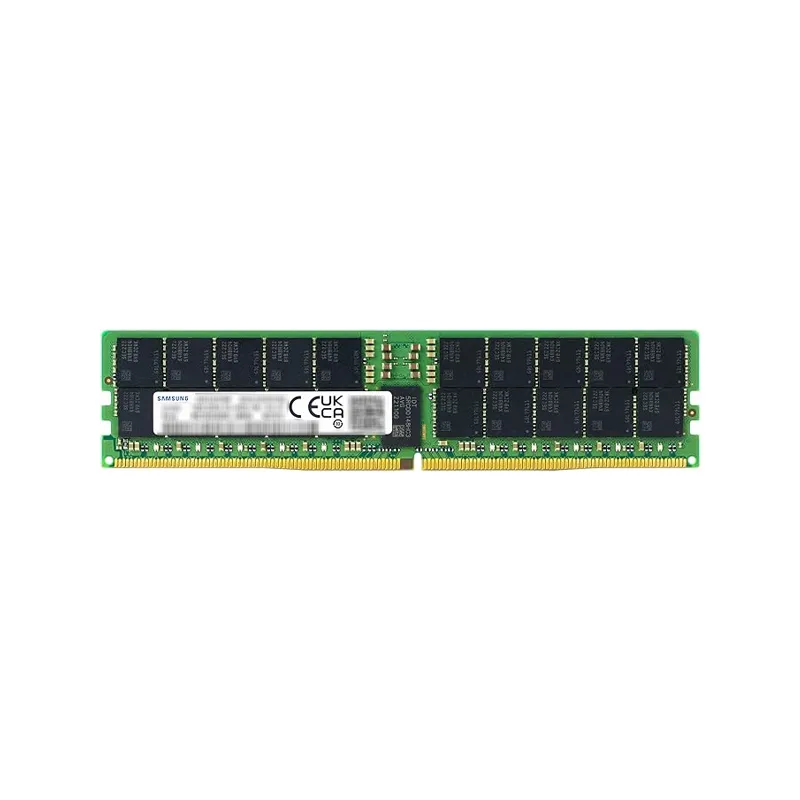
This 128GB DDR5-4800 RDIMM with ECC and registered signaling is engineered for enterprise server platforms handling memory-intensive workloads such as virtualization, in-memory databases, and mission-critical data processing, where its Quad Rank x4 configuration maximizes density per channel while maintaining signal integrity. The CL40 latency and 1.1V efficiency, combined with full error correction, ensure rock-solid data reliability and sustained throughput under 24/7 operation in multi-socket environments.
1. A 128GB capacity lets a single server consolidate far more virtual machines and containers, directly reducing hardware sprawl and licensing costs.
2. ECC memory eliminates the risk of silent data corruption, delivering the data integrity that transactional databases and critical enterprise applications depend on.
3. The registered signal type buffers command and address lines, maintaining electrical stability when all memory channels are populated in dense rack servers.
4. Quad Rank x4 organization packs higher total capacity onto each DIMM while keeping memory channels fed, ideal for memory-hungry workloads like large-scale in-memory analytics.
5. 4800MT/s transfer speed boosts memory bandwidth per socket, accelerating parallel processing for real-time financial modeling and AI inference.
The M321RAGA0B20-CWKPH is a 128GB DDR5-4800 RDIMM engineered for critical server workloads. Its ECC, registered signaling, quad-rank architecture, and 1.1V DDR5 efficiency address the core challenges in virtualization and memory-hungry databases. In a dense VM cluster, a single uncorrected bit flip can silently corrupt guest data or crash a host; ECC detects and corrects these errors, ensuring data integrity and SLA compliance. The registered buffer cleans command and address signals, stabilizing full channel population—essential for scaling virtualized infrastructure. For in-memory databases like SAP HANA, this quad-rank module delivers 128GB in a single slot, quadrupling density and minimizing footprint. The quad-rank x4 design also leverages rank interleaving to boost effective bandwidth, accelerating real-time queries. Operating at 4800MT/s and just 1.1V, it improves energy efficiency, lowering power and cooling costs while breaking performance ceilings. This DIMM transforms risk into resilience and capacity into speed.
This memory module is unequivocally a server-class component—a registered, ECC DDR5-4800 RDIMM with a massive 128 GB capacity, quad-rank x4 organization, and 1.1 V operating voltage. It is designed for enterprise platforms that demand reliability and high density. The following capacity planning advice addresses three typical server workloads.
General Virtualization
Focus on balancing VM density with cost. Populate all memory channels with one 128 GB DIMM per channel (1DPC) to maintain the full 4800 MT/s speed while maximizing headroom. For a dual-socket server with eight channels per CPU, 16 modules deliver 2 TB, comfortably hosting hundreds of mixed-workload VMs. You can later add a second DIMM per channel for growth, though speed may drop to 4400 MT/s due to quad-rank loading.
In-Memory Database
In-memory databases like SAP HANA or Redis require low latency and large, symmetric capacity. Install one 128 GB RDIMM in every channel to stay at 1DPC and avoid speed penalties. An eight-channel platform provides 1 TB per socket, which satisfies most large in-memory datasets while preserving confidence in ECC protection. Do not mix capacities; the four-ranks-per-DIMM design already stresses the memory controller, so 1DPC is the sweet spot for reliable, consistent performance.
High-Performance Computing (HPC)
Bandwidth is critical for simulation and modeling codes. Fill all channels identically with these quad-rank 128 GB modules, one per channel, to maximize aggregate throughput. A dual-processor server with 16 populated slots delivers 2 TB of balanced, symmetric memory at DDR5-4800. This uniform population eliminates NUMA imbalances and ensures every core enjoys full memory bandwidth, accelerating tightly coupled parallel computations.
Rigorously tested server memory, validated for Dell PowerEdge R760, HPE ProLiant DL380 Gen11, and Lenovo ThinkSystem SR650 V3.
Q: Can I mix this M321RAGA0B20-CWKPH with other memory modules of different brands or speeds?
A: Mixing different brands or speeds is not recommended for Registered ECC RDIMMs. Systems default to the lowest common speed, and mismatched ranks or timings often cause boot failures or instability in mission-critical server environments.
Q: Is this 128GB DDR5 RDIMM compatible with my Intel Xeon or AMD EPYC server platform?
A: This module targets DDR5-capable server platforms supporting Registered ECC, such as 4th Gen Intel Xeon Scalable or AMD EPYC 9004 Series. Please consult your motherboard or system QVL to confirm compatibility with this specific MPN.
Q: What is the recommended DIMM population order for optimal performance?
A: Populate identically across memory channels following your server manual. With quad-rank modules, install one DIMM per channel first for balanced interleaving, then fill remaining slots in the specified sequence to maintain optimal bandwidth and reliability.
Q: Does this module support overclocking or XMP profiles?
A: No. This JEDEC-compliant DDR5-4800 RDIMM operates at standard specifications. It disables overclocking and XMP profiles by design, ensuring maximum data integrity and operational stability in enterprise data centers.
Q: What warranty and typical failure rate can I expect?
A: This module includes a 1-year warranty. Enterprise-class RDIMMs demonstrate very low failure rates, typically single-digit FIT (Failures In Time), delivering the high reliability demanded by always-on, mission-critical server workloads.