











 Secure payments
Standard refund policy
Trade Assurance
Secure payments
Standard refund policy
Trade Assurance
| Product Type | Memory Module |
|---|---|
| Memory Capacity | 128 GB |
| Memory Technology | DDR5 |
| Product Voltage | 1.1 V |
| RAM Speed | 4800 MHz |
| RAM Standard | DDR5-4800/PC5-38400 |
| Error Identifying | ECC |
| Signal Type | Registered |
| Column Access Strobe (CAS) | CL40 |
| Rank | Quad Rank x4 |
| Quantity of Pins | 288-pin |
| RAM Genre | RDIMM |
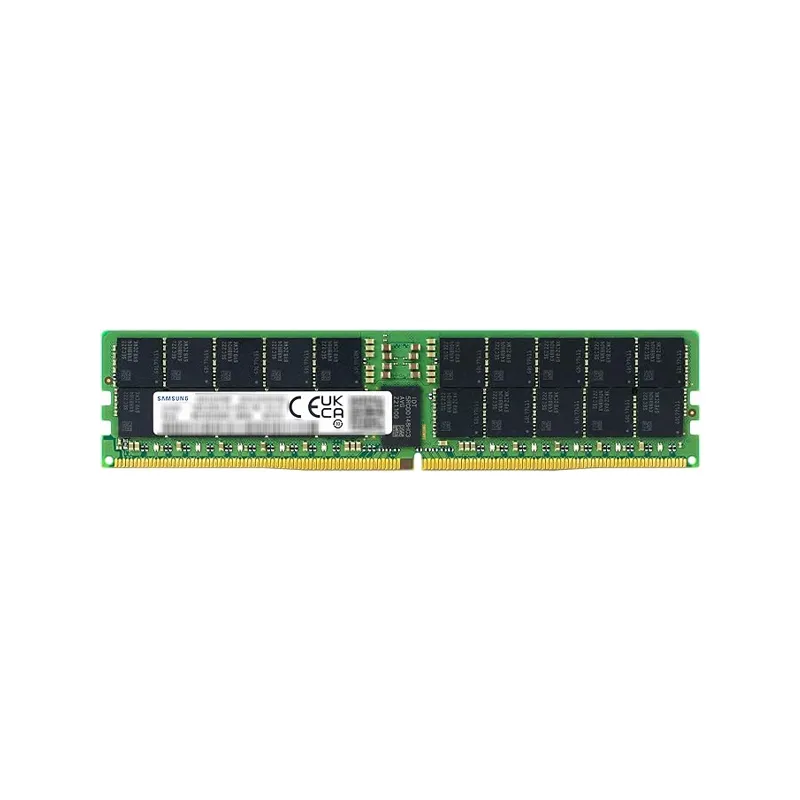
Designed for enterprise servers, this 128GB DDR5-4800 RDIMM with ECC and registered signaling ensures data integrity and stability under heavy virtualization and in-memory database workloads. Its quad-rank x4 organization maximizes capacity density, allowing large memory footprints with reliable operation at CL40 latency on next-generation server platforms.
1. High-density capacity per module allows server platforms to maximize memory footprints in limited DIMM slots, directly boosting virtualization density for large-scale VM deployments.
2. DDR5 technology elevates memory bandwidth and power efficiency, critical for sustaining throughput in data-intensive workloads such as real-time analytics and in-memory databases.
3. ECC protection continuously corrects single-bit errors, preserving data integrity and system uptime in mission-critical environments where silent corruption is unacceptable.
4. Registered signal buffering maintains stable electrical signaling across fully loaded memory channels, enabling seamless scalability to terabyte-class configurations without compromising reliability.
5. Quad Rank x4 organization leverages bank interleaving to keep data pipelines saturated, delivering consistent low-latency access under heavy concurrent query loads typical of enterprise applications.
When deploying memory for mission‑critical server infrastructure, the Samsung M321RAGA0B20-CWKBH 128GB DDR5‑4800 Registered DIMM addresses the real demands of modern data centers where downtime is unacceptable and throughput directly impacts revenue. Consider a dense virtualization cluster running dozens of business‑critical VMs: the module’s ECC technology continuously detects and corrects single‑bit errors caused by background radiation before they corrupt guest operating systems or in‑flight transactions—essential when even one silent data corruption event can cascade into application failure. Meanwhile, in an in‑memory database like SAP HANA or a Redis cache layer, the Registered buffer and quad‑rank x4 organization allow the memory controller to command 128 GB of capacity on a single stick without signal degradation, letting you populate all channels with confidence that timing remains stable. The DDR5‑4800 bandwidth, delivering PC5‑38400 throughput, feeds hungry analytics queries with lower latency than previous generations, while the 1.1 V operating voltage helps control thermal footprint inside dense 1U nodes. Together, these characteristics translate directly into predictable performance under sustained 100‑percent load and a substantially lower risk of memory‑related service interruptions.
General Virtualization
For a virtualization host, this 128GB DDR5-4800 RDIMM provides substantial headroom per module. Start with one DIMM per populated channel to balance cost and density; a dual-socket server with 16 memory slots can easily reach 2TB using 16 modules, supporting hundreds of moderate VMs. Avoid mixing quad-rank DIMMs on the same channel with other ranks to maintain stable 4800MT/s speeds.
In-Memory Database
In-memory databases like Redis or SAP HANA demand both capacity and data integrity, making ECC Registered DIMMs essential. Populate all memory channels symmetrically—six or eight identical 128GB modules in a typical 1-socket server—to maximize bandwidth. This scales to 1TB or more while ensuring error-free operation for critical transactional workloads.
High-Performance Computing (HPC)
HPC workloads thrive on bandwidth, so install these modules in a balanced configuration across all memory channels (e.g., 8 DIMMs in an 8-channel platform). Quad-rank x4 DIMMs deliver high capacity per channel but may force a slight speed reduction when fully populated; benchmark your application to decide between maximum capacity at 4800MT/s or slightly lower frequency with more total memory. For memory-bound simulations, a full 8‑DIMM, 1TB setup is often ideal.
Rigorously tested, this 128GB DDR5-4800 RDIMM fits Dell PowerEdge R760, HPE ProLiant DL380 Gen11, Lenovo ThinkSystem SR650 V3.
Q: Can I mix this M321RAGA0B20-CWKBH with other memory modules of different brands or speeds?
A: Mixing RDIMMs of different brands or speeds is not recommended. All modules should share identical rank, speed, and timing to ensure signal integrity and stable server operation.
Q: Is this memory compatible with my system?
A: This DDR5-4800 Registered ECC module is designed for Intel Xeon Scalable (Sapphire Rapids) and AMD EPYC 7003/9004 platforms. Verify your server board's qualified vendor list (QVL) for exact compatibility.
Q: What is the recommended DIMM population order for optimal performance?
A: For this quad-rank x4 RDIMM, populate identical modules in matched sets per memory channel. Follow your server manual's balanced configuration, typically filling white slots first, to maximize interleaving and bandwidth.
Q: Does this module support overclocking or XMP profiles?
A: No. As a server-class Registered ECC DIMM, it adheres strictly to JEDEC DDR5-4800 standards. XMP and overclocking are not supported to maintain data integrity and 24/7 stability.
Q: What warranty and typical failure rate can I expect?
A: This module includes a one-year warranty. Enterprise DDR5 RDIMMs typically exhibit an annualized failure rate (AFR) below 0.5% under rated conditions, ensuring high reliability for mission-critical workloads.