











 Secure payments
Standard refund policy
Trade Assurance
Secure payments
Standard refund policy
Trade Assurance
| Model | M390S1723DT1-C7A |
|---|---|
| Product Type | Memory Module |
| Compliance Standards | EU RoHS,FCC |
| Memory Capacity | 128 MB |
| Product Voltage | 3.3V |
| RAM Speed | 133MHz |
| Error Identifying | ECC |
| Signal Type | Registered |
| Column Access Strobe (CAS) | CL3 |
| Quantity of Pins | 168-pin |
| RAM Genre | RDIMM |
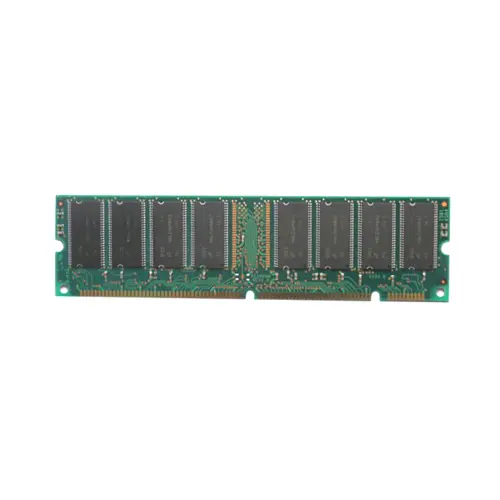
This is a legacy server-grade SDRAM Registered DIMM designed for vintage dual-processor or high-reliability systems, where its 128 MB capacity, ECC error correction, and registered signal buffering ensure data integrity and stable operation under heavy, multi-bank memory access workloads typical of early virtualization hosts and in-memory database servers. The module’s CL3 latency at 133 MHz delivers deterministic timing critical for synchronous chipset architectures, making it the optimal upgrade for retro enterprise platforms requiring strict EU RoHS compliance.
1. Module capacity furnishes dedicated resources for lightweight virtualized appliances and embedded server tasks, ensuring predictable performance without resource contention.
2. ECC memory transparently detects and corrects single-bit errors, safeguarding data integrity for transaction processing and long-duration computational workloads.
3. Registered buffering reduces electrical loading on the memory controller, enabling stable operation across multiple DIMMs in dense, scaled-up server configurations.
4. Strict operating voltage sustains clean power delivery and signal integrity, a critical factor for uninterrupted service in continuous-operation enterprise environments.
5. Conservative clock speed minimizes power consumption and thermal dissipation, enhancing long-term reliability in servers with constrained cooling and always-on duty cycles.
The M390S1723DT1-C7A is a server-class RDIMM purpose-built for mission-critical computing, where a single bit error can cascade into a system-wide failure. Its ECC capability actively detects and corrects single-bit memory errors on the fly, eliminating silent data corruption that would otherwise poison an in-memory database or crash an entire virtualized cluster. For you, this means your critical financial transaction logs remain accurate and your hypervisor host stays online without unexplained blue screens. The Registered signal type places a buffer on the module to condition address and command signals, drastically reducing the electrical load on the memory controller. This stabilization lets you fully populate all memory banks without signal degradation—essential when scaling up a virtual desktop infrastructure that demands dense, reliable RAM. A low CAS latency of 3 cycles further reduces read wait states, directly accelerating query response times in caching engines and delivering snappier performance under heavy concurrent loads. Combined with the standard 168-pin form factor and solid 3.3V regulation, the module integrates flawlessly into legacy yet revenue-generating server platforms, giving you enduring life-cycle stability and a fortified shield against data corruption in always-on environments.
General Virtualization
This is a legacy 168-pin Registered ECC SDRAM module with only 128 MB capacity, making it unsuitable for modern hypervisors. Even lightweight containers or ancient operating systems will require multiple identical modules to reach the minimal memory floor — plan on fully populating all available slots (e.g., eight modules for 1 GB) to host a single tiny VM. Beyond basic functional testing or retro computing, meaningful virtualization is not feasible with this module.
In-Memory Database
The extremely low capacity and 133 MHz CL3 speed severely constrain in-memory datasets. You can only cache trivial lookup tables or act as a small write buffer. To maximize usable space, install a symmetric set across all channels (typically 4 or 8 identical modules) for interleaved ECC protection, but understand that even a fully loaded system will offer less memory than a single modern DIMM.
High-Performance Computing
This module predates current HPC norms; its bandwidth and 128 MB granularity are inadequate for compute‑heavy workloads. If reuse in a vintage cluster is intended, equip every node with a full complement of modules to reach the board’s maximum supported RAM, and enforce strict ECC scrubbing to mitigate age-related bit errors. Such a configuration can only support very old, single-precision scientific codes or educational retrocomputing projects.
Rigorously tested server memory, compatible with Dell PowerEdge 2650, HP ProLiant DL380 G2, IBM xSeries 340.
Q: Can I mix this M390S1723DT1-C7A with other memory modules of different brands or speeds?
A: Mixing is not recommended. This is a 133MHz registered ECC SDRAM module. Using unmatched brands or speeds may cause instability, force lower speed alignment, or prevent the server from POSTing reliably.
Q: Is this memory compatible with my system?
A: Compatibility is intended for older server platforms supporting 168-pin PC133 Registered ECC SDRAM, such as Intel 440BX/GX-based or equivalent AMD platforms. Please verify your board's qualified vendor list for ECC RDIMM support.
Q: What is the recommended DIMM population order for optimal performance?
A: Populate slots in ascending order per the server board manual, typically filling Bank 1 first. For mirrored or sparing modes, install identical modules in pairs across corresponding banks to maintain signal integrity and ECC functionality.
Q: Does this module support overclocking or XMP profiles?
A: No. This is a server-grade registered ECC module running at standard JEDEC PC133 specification. Overclocking and XMP are not supported; the module is tuned for stability at 133MHz with CL3 timing.
Q: What warranty and typical failure rate can I expect?
A: This module includes a one-year warranty. Typical failure rate is very low under proper conditions, with AFR well below 1%. ECC technology mitigates single-bit errors, ensuring high operational reliability in 24/7 server environments.