











 Secure payments
Standard refund policy
Trade Assurance
Secure payments
Standard refund policy
Trade Assurance
| Model | M386B2K70DM0-YH9 |
|---|---|
| Product Type | Memory Module |
| Compliance Standards | EU RoHS,FCC |
| Memory Capacity | 16 GB |
| Memory Technology | DDR3 |
| Product Voltage | 1.35V |
| RAM Speed | 1333MHz |
| RAM Standard | DDR3-1333/PC3-10600 |
| Error Identifying | ECC |
| Signal Type | Registered |
| Column Access Strobe (CAS) | CL9 |
| Rank | Quad Rank x4 |
| Quantity of Pins | 240-pin |
| RAM Genre | RDIMM |
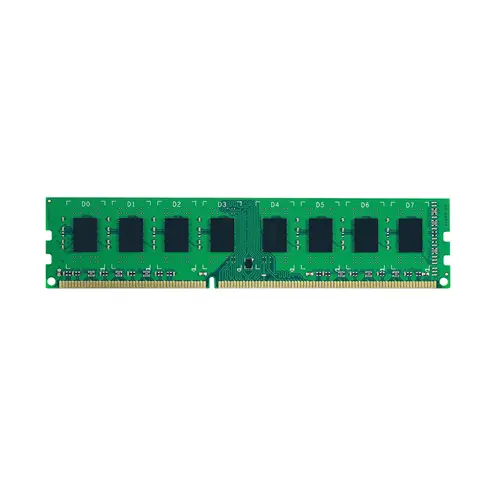
This DDR3L-1333 RDIMM is a server-grade memory module purpose-built for virtualization, in-memory databases, and other enterprise workloads that demand uncompromising data integrity. Its quad-rank x4 configuration maximizes capacity density per channel while running at a low 1.35 V, and the combination of ECC with registered signal buffering delivers robust single-bit error correction and superior signal stability under heavy, concurrent access.
1. A 16GB capacity per module enables higher memory density in rack servers, allowing more virtual machines and larger in-memory databases to run efficiently under a single hypervisor.
2. ECC protection continuously detects and corrects single-bit errors, preventing silent data corruption that could compromise financial transactions or database integrity.
3. Registered signal buffering stabilizes command and address lines when populating many DIMMs, which is essential for maintaining reliability in scaled-up multi-socket server platforms.
4. Quad Rank x4 organization multiplies bank interleaving, boosting effective bandwidth for concurrent OLTP queries and heavy consolidation workloads without adding clock cycles.
5. 1.35V low-voltage operation shrinks the power and cooling envelope across dense server racks, directly lowering datacenter opex and extending component lifespan.
The M386B2K70DM0-YH9 is a DDR3 registered DIMM purpose‑built for server environments, and its four defining characteristics translate directly into real‑world reliability where it matters most. In a dense virtualization cluster hosting dozens of VMs, silent data corruption is an operational nightmare. The onboard ECC engine actively detects and corrects single‑bit errors, ensuring that a stray cosmic particle does not flip a memory cell and crash a critical database transaction or silently alter financial records. That protection is non‑negotiable when one physical host supports multiple tenants. Meanwhile, the registered signal buffering architecture stabilizes the command‑address bus across the module’s quad‑rank x4 organization, allowing a server to populate all 24 DIMM slots without signal degradation. This becomes vital in memory‑hungry in‑memory databases like Redis or SAP HANA, where you need massive 16‑GB modules to keep entire datasets in RAM with deterministic latency. The low 1.35‑V operating voltage further curbs the thermal footprint inside a packed data center rack, lowering cooling costs and extending the lifespan of the memory controller over years of continuous operation. Together, these features deliver the unwavering data integrity and capacity scalability that enterprise workloads demand.
General Virtualization
For moderate consolidation of virtual machines, populate the server with at least six to eight of these 16 GB RDIMMs to achieve 96–128 GB of total capacity. Distribute them evenly across all memory channels (e.g., one DIMM per channel) to maintain balanced, low-latency access while leaving room for future expansion.
In-Memory Database
Maximize capacity and fault tolerance by installing a full set of 12 or more identical modules, targeting 192 GB and above. Adhere to a symmetric population order and enable mirroring or sparing modes if supported, as ECC and registered buffering are critical for preventing data corruption in memory-resident datasets.
HPC
Fill all available memory channels with a single module per channel first to prioritize bandwidth over sheer density—typically 8 modules for a dual-socket system. This configuration delivers the highest throughput for bandwidth-bound simulations, and the 1.35 V low-voltage operation helps reduce aggregate power draw in dense cluster nodes.
Verified compatible after rigorous testing: this 16GB DDR3L-1333 RDIMM works with Dell PowerEdge R720, HP DL380p Gen8, and IBM x3650 M4.
Q: Can I mix this M386B2K70DM0-YH9 with other memory modules of different brands or speeds?
A: Mixing is strongly discouraged in server environments. Using mismatched modules risks signal integrity issues, disables ECC protection, and may cause POST failures. Always populate identical Samsung RDIMMs for validated performance.
Q: Is this memory compatible with my system?
A: It is designed for servers supporting DDR3 ECC Registered DIMMs, typically Intel Xeon E5-2400/2600 or AMD Opteron 6300 series platforms. Verify your motherboard’s QVL and ensure 240-pin RDIMM support before purchasing.
Q: What is the recommended DIMM population order for optimal performance?
A: For this Quad Rank x4 RDIMM, populate identical modules per channel starting from the furthest slot (DIMM 1). Consult your server manual—typically filling all channels evenly maximizes bandwidth while respecting rank-per-channel limits.
Q: Does this module support overclocking or XMP profiles?
A: No. This is a JEDEC-standard DDR3-1333 CL9 server module. Overclocking and XMP are not supported; it operates strictly at 1.35V or 1.5V for maximum datacenter reliability and error-free operation.
Q: What warranty and typical failure rate can I expect?
A: It carries a one-year warranty. As an enterprise-grade Samsung RDIMM, the annualized failure rate (AFR) is typically well below 0.5%, ensuring mission-critical stability when properly installed and cooled.