











 Secure payments
Standard refund policy
Trade Assurance
Secure payments
Standard refund policy
Trade Assurance
| Product Type | Memory Module |
|---|---|
| Compliance Standards | |
| Memory Capacity | 16 GB |
| Memory Technology | DDR3 |
| Product Voltage | 1.5 V |
| RAM Speed | 1866 MHz |
| RAM Standard | DDR3-1866/PC3-14900 |
| Error Identifying | ECC |
| Signal Type | Registered |
| Column Access Strobe (CAS) | CL13 |
| Rank | Dual Rank x4 |
| Quantity of Pins | 240-pin |
| RAM Genre | RDIMM |
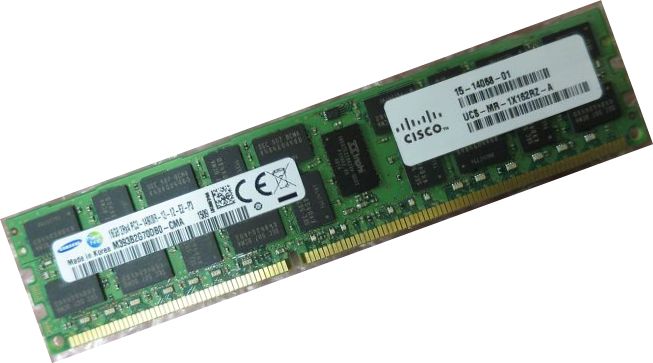
This DDR3-1866 RDIMM with ECC and registered signaling is engineered for legacy server platforms running memory-intensive workloads such as virtualization and in-memory databases, where its dual-rank x4 organization balances capacity and bandwidth while ECC ensures end-to-end data integrity. The registered signal type enhances signal stability across fully populated multi-DIMM channels, and the CL13 latency provides a responsive timing profile for consistent performance under sustained enterprise loads.
1. ECC error correction detects and corrects single-bit memory faults in real time, preventing silent data corruption during continuous financial transaction processing or database operations.
2. Registered signal buffering stabilizes address and command lines under heavy DIMM population, enabling reliable scaling of memory-intensive virtualized workloads across large server farms.
3. Dual Rank x4 organization interleaves internal banks to maximize sustained bandwidth utilization, improving response times for concurrent user requests in multi-tenant cloud platforms.
4. 16 GB module capacity allows dense per-channel memory expansion, raising the ceiling for hypervisor consolidation ratios without sacrificing guest application performance.
5. 1866 MT/s throughput accelerates in-memory caching and analytical query execution, delivering faster insights while maintaining power budgets in energy-conscious data centers.
The Samsung M393B2G70DB0-CMA is a server-class DDR3 Registered ECC DIMM, purpose-built for mission-critical enterprise environments where data integrity and unwavering uptime are non-negotiable. Its four defining characteristics directly address the real pain points of IT architects managing virtualized clusters and in-memory databases.
First, the ECC technology means every bit of data is actively checked and corrected on the fly. In a 24/7 VMware cluster hosting multiple financial or medical applications, a single undetected bit-flip caused by cosmic radiation could corrupt a transaction or crash a node. ECC eliminates that silent risk, ensuring your results are always mathematically accurate. Second, the Registered signal buffer stabilizes the electrical load on the memory controller. When you populate a server board with 12 or 24 DIMMs to maximize capacity for large Redis or SAP HANA instances, unbuffered memory would suffer signal degradation and instability. The register chip guarantees reliable command and address signaling, letting you scale to terabyte-level memory pools without random lockups. Third, the Dual Rank x4 organization leverages rank interleaving: the memory controller can prepare data on one rank while reading from another, overlapping access cycles. This dramatically boosts effective bandwidth for latency-sensitive virtual machines contending for shared memory resources, preventing the sluggish performance that plagues overcommitted hosts. Finally, the DDR3-1866 speed and tight CL13 latency accelerate data retrieval, shrinking disk I/O wait times in database caches and enabling faster virtual machine migration. Together, these features transform raw silicon into a fortress of data reliability and performance, safeguarding the very core of your business logic.
This capacity planning guide applies to the 16GB DDR3-1866 Registered ECC RDIMM (P/N M393B2G70DB0-CMA) for server environments.
General Virtualization
Populate every memory channel with one identical 16GB RDIMM to ensure balanced performance and ECC reliability. A dual-socket server with eight channels yields 128GB, which comfortably supports moderate VM densities. When consolidation demands more capacity, add a second DIMM per channel, but plan for a possible speed reduction to 1600 MT/s.
In-Memory Database
Maximize capacity by filling all available DIMM slots with matching 16GB RDIMMs. A 24-slot dual-socket host provides 384GB, suiting medium-sized in-memory datasets. For critical integrity, enable memory mirroring or sparing, accepting the resulting capacity trade-off. Confirm the platform’s speed support, as running two DIMMs per channel often forces a down-clock to 1600 MT/s.
High-Performance Computing
Install a single 16GB RDIMM per channel to preserve the full DDR3-1866 bandwidth and lowest latency. An eight-channel system delivers 128GB, ideal for bandwidth-sensitive HPC workloads. If larger memory footprints are unavoidable, populate two DIMMs per channel while anticipating a drop to 1600 MT/s and tuning job placement accordingly.
Rigorously validated for seamless server compatibility: Dell PowerEdge R720, HP ProLiant DL380p Gen8, IBM System x3650 M4.
Q: Can I mix this M393B2G70DB0-CMA with other memory modules of different brands or speeds?
A: Mixing is not recommended for Registered ECC memory. Different brands or speeds may cause unbuffered conflicts, timing mismatches, and system instability. For reliable 24/7 operation, use identical modules throughout all channels.
Q: Is this memory compatible with my system?
A: This DDR3-1866 Registered ECC RDIMM is designed for dual-socket servers using Intel Xeon E5-2600 v2 or AMD Opteron 6300 series platforms. Please verify your motherboard’s qualified vendor list for 240-pin ECC support.
Q: What is the recommended DIMM population order for optimal performance?
A: Populate identical DIMMs per channel, starting with the slots farthest from the CPU. For dual-rank RDIMMs like this, install one DIMM per channel first to maximize bandwidth, then add the second symmetrically to maintain balance.
Q: Does this module support overclocking or XMP profiles?
A: No. As a server-grade Registered ECC DIMM, it adheres strictly to JEDEC DDR3-1866 CL13 specifications. Overclocking and XMP are not supported; the module is engineered for error-free stability, not frequency headroom.
Q: What warranty and typical failure rate can I expect?
A: This Samsung module is backed by a one-year warranty. When operated within spec, enterprise DDR3 RDIMMs exhibit an extremely low annualized failure rate (AFR), typically under 0.5%, ensuring strong long-term reliability.