











 Secure payments
Standard refund policy
Trade Assurance
Secure payments
Standard refund policy
Trade Assurance
| Product Type | Memory Module |
|---|---|
| Memory Capacity | 16 GB |
| Memory Technology | DDR3 |
| Product Voltage | 1.5V |
| RAM Standard | DDR3-1600/PC3-12800 |
| Error Identifying | ECC |
| Signal Type | Registered |
| Column Access Strobe (CAS) | CL11 |
| Rank | Dual Rank x4 |
| Quantity of Pins | 276-pin |
| RAM Genre | CDIMM |
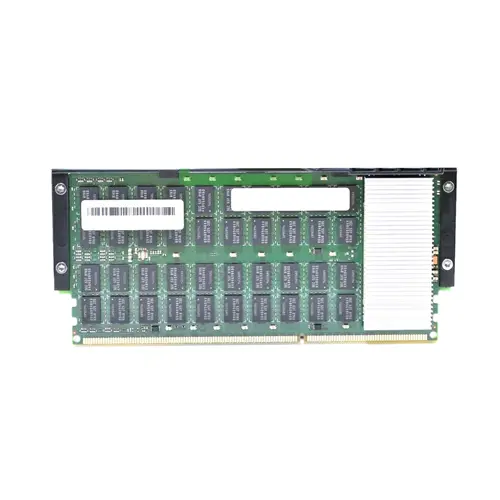
Evaluated as server memory given its ECC and Registered signal type, this DDR3-1600 CDIMM is ideally suited for legacy enterprise platforms handling virtualization, in-memory databases, and data-integrity-critical workloads. Its dual-rank x4 organization boosts memory bandwidth through interleaving, while the registered architecture stabilizes high-density signal paths and ECC corrects single-bit errors for heightened system reliability.
1. ECC error correction detects and corrects single-bit errors in real time, preserving data integrity for mission-critical databases and financial transaction processing.
2. Registered signal buffering stabilizes command and address lines under heavy memory population, enabling larger total capacities without risking signal dropout and unplanned downtime.
3. 16 GB capacity gives a virtualized host enough headroom to pack more stable guest VMs per socket, raising consolidation ratios without triggering costly swap storms.
4. Dual Rank x4 organization interleaves accesses to keep memory channels fully saturated, delivering steady bandwidth even when multiple VMs compete for throughput simultaneously.
5. DDR3-1600 speed supplies up to 12.8 GB/s per channel, striking a practical balance between thermal profile and throughput that sustains predictable performance in legacy enterprise racks.
The M351B2G73DB0-YK0M2 is a DDR3 server DIMM engineered to resolve the reliability and density challenges of enterprise infrastructure. Its registered buffer isolates the memory controller from the electrical load of multiple modules, allowing you to populate a virtualization host with all slots full of 16GB DIMMs without signal timing issues—directly enabling more virtual machines per physical server. ECC safeguards every data transaction from random bit flips, which is indispensable when a single undetected error in a financial ledger or medical database could corrupt critical records; this module corrects those errors in real time to preserve data integrity. The dual-rank x4 configuration interleaves accesses across numerous DRAM banks to raise throughput significantly, giving in-memory databases like SAP HANA predictable, low-latency performance even under concurrent user spikes. Finally, DDR3-1600 speed at CL11 delivers the bandwidth required for responsive containerized workloads while maintaining cost and power efficiency. Together, these attributes ensure that your virtualized clusters and data-critical applications run with unwavering stability.
General Virtualization
For dense virtualization hosts running hypervisors like VMware ESXi or Hyper-V, populate all memory channels symmetrically to maximize bandwidth and leave room for future scaling. A configuration with six or eight registered 16 GB DDR3-1600 modules (96–128 GB total) per dual-socket server balances cost against the needs of 20–40 moderate virtual machines, while dual-rank x4 modules help maintain stable signal integrity under mixed workloads.
In-Memory Database
In-memory databases such as SAP HANA or Redis demand maximum capacity and reliability. Equip each server with the highest supported number of identical 16 GB ECC registered DIMMs—typically 24 modules across four channels on a two-socket platform to reach 384 GB or more. Dual-rank x4 organization improves error correction coverage and resilience during continuous data processing, ensuring memory-resident datasets remain protected against single-bit errors.
High-Performance Computing (HPC)
HPC clusters benefit from balanced memory bandwidth and capacity to feed compute-intensive codes. Fill all memory channels with the same dual-rank 16 GB registered DIMMs per node, aiming for 64–128 GB to keep data close to the CPU in fluid dynamics or molecular modeling runs. The 1.5V operating voltage and CL11 latency provide a predictable thermal envelope, which is critical when nodes run flat out for days in dense rack environments.
Rigorously tested and verified compatible with Dell PowerEdge R720, HP DL380p Gen8, and Lenovo ThinkServer RD430.
Q: Can I mix this M351B2G73DB0-Y0K0M2 with other memory modules of different brands or speeds?
A: Mixing is not recommended. For Registered ECC DDR3, identical ranks, voltage, and timings are critical. Dissimilar modules may cause instability or force lower speeds, compromising your server's reliability.
Q: Is this memory compatible with my system?
A: This 16GB DDR3-1600 Registered ECC CDIMM is compatible with Intel Xeon E5/E3 v1/v2 and AMD Opteron platforms using DDR3-1600/PC3-12800. Verify your server board supports Registered ECC 1.5V modules.
Q: What is the recommended DIMM population order for optimal performance?
A: Populate identical DIMMs per channel first, starting from slot 0. For dual-rank x4 modules like this, install in matched sets to balance memory channels. Consult your server’s manual for specific population sequences.
Q: Does this module support overclocking or XMP profiles?
A: No. As a JEDEC-compliant Registered ECC server module, it does not support XMP or overclocking. It runs at standard DDR3-1600 with CL11 timings to ensure data integrity and platform stability.
Q: What warranty and typical failure rate can I expect?
A: This module carries a 1-year warranty. Enterprise-grade Registered ECC memory typically exhibits an annualized failure rate (AFR) below 0.5% under normal operating conditions, ensuring high reliability.