











 Secure payments
Standard refund policy
Trade Assurance
Secure payments
Standard refund policy
Trade Assurance
| Product Type | Memory Module |
|---|---|
| Memory Capacity | 16 GB |
| Memory Technology | DDR5 |
| Product Voltage | 1.1 V |
| RAM Speed | 5600 MHz |
| RAM Standard | DDR5-5600/PC5-44800 |
| Error Identifying | ECC |
| Signal Type | Registered |
| Column Access Strobe (CAS) | CL46 |
| Rank | Single Rank |
| Quantity of Pins | 288-pin |
| RAM Genre | RDIMM |
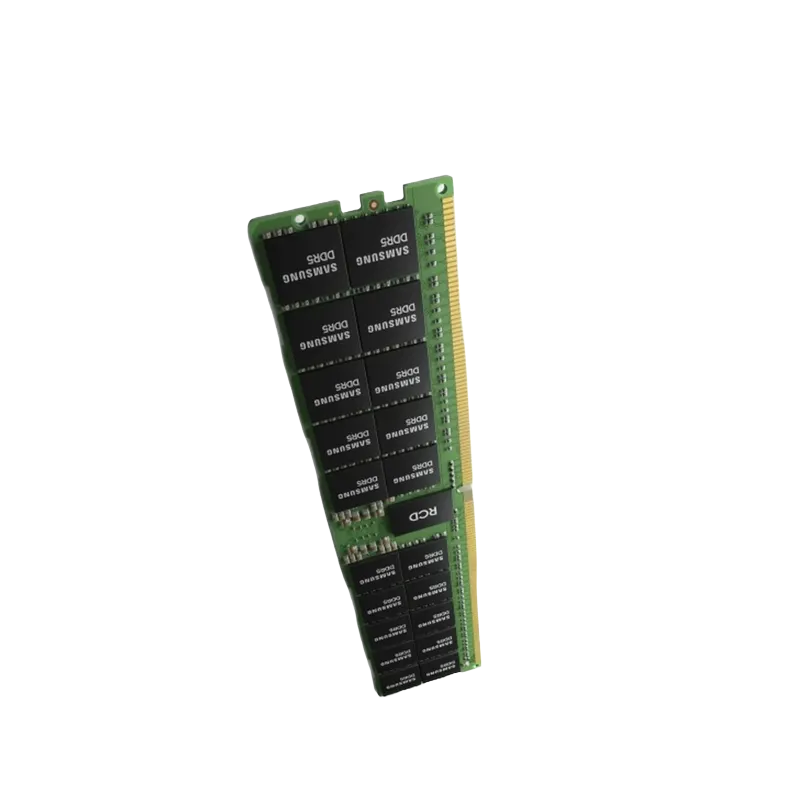
This 16GB DDR5-5600 Registered ECC module, in a single-rank configuration, ensures reliable signal integrity and low latency for mission-critical enterprise servers. It is ideally suited for virtualization, in-memory databases, and data-intensive workloads where end-to-end data integrity and stable registered command/address signaling are non-negotiable.
1. DDR5 technology lifts per-channel bandwidth to new heights, letting virtualized server fleets process larger in-memory datasets without stalling on data starvation.
2. ECC protection silently intercepts and corrects single-bit upsets, preserving the data integrity that transactional databases and financial engines rely on around the clock.
3. Registered signaling decouples electrical loading from the CPU memory controller, so hyperscale nodes can populate all 24 DIMM slots without signal degradation under sustained load.
4. Sixteen gigabyte capacity provides the sweet spot for dense container hosts, allowing more lightweight instances per socket while keeping memory access latencies low.
5. 5600 megatransfers per second saturates modern server memory pipelines, accelerating real-time analytics queries and shrinking response windows in latency-bound workloads.
When you are running a virtualized cluster or an in-memory database like SAP HANA, every bit of data matters. The M321R2GA3PB0-CWMJJ is a server-grade DDR5 RDIMM, and its four defining characteristics directly shield your critical workloads from downtime and performance bottlenecks. The integrated Error Correcting Code (ECC) silently detects and corrects single-bit memory errors caused by cosmic radiation or electrical noise. In a hypervisor hosting dozens of virtual machines, a single uncorrected bit-flip can corrupt a transaction or crash a guest OS; ECC makes that risk negligible. The registered architecture buffers command and address signals, so a single server node can stably populate 16 GB or higher density across 24 or more DIMM slots without signal degradation. For a memory database that demands terabytes of working set, this scaling is not optional—it is the foundation of consistent low-latency access. Speeds of DDR5-5600 push bandwidth to 44.8 GB/s, letting your virtualization platform migrate VMs faster and letting analytics queries scan massive in-memory tables without stutter. Finally, the 1.1 V operating voltage reduces power draw per module. In a rack densely packed with hundreds of DIMMs, that directly trims cooling opex and helps meet your data center sustainability targets without sacrificing a single clock cycle.
General Virtualization
DDR5-5600 Registered ECC DIMMs deliver the reliability demanded by virtualized environments. Deploy six to eight modules per dual-socket host to achieve 12-channel balanced populations (e.g., 6×16 GB for 96 GB total), satisfying moderate VM density with low latency. For higher consolidation ratios, populate all channels symmetrically with single-rank modules to sustain bandwidth while reserving room for future scaling.
In-Memory Database
In-memory databases require large, fault-resilient capacity and high throughput. Populate all memory channels with at least one 16 GB RDIMM per channel (8 modules, 128 GB) on single-socket platforms, or match identically on both sockets for dual-socket systems. The ECC and register features prevent silent data corruption under heavy write loads, while the 5600 MT/s speed accelerates data-set scans.
High-Performance Computing
HPC workloads benefit from strong bandwidth and predictable latencies. Install balanced sets of single-rank 16 GB RDIMMs across all channels (typically 8 or 12 DIMMs) to avoid performance cliffs from sparse populations. Registered clock drivers stabilize large-capacity configurations in dense compute nodes, and the 1.1 V operating point helps control node-level power budgets during sustained parallel runs.
Strictly tested, compatible with Dell PowerEdge R760, HPE DL380 Gen11, Lenovo SR650 V3, and Supermicro X13 servers.
Q: Can I mix this M321R2GA3PB0-CWMJJ with other memory modules of different brands or speeds?
A: Mixing with different brands or speeds is not recommended for registered server memory. It can cause stability issues, require disabled ECC, and is unsupported. Identical modules ensure validated, reliable 24/7 operation.
Q: Is this memory compatible with my system?
A: This DDR5 RDIMM is designed for servers using Intel Xeon Scalable (4th Gen+) or AMD EPYC 9004 series platforms. Verify your board supports 288-pin DDR5 Registered ECC memory at 5600 MT/s.
Q: What is the recommended DIMM population order for optimal performance?
A: Follow your server board’s memory population guide. Typically, install identical DIMMs in balanced sets per CPU, populating the farthest slots from the CPU in each channel first for uniform signal integrity and bandwidth.
Q: Does this module support overclocking or XMP profiles?
A: No. This is a JEDEC-standard server module without XMP or overclocking support. It operates at fixed 5600 MT/s with CL46 for mission-critical stability and data integrity, not performance tuning.
Q: What warranty and typical failure rate can I expect?
A: This module is covered by a 1-year limited warranty. The typical annualized failure rate (AFR) for enterprise-grade RDIMMs is well under 1%, ensuring high long-term reliability.