











 Secure payments
Standard refund policy
Trade Assurance
Secure payments
Standard refund policy
Trade Assurance
| Product Type | Memory Module |
|---|---|
| Compliance Standards | EU RoHS,FCC |
| Memory Capacity | 16 GB |
| Memory Technology | DDR3 |
| Product Voltage | 1.5 V |
| RAM Speed | 1066 MHz |
| RAM Standard | DDR3-1066/PC3-8500 |
| Error Identifying | ECC |
| Signal Type | Registered |
| Column Access Strobe (CAS) | CL7 |
| Rank | Quad Rank x4 |
| Quantity of Pins | 240-pin |
| RAM Genre | RDIMM |
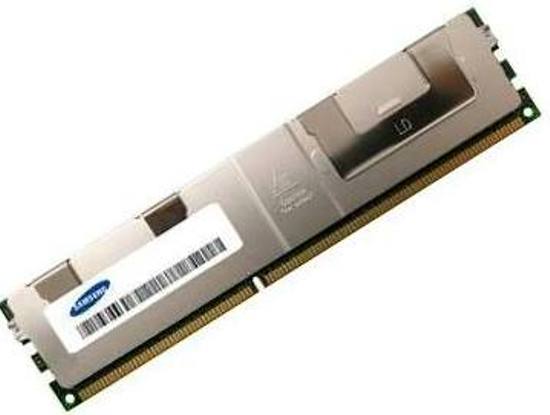
This 16GB DDR3-1066 Registered ECC RDIMM is a legacy server-grade module purpose-built for virtualization, in-memory databases, and other enterprise workloads that demand uncompromising data integrity. Its Registered signal architecture ensures stable operation in high-density multi-DIMM configurations, while the Quad Rank x4 organization allows dense 16GB capacity per module and ECC actively corrects single-bit errors to protect mission-critical data.
1. ECC protection detects and corrects memory errors in real time, preserving data integrity for mission-critical enterprise workloads where even a single-bit error can cause system crashes or data corruption.
2. Registered signal buffering stabilizes high-capacity memory configurations, allowing dense server deployments to scale memory without sacrificing electrical signaling quality or system reliability.
3. Quad Rank x4 organization maximizes per-DIMM capacity while keeping all memory banks active, sustaining throughput under heavy virtualization and large in-memory database loads.
4. 16GB capacity per module raises the memory ceiling for hypervisor hosts, enabling more virtual machines and containers to run concurrently on the same physical server.
5. DDR3-1066 speed delivers a balanced bandwidth envelope for mainstream server tasks, matching typical dual-channel throughput needs without excess power draw or thermal overhead.
The Samsung M393B2K70CM0-CF8 is unmistakably a server-class RDIMM, and its four defining characteristics directly address the critical pain points of enterprise data centers. ECC becomes non-negotiable when you are running a virtualized cluster: a single undetected bit flip in the hypervisor’s memory space can silently corrupt multiple guest VMs, leading to cascading failures and unplanned downtime. With on-die error correction, this module turns statistical risk into deterministic uptime, safeguarding business continuity. The Registered buffer architecture means you can fully populate all 24 DIMM slots on a dual-socket server without signal degradation, allowing you to scale RAM to hundreds of gigabytes for dense VMware or Hyper-V consolidation. Its quad-rank x4 organization crams 16 GB onto a single stick, maximizing capacity per channel so you can host more tenants per physical host. Meanwhile, the tight CL7 latency is a tangible advantage for in-memory databases like Redis or SAP HANA: every nanosecond shaved off column access strobe directly accelerates transactional throughput, ensuring your real-time analytics and caching layers respond with predictable, low-latency performance under heavy load.
This 16GB DDR3-1066 Registered ECC RDIMM is server-class memory. Capacity planning advice for three workloads follows.
General Virtualization
Populate at least four identical 16GB modules (64GB total) across all memory channels for balanced VM hosting. For larger environments, 6–8 DIMMs (96–128GB) allow generous RAM overcommit and stable multi-tenancy, with ECC protecting guest data integrity.
In-Memory Database
Maximize capacity by fully filling DIMM slots—deploy 12–24 of these modules for 192–384GB. Use matched quad-rank RDIMMs per channel to keep latency predictable. ECC is essential for transactional systems like Redis or SAP HANA where memory errors can corrupt live data.
High Performance Computing (HPC)
Adopt a symmetric multi-channel configuration, ideally 8 DIMMs (128GB) across all channels to leverage full memory interleaving. While 1066 MT/s is moderate, using every channel sustains aggregate bandwidth for parallel jobs; ECC guards against silent bit-flips during long simulation runs.
Strictly validated, compatible with Dell PowerEdge R710/R720, HP DL380p Gen8, IBM x3650 M3, and similar servers.
Q: Can I mix this M393B2K70CM0-CF8 with other memory modules of different brands or speeds?
A: Mixing is not recommended. For reliable server operation, always pair identical Registered ECC DIMMs with matching rank, speed, and chip organization to prevent stability issues and memory errors.
Q: Is this memory compatible with my system?
A: This DDR3-1066 Registered ECC RDIMM is designed for servers using Intel Xeon 5500/5600 series or AMD Opteron 6100 series platforms. Confirm your server board supports quad-rank, 1.5V registered DIMMs.
Q: What is the recommended DIMM population order for optimal performance?
A: Populate identical DIMMs per channel, starting with slots farthest from the CPU. For quad-rank RDIMMs, follow your server's population guide to avoid speed downgrades and maximize memory bandwidth.
Q: Does this module support overclocking or XMP profiles?
A: No. This is a server-grade Registered ECC DIMM running at fixed JEDEC standard speeds. Overclocking and XMP are not supported, as data integrity and stability take priority over performance tuning.
Q: What warranty and typical failure rate can I expect?
A: It comes with a 1-year warranty. Enterprise RDIMMs like this typically exhibit an annualized failure rate (AFR) under 0.5%, ensuring dependable 24/7 operation in demanding server environments.