











 Secure payments
Standard refund policy
Trade Assurance
Secure payments
Standard refund policy
Trade Assurance
| Model | M393B2K70CM0-CF805 |
|---|---|
| Product Type | Memory Module |
| Compliance Standards | CE,WEEE,RoHS |
| Memory Capacity | 16 GB |
| Memory Technology | DDR3 |
| Product Voltage | 1.5V |
| RAM Speed | 1066MHz |
| RAM Standard | DDR3-1066/PC3-8500 |
| Error Identifying | ECC |
| Signal Type | Registered |
| Column Access Strobe (CAS) | CL7 |
| Rank | Quad Rank x4 |
| Quantity of Pins | 240-pin |
| RAM Genre | RDIMM |
This DDR3-1066 Registered ECC RDIMM is designed for legacy server platforms, ideally suited for virtualization hosts and memory-intensive enterprise workloads where data integrity and system uptime are critical. Its Quad Rank x4 configuration maximizes capacity density per channel, while the Registered signal type and ECC engine collectively stabilize high-capacity memory arrays and correct single-bit errors on the fly.
1. The 16GB density per module doubles the memory footprint within the same slot count, enabling denser virtualization hosts that can sustain more concurrent enterprise VMs without expanding hardware.
2. On-the-fly ECC correction eliminates single-bit soft errors in real time, preserving data integrity for financial ledgers and long-running database transactions where error-free uptime is non-negotiable.
3. Registered signal buffering stabilizes command and address lines across fully populated channels, making large-capacity multi-DIMM configurations reliable in 2U and 4U rack server deployments.
4. Quad rank x4 organization packs maximum DRAM packages onto the PCB, letting workload-heavy nodes achieve higher total capacity per channel while preserving electrical margins and serviceability.
5. An access latency of just seven clock cycles reduces stall time on cache misses, delivering tangible gains in response-critical applications such as in-memory caching clusters and online transaction processing.
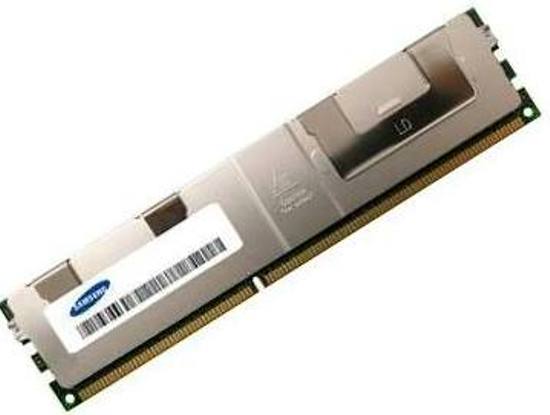
The Samsung M393B2K70CM0-CF805 is a server-class DDR3 Registered DIMM engineered for unwavering reliability in data centers. Its ECC error correction actively prevents single-bit memory errors from silently corrupting critical workloads. In a dense virtualization cluster hosting dozens of virtual machines, an undetected bit flip can crash a hypervisor or introduce data anomalies into an in-memory database; ECC eliminates that risk, preserving transactional accuracy around the clock. The registered buffer is equally vital—it redrives command and address signals, stabilizing communication when all memory channels are fully populated. This means you can confidently scale capacity across multiple DIMMs per channel in a VMware farm without signal degradation or unexpected reboots. The quad-rank x4 organization delivers a dense 16 GB per module while maintaining rank interleaving efficiency, giving memory-hungry applications like SAP HANA predictable bandwidth for real-time analytics. Operating at DDR3-1066 with standard 1.5 V power and a 240-pin interface, it offers guaranteed interoperability with legacy enterprise platforms, allowing cost-effective, worry-free memory expansions that uphold both stability and data integrity in your continually evolving server infrastructure.
General Virtualization
For general virtualization, balance capacity and channel efficiency by installing two of these 16 GB registered DIMMs per channel on a typical dual‑socket platform. With three memory channels per CPU, this yields a total of 12 modules (192 GB), providing ample headroom for dozens of virtual machines while preserving dual‑channel interleaving and ECC reliability. Stick to homogeneous quad‑rank population to avoid complex speed degradation and ensure stable, predictable performance under mixed workloads.
In‑Memory Database
When deploying an in‑memory database, maximize total capacity by fully populating all available DIMM slots, as quad‑rank modules deliver high density per channel. In a 24‑slot dual‑processor server, 24 units of M393B2K70CM0‑CF805 offer 384 GB of fault‑tolerant memory, sufficient for substantial dataset caching. Be aware that heavily loaded channels force the memory controller to drop to 800 MT/s or lower; evaluate whether the capacity gain justifies the bandwidth trade‑off for your database latency targets.
High‑Performance Computing
HPC applications demand peak memory bandwidth, so configure one quad‑rank DIMM per channel to sustain the full 1066 MT/s data rate. This arrangement—six modules per dual‑socket node with three channels each—provides 96 GB of capacity while maximizing throughput on every channel. If problem sizes require more memory, cautiously add a second DIMM per channel, but expect a downshift to slower speeds due to heavy electrical loading; tightly coupled parallel jobs may benefit more from installing additional compute nodes with the faster single‑DIMM‑per‑channel layout.
Rigorously tested server memory. Compatible with Dell PowerEdge R720/R620, HP ProLiant DL380p Gen8, IBM System x3650 M4.
Q: Can I mix this M393B2K70CM0-CF805 with other memory modules of different brands or speeds?
A: Mixing brands or speeds is not recommended in server environments. This RDIMM requires identical part numbers, rank, and timings to maintain signal integrity and prevent system instability.
Q: Is this memory compatible with my system?
A: It is compatible with servers supporting DDR3 Registered DIMMs, such as Intel Xeon E5-2600/E5-4600 series or AMD Opteron 6200/6300 platforms. Verify quad-rank x4 support and 1.5V on your motherboard's qualified vendor list.
Q: What is the recommended DIMM population order for optimal performance?
A: Populate identical DIMMs per channel, starting with the slot farthest from the CPU. For quad-rank configurations, balance load across memory channels as per the server board manual to maintain optimal bandwidth and interleaving.
Q: Does this module support overclocking or XMP profiles?
A: No. This JEDEC-compliant server RDIMM operates at fixed PC3-8500 timings (CL7) and 1.5V. Overclocking and XMP are not supported, as server platforms prioritize stability over tunable memory profiles.
Q: What warranty and typical failure rate can I expect?
A: It includes a 1-year warranty. Enterprise-class DDR3 RDIMMs typically achieve an AFR below 0.5%, ensuring high reliability for 24/7 data center operations when operated within specified conditions.