











 Secure payments
Standard refund policy
Trade Assurance
Secure payments
Standard refund policy
Trade Assurance
| Model | M393B2K70CM0-YF8Q5 |
|---|---|
| Product Type | Memory Module |
| Compliance Standards | EU RoHS,FCC |
| Memory Capacity | 16 GB |
| Memory Technology | DDR3 |
| Product Voltage | 1.35V |
| RAM Speed | 1066MHz |
| RAM Standard | DDR3-1066/PC3-8500 |
| Error Identifying | ECC |
| Signal Type | Registered |
| Column Access Strobe (CAS) | CL7 |
| Rank | Quad Rank x4 |
| Quantity of Pins | 240-pin |
| RAM Genre | RDIMM |
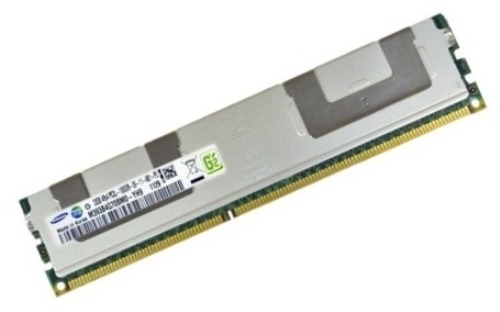
Designed for server environments, this Samsung M393B2K70CM0-YF8Q5 16GB DDR3-1066 RDIMM leverages a quad-rank x4 configuration to maximize memory density per channel, while its registered signal architecture and ECC ensure rock-solid data integrity. It is ideally suited for virtualization platforms and memory-centric workloads like in-memory databases where stability under high utilization is non-negotiable.
1. Error-correcting code protection silently rectifies single-bit memory faults, eliminating corruption risks for virtualized databases and financial transaction logs.
2. Registered clock and command signaling stabilizes high-density memory banks, enabling fully populated server nodes to operate reliably under 24/7 workloads.
3. Multi-rank module organization maximizes data capacity per channel while maintaining balanced loads, critical for dense virtualization farms that demand both capacity and bandwidth.
4. A per-module capacity suited for in-memory analytics and container-heavy hosts allows more services per server, cutting software licensing and footprint costs.
5. Ultra-low voltage operation drives down datacenter energy consumption and heat output, extending hardware lifespan and reducing cooling overhead in scale-out deployments.
Designed specifically for server and data center environments, the Samsung M393B2K70CM0-YF8Q5 is an RDIMM that addresses the critical demands of enterprise computing where downtime is not an option. Its error-correcting code (ECC) capability actively detects and corrects single-bit memory errors caused by cosmic radiation or electrical interference. For a financial database processing millions of transactions, this means preventing silent data corruption that could lead to calculation errors or system crashes. The registered signal buffer stabilizes the electrical load on the memory bus, enabling you to populate all memory channels with 16 GB modules without signal degradation. In a dense virtualized cluster hosting dozens of virtual machines, this translates to rock-solid uptime and the confidence to consolidate workloads onto fewer physical servers. The quad-rank x4 organization packs high density into a single stick, which is invaluable for memory-resident databases like SAP HANA that demand massive, low-latency data pools to deliver real-time analytics. Meanwhile, the 1.35 V low-voltage design significantly reduces power consumption and cooling costs across a fleet of servers, directly improving your total cost of ownership while sustaining the throughput required by always-on cloud services and enterprise applications.
General Virtualization
For a typical dual-socket virtualization host, populate all memory channels symmetrically to maximize bandwidth and NUMA efficiency. Using this 16GB RDIMM, install at least eight modules (128GB total) to run a moderate number of virtual machines. For higher consolidation ratios, scale to 16 or 24 modules (256–384GB) so memory is rarely the bottleneck.
In-Memory Database
In-memory databases demand massive capacity and reliable error correction. Plan for a minimum of 256GB using sixteen 16GB quad-rank modules, spreading them evenly across both processors. Although quad-rank DIMMs may limit operating speed in some systems, the ECC and registered design ensure data integrity. Validate platform support for mixed rank configurations if scaling further.
High-Performance Computing
HPC workloads benefit from the cumulative bandwidth of fully populated memory channels. Equip each CPU with all its channels filled—ideally one 16GB RDIMM per channel—to achieve peak throughput. For a dual-socket node, 16 modules (256GB) is a balanced baseline; memory-bound simulations may justify 384GB or more while carefully managing power and thermal budgets.
Rigorously tested for server compatibility with Dell PowerEdge R720, HP DL380p Gen8, and Lenovo System x3650 M4.
Q: Can I mix this M393B2K70CM0-YF8Q5 with other memory modules of different brands or speeds?
A: Mixing is not recommended for RDIMMs. Ensure identical part numbers and ranks to avoid signal integrity issues and maintain ECC reliability in multi-rank configurations.
Q: Is this memory compatible with my server platform?
A: It supports DDR3 Registered ECC systems, typically Intel Xeon E5-2600 v1/v2 or select AMD Opteron processors. Confirm your board accepts 1.35V, quad-rank, 1066MHz RDIMMs.
Q: What is the recommended DIMM population order for optimal performance using this quad-rank module?
A: Follow your server vendor’s guide. Generally, populate identical channels first, starting with the farthest slot per channel. Mixing quad-rank and other ranks may lower speed.
Q: Does this module support overclocking or XMP profiles?
A: No. As an enterprise-grade registered ECC DIMM, it strictly adheres to JEDEC DDR3-1066 specifications for maximum stability, not supporting overclocking or XMP.
Q: What warranty and typical failure rate can I expect for this memory?
A: It includes a 1-year warranty. Engineered for 24/7 operation, its AFR is extremely low under specified conditions, ensuring high mission-critical reliability.