











 Secure payments
Standard refund policy
Trade Assurance
Secure payments
Standard refund policy
Trade Assurance
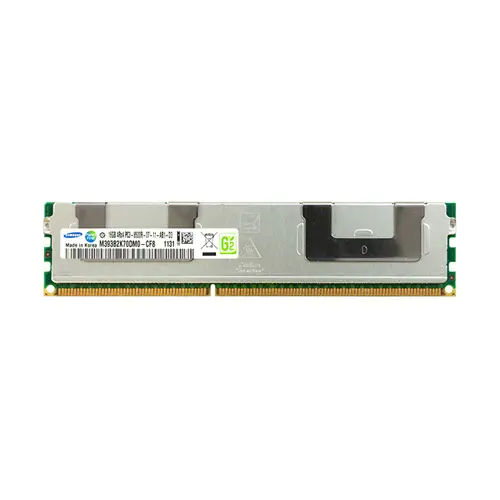
| Model | M393B2K70DM0-CF8Q8 |
|---|---|
| Product Type | Memory Module |
| Compliance Standards | EU RoHS,FCC |
| Memory Capacity | 16 GB |
| Memory Technology | DDR3 |
| Product Voltage | 1.5V |
| RAM Speed | 1066MHz |
| RAM Standard | DDR3-1066/PC3-8500 |
| Error Identifying | ECC |
| Signal Type | Registered |
| Column Access Strobe (CAS) | CL7 |
| Rank | Quad Rank x4 |
| Quantity of Pins | 240-pin |
| RAM Genre | RDIMM |
This DDR3-1066 RDIMM is engineered for legacy server platforms, delivering data integrity through registered signal buffering and ECC error correction, which makes it suitable for virtualization hosts and memory-intensive database applications. Its quad-rank x4 organization maximizes capacity per channel while the CL7 latency ensures efficient access in steady-state workloads, reinforcing stability in multi-DIMM configurations.
1. ECC protection automatically corrects single-bit errors, preventing silent data corruption in mission-critical database workloads.
2. Registered signal type stabilizes command and address lines, allowing servers to scale to massive memory configurations without signal degradation.
3. 16GB module capacity fuels high-density virtualized environments, allowing more VMs per server.
4. Quad Rank x4 organization maximizes memory footprint per channel, ideal for large in-memory datasets.
5. 1066MHz speed delivers 8.5 GB/s bandwidth, matching legacy enterprise applications that require steady throughput.
The M393B2K70DM0-CF8Q8 is a server-grade DDR3 Registered ECC RDIMM, purpose-built for mission-critical enterprise environments where failure is not an option. In a dense virtualization cluster, bit flip errors caused by background cosmic radiation can silently corrupt guest memory, crashing dozens of virtual machines without warning. Its integrated ECC technology detects and corrects single-bit errors in real time, preserving data integrity across your entire hypervisor stack—meaning you avoid costly application outages and forensic troubleshooting. The registered buffer is equally vital: as you scale to 16 GB quad-rank modules across 24 DIMM slots, unbuffered designs suffer crippling electrical loading that breeds intermittent faults. Registered logic stabilizes command and address signals, ensuring clean communication between the memory controller and fully populated banks. This reliability directly translates to predictable performance in memory-intensive databases like SAP HANA or an in-memory Redis cluster, where the quad-rank organization interleaves banks to sustain bandwidth under concurrent access. Running at a conservative 1.5 V, it keeps thermals in check inside rack servers, reducing cooling demands while delivering the deterministic latency that transactional workloads depend on. For your virtualized data center or database engine, this module doesn’t just store data—it safeguards business continuity.
General Virtualization
For hypervisor-based workloads running multiple VMs, populate at least six to eight identical 16 GB RDIMMs across memory channels to ensure balanced NUMA access and sufficient capacity. With DDR3-1066 and quad-rank DIMMs, observe the platform’s rank-per-channel limit—typically no more than two quad-rank DIMMs per channel to avoid clocking down to 800 MHz. Target 96–128 GB per host to handle moderate consolidation ratios without swapping.
In-Memory Database
In-memory datasets demand the lowest latency and highest capacity a server can supply. Install fully populated channels—e.g., 12 × 16 GB (192 GB) on a dual-socket system—while respecting that quad-rank RDIMMs will force a lower speed grade; use the largest capacities your platform allows per channel to maximize density. Keep a spare bank of identical DIMMs on hand, as ECC protection is mandatory but a single uncorrectable error can still bring down an in-memory node.
HPC
HPC clusters prioritize memory bandwidth over raw capacity. Configure your nodes with the minimum number of DIMMs per channel—typically one quad-rank 16 GB RDIMM per channel—to sustain 1066 MT/s and avoid rank-degradation penalties. Plan capacity so the working set fits entirely in memory across all cores, often 64–128 GB per node, and standardize on identical part numbers to simplify fail-over and slurm-driven job scheduling.
Rigorously tested server memory, compatible with Dell PowerEdge R720, HP ProLiant DL380p Gen8, and IBM System x3650 M4.
Q: Can I mix this M393B2K70DM0-CF8Q8 with other memory modules of different brands or speeds?
A: Mixing is not recommended. Mismatched ranks, speeds, or timings may cause instability. For mission‑critical server environments, use identical Samsung RDIMMs to ensure reliable ECC operation.
Q: Is this memory compatible with my Intel or AMD server platform?
A: It is compatible with DDR3-1066/PC3-8500 ECC Registered platforms, typically Intel Xeon 5500/5600 series or AMD Opteron 6100 series. Verify 240‑pin RDIMM support and quad‑rank limits in your server’s manual.
Q: What is the recommended DIMM population order for optimal performance?
A: Populate identical DIMMs in sets of two or four per memory channel, following your motherboard’s slot numbering (commonly blue slots first). Balanced channel loading maximizes throughput and maintains ECC multi‑bit correction coverage.
Q: Does this module support overclocking or XMP profiles?
A: No. This is a JEDEC‑compliant server RDIMM running at fixed 1066MHz CL7. Overclocking or XMP is not supported; stability and data integrity are prioritized over frequency tuning.
Q: What warranty and typical failure rate can I expect?
A: It includes a one‑year warranty. Samsung enterprise memory exhibits very low annualized failure rates (typically <0.1%), provided it is operated within specified voltage and thermal conditions.