











 Secure payments
Standard refund policy
Trade Assurance
Secure payments
Standard refund policy
Trade Assurance
| Product Type | Memory Module |
|---|---|
| Compliance Standards | |
| Memory Capacity | 16 GB |
| Memory Technology | DDR3 |
| Product Voltage | 1.5V |
| RAM Speed | 1066MHz |
| RAM Standard | DDR3-1066/PC3-8500 |
| Error Identifying | ECC |
| Signal Type | Registered |
| Column Access Strobe (CAS) | CL7 |
| Rank | Quad Rank x4 |
| Quantity of Pins | 240-pin |
| RAM Genre | RDIMM |
This 16GB DDR3-1066 Registered ECC RDIMM operates at CL7 latency with a quad-rank x4 configuration, making it purpose-built for legacy server platforms that demand high memory density and data integrity in virtualization or in-memory database workloads. Its registered signal buffering stabilizes multi-DIMM channels while integrated ECC corrects single-bit errors, and the quad-rank design maximizes capacity per channel to sustain reliable performance under heavy, continuous load.
1. ECC protection actively detects and corrects single-bit memory errors in real time, safeguarding transactional databases and financial workloads from silent data corruption that could otherwise crash critical services.
2. Registered signal buffering stabilizes high-capacity memory channels by reducing electrical load on the CPU’s memory controller, a must-have when populating dense server nodes for large-scale virtualization clusters.
3. Quad Rank x4 organization maximizes per-channel capacity density, allowing hypervisors to host more virtual machines per server without sacrificing memory bandwidth under simultaneous heavy guest paging.
4. 16 GB module capacity offers the right building block for scaling total system memory to triple-digit gigabyte levels, supporting in-memory analytics and caching layers that demand expansive, low-latency footprints.
5. DDR3-1066 speed provides a dependable, power-efficient clock envelope for legacy enterprise platforms, ensuring stable operation in existing data center deployments where validated part longevity trumps peak transfer rates.
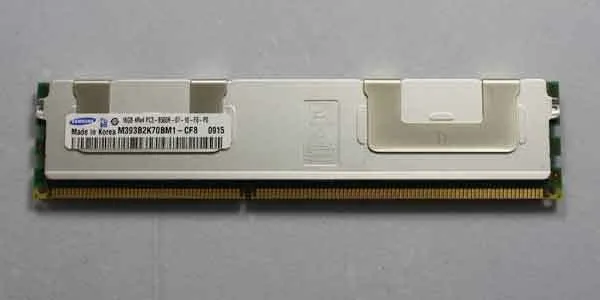
Let’s talk about the Samsung M393B2K70BM1-CF8, a 16GB DDR3-1066 registered DIMM built specifically for server platforms. It isn’t desktop or laptop memory—it’s an RDIMM, and every specification addresses the real-world pain points of running enterprise workloads. The first critical feature is ECC. In a 24/7 virtualized cluster, a single bit-flip caused by background radiation can corrupt a hypervisor’s memory table or silently flip a financial transaction inside an in-memory database. ECC detects and corrects these single-bit errors, preventing data corruption and costly downtime without any intervention.
Second, the registered buffer makes dense memory configurations possible. When you need to populate all DIMM slots in a 2U server to run dozens of virtual machines, unbuffered memory would overload the memory controller with electrical noise and signal degradation. The register re-drives the command and address signals, so you can use the high-capacity Quad Rank x4 organization of this module to reach 192 GB or more per host while keeping signaling clean and reliable. That density directly translates to higher VM consolidation ratios.
Third, the combination of 16GB capacity per stick and Quad Rank x4 technology matters for memory-intensive applications like a large Redis or Memcached instance. More ranks per channel allow better interleaving, improving bandwidth utilization even with the 1066MHz clock speed. Your key-value store sees lower latency for tens of thousands of concurrent reads, not because of a single timing figure like CL7, but because the memory subsystem can serve requests more efficiently. For a vSphere farm or a database node, this means consistent performance under load rather than peak benchmarks. Everything about this module is engineered to deliver what servers truly need: integrity, stability, and scalable capacity.
The M393B2K70BM1-CF8 is a 16GB DDR3-1066 ECC Registered RDIMM targeted at servers. Capacity planning advice for common workloads is outlined below.
General Virtualization
For reliable virtualized environments, populate memory channels symmetrically with these 16GB RDIMMs. A baseline of 128GB (eight modules) supports moderate consolidation; scale to 256GB or 512GB as needed. The ECC and registered buffer reduce memory errors and electrical load, ensuring stable guest operation.
In-Memory Database
In-memory databases demand maximum RAM. Fill every available DIMM slot with these quad‑rank 16GB modules to reach totals of 512GB and beyond. ECC is critical for data integrity. Configure the server BIOS to accommodate the high rank count, possibly at slightly reduced speed, to enable full capacity.
High Performance Computing
HPC nodes need balanced capacity and bandwidth. Install one module per channel to avoid the speed penalty of multiple quad‑rank DIMMs, thus retaining 1066MHz. Aim for 2–4GB per core. The registered, ECC design ensures data correctness through long compute runs, though bandwidth‑heavy workloads may require faster RAM if scalability permits.
Rigorously tested, this server RAM fits Dell PowerEdge R720, HP DL380p G8, Lenovo x3650 M4, and more.
Q: Can I mix this M393B2K70BM1-CF8 with other memory modules of different brands or speeds?
A: Mixing is not recommended. Mismatched ECC Registered DIMMs often cause POST failures or system instability. To ensure reliability, always populate with identical part numbers and matching rank configurations.
Q: Is this memory compatible with my system?
A: It fits platforms supporting DDR3-1066 ECC Registered DIMMs, such as Intel Xeon E5/E7 or AMD Opteron 6000/6300 series. Verify your server board’s QVL for 16GB Quad Rank x4 RDIMM support before ordering.
Q: What is the recommended DIMM population order for optimal performance?
A: Refer to your server manual. Typically, populate identical memory channels first (e.g., slots A1+B1). Due to Quad Rank density, specific per-channel limits apply; balance ranks across channels for maximum throughput.
Q: Does this module support overclocking or XMP profiles?
A: No. This is a server-class ECC Registered DIMM tuned strictly to JEDEC CL7 at 1066MHz. Overclocking or XMP is disabled to maintain 24/7 data integrity in mission-critical environments.
Q: What warranty and typical failure rate can I expect?
A: This module carries a one-year warranty. Enterprise-grade RDIMMs demonstrate an annualized failure rate well below 0.1% under spec, backed by exhaustive Samsung burn-in and RAS testing.