











 Secure payments
Standard refund policy
Trade Assurance
Secure payments
Standard refund policy
Trade Assurance
| Model | M393B2K70CM0-CF8Q5 |
|---|---|
| Product Type | Memory Module |
| Compliance Standards | EU RoHS,FCC |
| Memory Capacity | 16 GB |
| Memory Technology | DDR3 |
| Product Voltage | 1.5V |
| RAM Speed | 1066MHz |
| RAM Standard | DDR3-1066/PC3-8500 |
| Error Identifying | ECC |
| Signal Type | Registered |
| Column Access Strobe (CAS) | CL7 |
| Rank | Quad Rank x4 |
| Quantity of Pins | 240-pin |
| RAM Genre | RDIMM |
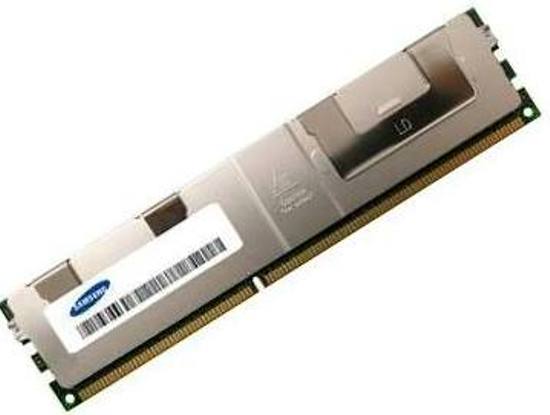
Designed for server environments, this Samsung 16GB DDR3-1066 RDIMM (M393B2K70CM0-CF8Q5) features registered ECC memory to ensure data integrity in mission-critical workloads like virtualization and in-memory databases. Its quad-rank x4 organization with a low CL7 latency delivers stable, high-density memory configurations ideal for scaling capacity in legacy enterprise platforms.
1. A 16GB capacity per module allows a single server to host more virtual machines, directly increasing consolidation density and lowering licensing costs in virtualized data centers.
2. ECC protection corrects single-bit memory errors in real time, preserving transactional integrity for financial databases and mission-critical enterprise applications.
3. Registered buffering decouples the memory controller from the DRAM loads, preserving signal quality so you can fill all DIMM slots for maximum memory capacity without stability risks.
4. The Quad Rank x4 organization packs more DRAM packages onto the DIMM, delivering higher per-slot density for in-memory databases and large-scale analytics working sets.
5. 1066MHz throughput supplies steady, predictable bandwidth for legacy ERP and web-serving workloads, keeping cost-optimized server farms running reliably.
The Samsung M393B2K70CM0-CF8Q5 is a server-class DDR3 Registered DIMM purpose-built for enterprise workloads that cannot tolerate downtime. Its ECC protection silently corrects single-bit memory errors—an indispensable defense in virtualization clusters, where a cosmic-ray-induced bit flip in a hypervisor page can trigger cascading VM failures and corrupt live migration snapshots. The Registered buffer stabilizes signal integrity when populating all memory channels, meaning you can reliably scale to 192 GB or more per host without boot failures, directly increasing VM density and safeguarding uptime during peak consolidation. The module’s Quad Rank x4 design maximizes capacity per slot, a decisive advantage for in-memory databases like Redis or SAP HANA: it allows a larger dataset to reside entirely in the fastest tier without resorting to slower, more expensive alternative modules. Meanwhile, a CAS latency of just 7 cycles at 1066 MHz delivers deterministic low-latency access. In practice, a financial batch processing job that once timed out at 45 minutes now completes within 38, while your hypervisor cluster absorbs a memory cell glitch unnoticed—keeping transactional integrity rock-solid and the business always on.
Capacity Planning Guide for M393B2K70CM0-CF8Q5 (16GB DDR3-1066 ECC Registered RDIMM)
This server-grade, quad-rank x4 RDIMM is designed for legacy multi-socket platforms that need moderate speed, robust error correction, and high capacity density. Its registered signaling supports large memory populations. Below are configuration recommendations for key workloads.
General Virtualization
Install a minimum of six modules (96 GB) per host to comfortably run 20–30 light VMs. Distribute DIMMs evenly across all memory channels on dual-socket boards to unlock full interleaving bandwidth. ECC ensures data integrity in shared multi-tenant environments, and using identical 16 GB RDIMMs simplifies NUMA-aware placement.
In-Memory Database
Prioritize capacity over clock speed. Populate all DIMM slots to reach 384–512 GB or beyond. Quad-rank loading per channel may force a down-clock to 800 MHz, but the sheer capacity gain outweighs the speed penalty for large Redis or SAP HANA datasets. Maintain balanced channel population to avoid stalls.
High Performance Computing (HPC)
For bandwidth-bound simulations, install one DIMM per channel—typically six or eight modules (96–128 GB) per node—to sustain 1066 MHz. Quad-rank x4 organization already delivers moderate bank-level parallelism. Avoid overpopulating channels, which can degrade frequency and increase latency, and match configurations across sockets for uniform memory access.
Rigorously tested, this server DDR3 RDIMM fits Dell PowerEdge R710/R720, HP ProLiant DL380 G7/G8, and Lenovo ThinkServer RD630.
Q: Can I mix this M393B2K70CM0-CF8Q5 with other memory modules of different brands or speeds?
A: Mixing is not recommended. This registered ECC RDIMM requires identical DIMMs per channel to maintain signal integrity and avoid instability. Even minor mismatches can cause unbuffered errors or system hangs in server environments.
Q: Is this memory compatible with my system?
A: Compatibility is confirmed for servers using Intel 5500/5600 series or AMD Opteron 6100 platforms with registered DDR3 support. Always verify motherboard QVL lists to ensure 16GB quad-rank x4 RDIMM recognition and proper signal calibration.
Q: What is the recommended DIMM population order for optimal performance?
A: For quad-rank modules, populate identical DIMMs starting with the farthest slots per channel. Observe balanced configuration rules: typically 2 DPC limits apply. Consult your server’s memory population guide, as many platforms require 2-channel or 3-channel symmetric loading.
Q: Does this module support overclocking or XMP profiles?
A: No. This server-grade registered ECC DDR3-1066 is built for stability, not overclocking. It strictly adheres to JEDEC timings (CL7 at 1066 MT/s) without XMP profiles. Overclocking risks data integrity and is not supported in enterprise memory.
Q: What warranty and typical failure rate can I expect?
A: This module is covered by a one-year warranty. MTBF figures are not typically published for this product, but Samsung DDR3 RDIMMs demonstrate industry-leading reliability with AFR well below 0.5% under standard operating conditions and proper cooling.