











 Secure payments
Standard refund policy
Trade Assurance
Secure payments
Standard refund policy
Trade Assurance
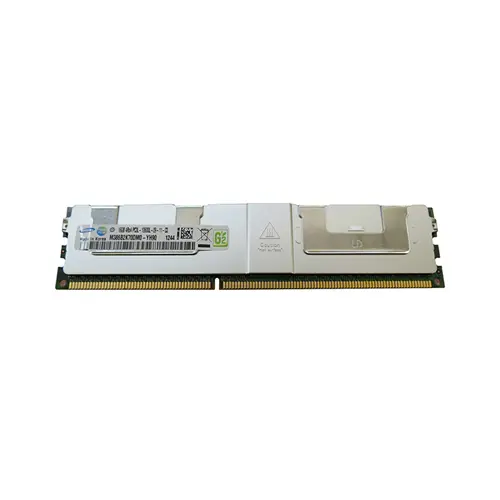
| Model | M386B2K70DM0-YH90 |
|---|---|
| Product Type | Memory Module |
| Compliance Standards | EU RoHS,FCC |
| Memory Capacity | 16 GB |
| Memory Technology | DDR3 |
| Product Voltage | 1.35V |
| RAM Speed | 1333MHz |
| RAM Standard | DDR3-1333/PC3-10600 |
| Error Identifying | ECC |
| Signal Type | Registered |
| Column Access Strobe (CAS) | CL9 |
| Rank | Quad Rank x4 |
| Quantity of Pins | 240-pin |
| RAM Genre | RDIMM |
This DDR3-1333 registered ECC module with quad-rank x4 organization and 1.35V low-voltage operation is purpose-built for enterprise servers and memory-intensive workloads such as virtualization and in-memory databases, where data integrity is paramount. Its registered signal type ensures reliable signal integrity across fully populated high-capacity platforms, while ECC and quad-rank density maximize fault tolerance and memory scalability per channel.
1. High-density module capacity enables deeper virtual machine consolidation, letting data centers run more workloads per physical server without expanding hardware.
2. ECC protection eliminates silent data corruption in memory, delivering the unwavering data integrity required for financial transactions and database operations.
3. Registered signal buffering preserves command and address integrity under fully populated channel configurations, essential for maintaining uptime in large-scale rack servers.
4. Quad Rank x4 organization packs more DRAM packages into a single DIMM, maximizing memory footprint while preserving electrical margins for 24/7 reliability.
5. Low-voltage operation curbs overall power consumption and thermal output, directly reducing cooling costs and improving energy efficiency in dense server deployments.
Based on its 240-pin RDIMM form factor, ECC support, and Registered signal type, the Samsung M386B2K70DM0-YH90 is unequivocally server-grade memory. In mission-critical environments such as virtualization clusters and in-memory databases, its four defining characteristics directly translate to business continuity and performance.
The ECC (Error-Correcting Code) functionality is your first line of defense against silent data corruption. In a VMware cluster hosting dozens of virtual machines, a single cosmic-ray-induced bit-flip in memory can crash a transactional database or corrupt a live financial record; ECC automatically detects and corrects these errors in real time, ensuring that your data integrity is never compromised. The Registered buffer stabilizes the electrical load on the memory bus, which means you can populate all 24 DIMM slots of a 2U server without signal degradation. This is critical for achieving the half-terabyte RAM footprints required by large-scale in-memory analytic platforms like SAP HANA. Furthermore, the Quad Rank x4 configuration packs a dense 16GB on a single stick, optimizing slot utilization in dense server blades where physical space is limited. Finally, operating at a low 1.35V instead of 1.5V significantly reduces power consumption and thermal output per node. For a data center running hundreds of these servers, that delta represents thousands of dollars in annual energy savings and reduces thermal throttling risks, keeping your rendering farms or database servers responsive under sustained heavy loads.
This 16GB DDR3-1333 registered ECC RDIMM is a server‑grade module built for reliable, high‑density deployments.
General Virtualization
For a typical dual‑socket server, install 8 identical modules (128 GB) or 16 modules (256 GB) evenly across all memory channels to balance capacity and throughput. Populate each channel with matched DIMMs to maintain memory interleaving and ECC integrity, providing ample headroom for dozens of virtual machines.
In‑Memory Database
Maximise total capacity by fully loading all DIMM slots with these quad‑rank 16 GB RDIMMs. A 24‑slot server yields 384 GB, ideal for storing large in‑memory datasets or caching hot tables. Be aware that quad‑rank DIMMs often down‑clock to 1066 MHz when heavily populated; verify your platform’s maximum‑rank limit per channel.
High‑Performance Computing
Prioritise bandwidth by using one DIMM per channel (1DPC) to sustain full 1333 MHz speed, or two per channel for a balance of capacity and bandwidth. In a dual‑socket node with 8 cores, 8 identical 16 GB modules per CPU supply 2 GB per core—a well‑matched ratio for most HPC workloads. Always configure symmetric populations to avoid NUMA imbalances.
Validated for servers like Dell PowerEdge R720, HP ProLiant DL380p Gen8. Rigorously tested for reliability.
Q: Can I mix this M386B2K70DM0-YH90 with other memory modules of different brands or speeds?
A: Mixing is not recommended. Registered ECC DIMMs require matched ranks, timings, and identical speed bins. Mixing different specifications may cause instability, reduced performance, or failure to POST in server platforms.
Q: Is this memory compatible with my server platform (Intel Xeon E5 or AMD Opteron)?
A: This DDR3-1333 quad-rank RDIMM is compatible with dual-processor Intel Xeon E5-2600 v1/v2 and AMD Opteron 6300 series platforms that support 1.35V low-voltage registered ECC memory and quad-rank configurations.
Q: What is the recommended DIMM population order for optimal performance on this 16GB quad-rank module?
A: Populate identical quad-rank RDIMMs starting with slot 1 per channel. For multi-channel architectures, balance ranks across memory channels and consult your server's population guide to avoid exceeding rank limits per channel.
Q: Does this RDIMM module support overclocking or XMP profiles?
A: No. As a server-grade Registered ECC module, it adheres strictly to JEDEC DDR3-1333 specifications. Enterprise platforms prioritize data integrity and stability over overclocking; XMP is not supported.
Q: What warranty and typical failure rate can I expect with this Samsung module?
A: It comes with a one-year warranty. Samsung server memory demonstrates an annualized failure rate typically below 0.2% under specified operating conditions, reflecting rigorous enterprise qualification and ECC reliability.