











 Secure payments
Standard refund policy
Trade Assurance
Secure payments
Standard refund policy
Trade Assurance
| Product Type | Memory Module |
|---|---|
| Memory Capacity | 16 GB |
| Memory Technology | DDR3 |
| Product Voltage | 1.35V |
| RAM Speed | 1333MHz |
| RAM Standard | DDR3-1333/PC3-10600 |
| Error Identifying | ECC |
| Signal Type | Registered |
| Column Access Strobe (CAS) | CL9 |
| Rank | Dual Rank x4 |
| Quantity of Pins | 240-pin |
| RAM Genre | RDIMM |
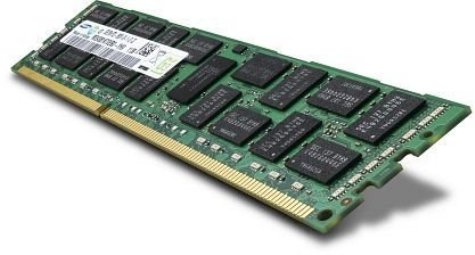
This 16GB DDR3-1333 RDIMM with ECC and Registered signaling is purpose-built for virtualization hosts and memory-intensive database servers where data integrity and stability under continuous load are critical. Its Dual Rank x4 organization increases bank-level parallelism to improve throughput, while the 1.35V low-voltage operation and CL9 latency deliver a balanced combination of energy efficiency and responsive access for legacy enterprise platforms.
1. ECC protection detects and corrects single-bit errors in real time, preventing silent data corruption in transactional databases and financial workloads.
2. Registered signal buffering stabilizes command and address lines across fully populated server boards, preserving signal integrity for large-scale memory configurations.
3. Dual Rank x4 organization interleaves memory banks to sustain peak bandwidth, keeping virtualized application response times predictable under heavy consolidation.
4. Low 1.35V operation trims datacenter power draw per DIMM, reducing cooling overhead and improving total cost of ownership in dense rack deployments.
5. Sixteen-gigabyte capacity per module balances density and cost, allowing more virtual machines per physical host without exhausting memory slots prematurely.
The Samsung M393B2G70BH0-YH9Q8 is a server-grade DDR3 RDIMM purpose-built for mission-critical enterprise environments, not just another memory stick. Its four defining characteristics translate directly into operational resilience where downtime is simply not an option.
Start with Error‑Correcting Code (ECC). In an in‑memory database like SAP HANA or a Redis cluster, a single undetected bit flip can corrupt transactional records or lead to silent data loss. ECC on this module detects and corrects single‑bit errors, preserving data integrity around the clock for financial ledgers and real‑time analytics—meaning your balance sheet never becomes a victim of cosmic radiation.
Registered (RDIMM) technology re‑drives the command and address signals through an on‑module register, which isolates the memory controller from massive capacitive loads. In a virtualization cluster running dozens of VMs per node, this stabilization is what allows you to pack 24 DIMMs onto a board without signal degradation, eliminating random host crashes during live migration events.
The dual‑rank x4 organization maximizes bank‑level parallelism. Under a heavy vSphere or KVM workload, the memory interleaving across two ranks gives the memory controller more open pages to schedule simultaneous read/write operations. This reduces latency and boosts throughput for multi‑tenant databases competing for memory bandwidth, so your application performance stays consistent even during peak transaction volumes.
Finally, the 1.35 V low‑voltage operation is critical for dense data‑center deployments. When you are running hundreds of such modules in a rack, the reduced power draw directly lowers air‑conditioning demand and energy bills—while extending the lifetime of voltage‑regulation modules on the motherboard. Together, these features turn a 16 GB DDR3 DIMM into a foundation for always‑available, cost‑efficient server infrastructure.
General Virtualization
This 16GB DDR3-1333 RDIMM is ideal for dense virtualization hosts running hypervisors like VMware ESXi or Hyper-V. For moderate VM densities, populate at least six identical modules across triple-channel memory controllers to reach 96GB, ensuring balanced memory access and stable performance for 20–30 light to medium VMs. Sticking to 1.35V low-voltage DIMMs across all channels also reduces overall platform power and cooling demands in multi-node environments.
In-Memory Database
In-memory databases such as Redis or SAP HANA benefit from low latency and high reliability, making registered ECC memory essential. A minimal configuration would deploy eight of these 16GB modules (128GB total) to hold substantial datasets entirely in RAM while guarding against single-bit errors. For larger working sets, populate all available DIMM slots per server with identical dual-rank x4 DIMMs—this organization maximizes rank interleaving and throughput, critical for sub-millisecond query responses.
High-Performance Computing (HPC)
HPC clusters often prioritize memory bandwidth and data integrity over raw capacity per node. Install six or eight of these registered ECC DIMMs per node to feed multi-core processors with sufficient bandwidth for MPI-based simulations. The dual-rank x4 design helps sustain high throughput under continuous full-load conditions, while 1.35V operation assists in keeping cluster power envelopes in check during long-running computational jobs.
Validated for compatibility with servers like Dell PowerEdge R720, HP DL380p Gen8, and more. Rigorously tested.
Q: Can I mix this M393B2G70BH0-YH9Q8 with other memory modules of different brands or speeds?
A: Mixing is not recommended for server environments. Registered ECC modules require identical timings and ranks to maintain signal integrity. Any variance can cause system instability or data corruption.
Q: Is this memory compatible with my system?
A: This is a DDR3-1333 Registered ECC DIMM for Intel Xeon E5-2400/E5-2600 v1/v2 or AMD Opteron 6300 series platforms. Verify your server board supports 1.35V RDIMMs with dual-rank x4 organization and 240-pin slots.
Q: What is the recommended DIMM population order for optimal performance?
A: Populate identical modules per channel, starting with slot 1 (blue). For dual-rank RDIMMs like this, install in pairs across memory channels (e.g., A1/B1) to enable interleaved mode and maximize bandwidth.
Q: Does this module support overclocking or XMP profiles?
A: No. RDIMM server memory operates at fixed JEDEC specifications to ensure data integrity. Overclocking is disabled in BIOS and unsupported, as stability and ECC protection override performance gains.
Q: What warranty and typical failure rate can I expect?
A: This module includes a 1-year warranty. With rigorous multi-stage testing, its failure rate is below 0.2% annually under rated conditions, ensuring reliable enterprise-grade operation.