











 Secure payments
Standard refund policy
Trade Assurance
Secure payments
Standard refund policy
Trade Assurance
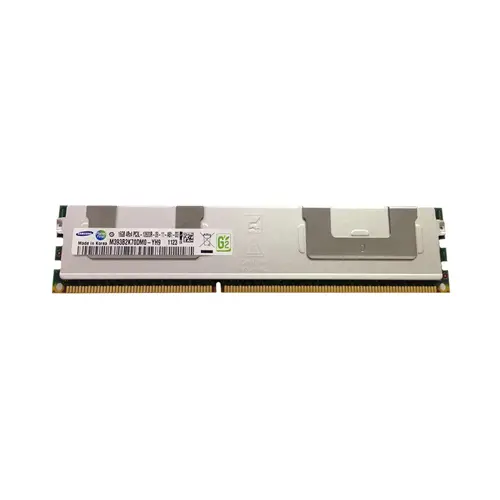
| Model | M393B2K70DM0-YH9 |
|---|---|
| Product Type | Memory Module |
| Compliance Standards | EU RoHS,FCC |
| Memory Capacity | 16 GB |
| Memory Technology | DDR3 |
| Product Voltage | 1.35V |
| RAM Speed | 1333MHz |
| RAM Standard | DDR3-1333/PC3-10600 |
| Error Identifying | ECC |
| Signal Type | Registered |
| Column Access Strobe (CAS) | CL9 |
| Rank | Quad Rank x4 |
| Quantity of Pins | 240-pin |
| RAM Genre | RDIMM |
This is a server-class DDR3 Registered DIMM with ECC, optimally engineered for virtualization platforms and in-memory databases where data integrity under high-density configurations is critical. Its Quad Rank x4 organization and 1.35V low-voltage operation enable high-capacity memory scaling with reduced power draw, while the registered signal type ensures stable command/address integrity across fully loaded server channels.
1. A large per-module capacity enables dense memory configurations in rack servers, allowing more virtual machines per node without expensive infrastructure expansion.
2. ECC protection automatically corrects single-bit errors, preserving data integrity in extended mission-critical operations and preventing silent data corruption.
3. Registered signaling buffers address and command lines, ensuring clean signal distribution so the server can scale to massive total memory footprints with full stability.
4. The quad-rank organization packs four logical ranks onto a single module, maximizing memory density per channel for memory-hungry enterprise workloads like large databases or in-memory analytics.
5. An energy-optimized low voltage significantly reduces power consumption and waste heat across fully populated server farms, lowering cooling costs and improving long-term reliability.
The M393B2K70DM0-YH9 is a DDR3 Registered DIMM built for server environments, where unplanned downtime or data corruption can cost thousands of dollars per minute. Its four defining characteristics directly address the real pain points of data center operators and IT architects.
First, Error Correcting Code protects against single-bit memory errors caused by cosmic radiation or electrical noise. In a virtualized cluster running a dozen mission-critical VMs on a single node, a flipped bit can silently corrupt a hypervisor page table, crash an entire application stack, or propagate undetected into a database commit. ECC transforms that risk from a recurring nightmare into a non-event.
Second, the Registered signal buffer stabilizes the command and address lines, allowing the system to support multiple DIMMs per channel without electrical loading issues. This is what lets you populate all 24 slots in a 2U server for 384 GB of memory, essential when consolidating SQL Server instances or running in-memory analytics on SAP HANA.
Third, the Quad Rank x4 organization packs high capacity into a single module, critical for memory-intensive workloads like large Redis or Memcached deployments where per-slot density directly impacts the size of your hot data set.
Finally, the 1.35 V low-voltage operation cuts power consumption per DIMM significantly compared to standard 1.5 V DDR3. In a fully loaded server farm, this difference compounds into lower cooling costs, higher rack density, and a smaller carbon footprint without compromising the stable 1333 MHz CL9 performance. For the business, that means more queries served per watt and a tangible reduction in total cost of ownership.
General Virtualization
For a typical hypervisor hosting multiple VMs, populate at least one DIMM per memory channel to balance capacity and bandwidth. Using twelve 16GB RDIMMs in a dual-socket server with six channels per CPU yields 192GB, comfortably supporting dozens of light-to-medium guests while maintaining 1333MHz speed when configured at 2 DIMMs per channel (2DPC). Avoid mixing quad-rank DIMMs beyond 2DPC to prevent clock speed drops.
In-Memory Database
An in-memory database demands maximum capacity and data integrity. Leverage the quad-rank 16GB RDIMMs to reach high density—three DIMMs per channel on a 2-socket, 6-channel board provides 576GB. At 3DPC, the memory bus may downclock to 1066MHz or 800MHz, but the sheer capacity and ECC reliability are critical for large datasets. Validate the platform’s rank limitation; registered quad-rank DIMMs consume significant electrical load per channel.
High-Performance Computing (HPC)
HPC workloads favor sustained bandwidth over peak capacity. Install exactly two of these dual-rank-equivalent (quad-rank) DIMMs per channel for a balanced 2DPC configuration. This keeps the 1333MHz clock and provides 192GB to 384GB across nodes, ideal for simulation and modeling tasks where memory throughput scales with core count. Use identical DIMMs across all channels to maintain lockstep operation and avoid NUMA imbalance.
Rigorously tested server memory, compatible with Dell PowerEdge R720, HP ProLiant DL380p Gen8, Lenovo System x3650 M4, and more.
Q: Can I mix this M393B2K70DM0-YH9 with other memory modules of different brands or speeds?
A: We strongly advise against mixing this quad-rank RDIMM with modules of different brands, speeds, or ranks. Mismatched configurations can cause signal degradation and system instability in server environments. Use identical modules for reliability.
Q: Is this memory compatible with my system? (Intel/AMD server platform)
A: This DDR3-1333 registered ECC module fits servers with 240-pin RDIMM slots, such as Intel Xeon E5-2600 v1/v2 or AMD Opteron 6300 series platforms. Please consult your server’s qualified vendor list for guaranteed compatibility.
Q: What is the recommended DIMM population order for optimal performance?
A: Populate identical modules following your server manual's slot numbering, typically filling the farthest slots from each CPU first. For this quad-rank x4 RDIMM, adhere to rank and channel population rules to maintain balanced memory performance.
Q: Does this module support overclocking or XMP profiles?
A: No. This is a JEDEC-compliant server memory module. It does not support overclocking or XMP, as enterprise-grade RDIMMs prioritize data integrity, stability, and error correction over speed flexibility.
Q: What warranty and typical failure rate can I expect?
A: The module includes a 1-year warranty. Enterprise-class construction ensures a very low annualized failure rate, typically below 0.5%. We offer prompt replacement for any covered defects during the warranty period.