











 Secure payments
Standard refund policy
Trade Assurance
Secure payments
Standard refund policy
Trade Assurance
| Model | M393B2G70AH0-CH9 |
|---|---|
| Product Type | Memory Module |
| Compliance Standards | EU RoHS,FCC |
| Memory Capacity | 16 GB |
| Memory Technology | DDR3 |
| Product Voltage | 1.5V |
| RAM Speed | 1333MHz |
| RAM Standard | DDR3-1333/PC3-10600 |
| Error Identifying | ECC |
| Signal Type | Registered |
| Column Access Strobe (CAS) | CL9 |
| Rank | Dual Rank x4 |
| Quantity of Pins | 240-pin |
| RAM Genre | RDIMM |
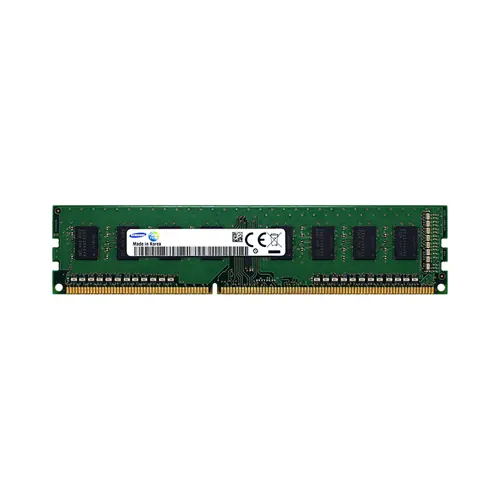
This Samsung 16GB DDR3-1333 Registered ECC RDIMM is purpose-built for enterprise servers and workstations running memory-intensive workloads like virtualization, in-memory databases, and mission-critical applications where data integrity cannot be compromised. Its dual-rank x4 organization with CL9 latency and registered signal buffering ensures stable operation under heavy multi-DIMM loads, while ECC error correction actively prevents single-bit memory errors from causing system crashes or silent data corruption.
1. ECC memory actively detects and corrects single-bit errors in real time, shielding virtualization hosts and database servers from silent data corruption that could crash critical workloads.
2. Registered signal buffering stabilizes command and address lines across fully populated server boards, enabling large memory configurations without signal integrity loss during sustained enterprise operations.
3. Dual Rank x4 organization interleaves access across internal banks to keep server memory channels fully saturated, boosting throughput for heavy consolidation of virtual machines and in-memory analytics.
4. A 16GB capacity per module allows dense memory footprints in 24-slot servers, maximizing the number of containers and VMs without sacrificing per-core memory allocation in multi-socket platforms.
5. DDR3-1333 speed delivers up to 10.6 GB/s bandwidth per channel, a dependable throughput for concurrent database queries and mid-tier application servers that demand balanced cost-effective performance.
The Samsung M393B2G70AH0-CH9 is a server-grade DDR3 Registered DIMM, purpose-built to eliminate the silent data corruption and downtime that plague data centers. Its integrated ECC technology is non-negotiable for financial transaction databases or virtualization clusters: a single bit-flip in a hypervisor’s memory can crash dozens of virtual machines, but ECC detects and corrects these errors in real time, directly preserving service-level agreements. The Registered signal buffer addresses a critical pain point in dense server nodes by stabilizing command signals across all 16 GB of dual-rank x4 DRAM, allowing you to populate all channels at 1333 MHz without timing degradation. This becomes vital when running in-memory analytics platforms like SAP HANA, where large-capacity stability ensures consistent low-latency access to hot datasets. With its JEDEC-standard 1.5V operation and 240-pin form factor, the module seamlessly scales across 2U and blade servers, delivering the reliable, deterministic performance required for mission-critical workloads where errors are measured in lost revenue.
General Virtualization
For general virtualization hosts, balance memory capacity and VM density. A common base configuration is six to eight of these 16GB RDIMMs per socket, delivering 96–128GB to handle moderate consolidation. Populate identical DIMMs across all memory channels to maintain uniform memory access and prevent performance penalties under mixed workloads.
In-Memory Database
In-memory databases demand maximum capacity and data integrity. Fully populate all channels with these dual-rank x4 16GB modules, often using 12 or 16 DIMMs per server for 192–256GB, to keep entire datasets in RAM. ECC and registered buffering are critical here to correct single-bit errors and sustain signal integrity under heavy continuous load.
High-Performance Computing (HPC)
HPC workloads benefit from high bandwidth and balanced memory interleaving. Install at least one DIMM per channel—groups of four or eight modules per socket—to maximize bandwidth via channel interleaving. For memory-bound simulations, scaling to 8–12 identical 16GB RDIMMs per node (128–192GB) provides the headroom needed while maintaining the predictable latency that registered DDR3-1333 offers.
Strictly tested, this server memory is compatible with Dell PowerEdge R710, HP ProLiant DL380 G7, IBM System x3650 M3, and more.
Q: Can I mix this M393B2G70AH0-CH9 with other memory modules of different brands or speeds?
A: Mixing RDIMMs with varying brands, speeds, or ranks is not recommended. It forces the memory controller to default to the slowest common speed and can compromise ECC integrity, leading to system instability.
Q: Is this memory compatible with my server?
A: This DDR3-1333 Registered ECC module is designed for servers using Intel Xeon E5-2600 series or AMD Opteron 6300 series platforms with C600/C602 chipsets. Please verify your motherboard supports 240-pin RDIMMs.
Q: What is the recommended DIMM population order for optimal performance?
A: For dual-socket servers, populate identical DIMMs per channel starting with the slots farthest from the CPU. Typically, fill blue slots first across all memory channels, then black, to balance interleaving and maintain rank symmetry.
Q: Does this module support overclocking or XMP profiles?
A: No. As a server-grade Registered ECC module, it strictly adheres to JEDEC DDR3-1333 standards for maximum data integrity. It does not support overclocking or Intel XMP profiles, which are features of consumer desktop memory.
Q: What warranty and typical failure rate can I expect?
A: This module comes with a 1-year warranty. Built with Samsung's stringent enterprise-grade components, it delivers an extremely low annualized failure rate (AFR) typical of high-reliability server memory, often below 0.5%.