











 Secure payments
Standard refund policy
Trade Assurance
Secure payments
Standard refund policy
Trade Assurance
| Model | M393B2G70CB0-CH9 |
|---|---|
| Product Type | Memory Module |
| Compliance Standards | EU RoHS,FCC |
| Memory Capacity | 16 GB |
| Memory Technology | DDR3 |
| Product Voltage | 1.5V |
| RAM Speed | 1333MHz |
| RAM Standard | DDR3-1333/PC3-10600 |
| Error Identifying | ECC |
| Signal Type | Registered |
| Column Access Strobe (CAS) | CL9 |
| Rank | Dual Rank x4 |
| Quantity of Pins | 240-pin |
| RAM Genre | RDIMM |
Sourced as a DDR3-1333 RDIMM with ECC and registered signaling, this 16GB module is purpose-built for server platforms running virtualization, in-memory databases, or other mission-critical workloads where data integrity and signal stability across fully-populated memory channels are non-negotiable. Its dual-rank x4 organization maximizes bank-level parallelism to sustain throughput under heavy load, while the CL9 latency and 1.5V operation provide a proven balance of responsiveness and power efficiency in legacy data-center environments.
1. A 16GB RDIMM packs enough density per stick to host extra virtual machines on the same physical server, directly raising consolidation ratios and stretching hardware budget further in data centers.
2. ECC technology instantly detects and corrects single-bit errors, protecting transactional databases and financial workloads from silent data corruption and unplanned downtime.
3. Registered signal buffering keeps command and address lines clean under heavy load, so fully populated channels stay stable even when scaling to maximum capacity across multiple DIMMs.
4. Dual Rank x4 organization interleaves access across numerous banks, sustaining channel saturation that keeps latency-sensitive enterprise applications responsive during concurrent VM bursts.
5. The 1333MHz clock speed supplies 10.6 GB/s of peak bandwidth per channel, ensuring memory-bound analytics and virtualization overhead won’t starve the CPU cores.
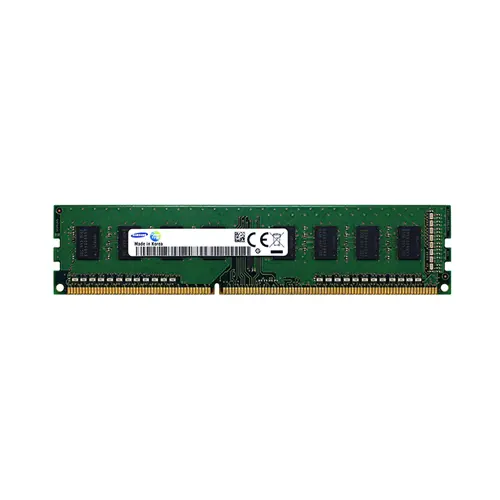
In the demanding world of server infrastructure, the Samsung M393B2G70CB0-CH9 RDIMM is engineered to keep mission-critical workloads running with unwavering integrity. Its ECC technology actively detects and corrects single-bit memory errors, a vital safeguard for virtualized clusters where a flipped bit in a hypervisor’s memory pool could corrupt multiple guest operating systems or silently poison transactional data across an entire node. The registered signal type buffers command and address lines, drastically reducing electrical load on the CPU’s memory controller. This enables you to populate all DIMM slots with 16 GB modules, scaling to massive capacities without sacrificing signal stability—essential when consolidating dozens of virtual machines or running in-memory databases like SAP HANA that demand terabytes of reliable RAM. Additionally, the dual-rank x4 organization delivers superior bandwidth through rank interleaving. In a Redis or Memcached cluster handling millions of queries per second, overlapping row activations across ranks slashes latency and accelerates hot data retrieval. Coupled with 1.5 V operation on a mature DDR3-1333 spec, this module blends proven compatibility with the robust throughput and fault resilience your data center cannot afford to compromise.
General Virtualization
With 16GB RDIMMs, a balanced virtualization host typically populates all memory channels using two modules per channel for optimal interleaving. For mid‑density workloads, start with six or eight modules (96–128 GB) to avoid memory contention while leaving headroom for growth, and always install identical kits to maintain uniform rank and timing.
In‑Memory Database
Latency‑sensitive databases demand maximum capacity and consistent access patterns, so fully populate each memory channel with Dual Rank x4 DIMMs to exploit rank interleaving. A 12‑module configuration using these 16GB sticks yields 192 GB, ideal for large in‑memory datasets, and ensures the memory bus runs at rated speed without throttle.
High‑Performance Computing
HPC environments benefit from wide memory bandwidth, so install one DIMM per channel across all channels to sustain peak throughput under heavy vectorized loads. For a dual‑socket server, 8 or 16 modules (128–256 GB) using this Registered ECC memory provide both error resilience and sufficient capacity for MPI‑based simulations without oversubscribing the memory controllers.
Verified server module: rigorously tested and compatible with Dell PowerEdge R720, HP ProLiant DL380p Gen8, Lenovo System x3650 M4.
Q: Can I mix this M393B2G70CB0-CH9 with other memory modules of different brands or speeds?
A: Mixing this registered ECC module with different brands or speeds is not recommended on server platforms. It may cause stability issues, unbootable states, or unexpected memory errors. Use identical Samsung modules for validated reliability.
Q: Is this memory compatible with my system?
A: This DDR3-1333 registered ECC RDIMM is compatible with servers using Intel Xeon 5500/5600 series or AMD Opteron 6100/6200 series platforms. Verify your board supports 1.5V, 240-pin registered ECC memory before purchasing.
Q: What is the recommended DIMM population order for optimal performance?
A: Populate identical modules per channel starting with the farthest slot from the CPU. On dual-socket boards, balance memory across both processors. Always follow your server motherboard’s population guidelines to maintain optimal memory interleaving.
Q: Does this module support overclocking or XMP profiles?
A: No. This is a JEDEC-compliant server memory module designed for stability. It does not support overclocking, XMP profiles, or voltage adjustments. It operates strictly at DDR3-1333 CL9 with 1.5V for enterprise-grade reliability.
Q: What warranty and typical failure rate can I expect?
A: This memory includes a 1-year warranty. Samsung server modules exhibit very low failure rates due to rigorous testing and ECC technology. Typical annualized failure rates are under 0.5% in properly cooled and maintained server environments.