











 Secure payments
Standard refund policy
Trade Assurance
Secure payments
Standard refund policy
Trade Assurance
| Model | M393B2K70CM0-CH9 |
|---|---|
| Product Type | Memory Module |
| Compliance Standards | EU RoHS,FCC |
| Memory Capacity | 16 GB |
| Memory Technology | DDR3 |
| Product Voltage | 1.5V |
| RAM Speed | 1333MHz |
| RAM Standard | DDR3-1333/PC3-10600 |
| Error Identifying | ECC |
| Signal Type | Registered |
| Column Access Strobe (CAS) | CL9 |
| Rank | Quad Rank x4 |
| Quantity of Pins | 240-pin |
| RAM Genre | RDIMM |
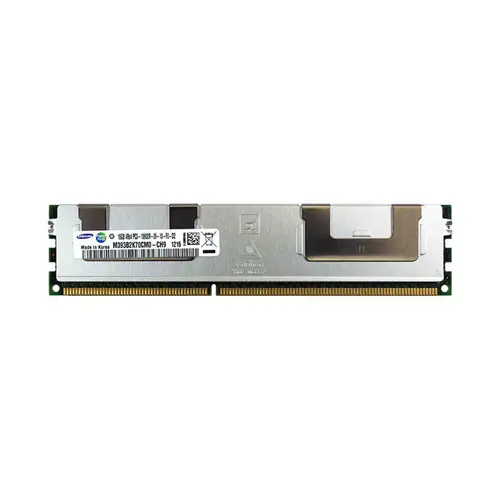
This Samsung M393B2K70CM0-CH9 is a 16GB DDR3-1333 registered ECC RDIMM engineered for server platforms handling memory-intensive workloads such as virtualization and in-memory databases, where its ECC protection safeguards data integrity against single-bit errors. The quad-rank x4 organization maximizes capacity density per memory channel while the registered signal path and CL9 latency ensure stable, reliable operation under heavy, sustained load.
1. ECC error correction continuously scans and remedies single-bit memory faults, preserving transactional accuracy in financial databases and eliminating silent data corruption that could destabilize long-running enterprise workloads.
2. Registered DIMM architecture buffers command and address signaling, allowing fully populated memory channels across multiple ranks to sustain stable operations in dense virtualization clusters.
3. Quad Rank x4 organization packs maximum capacity per DIMM while keeping electrical loading balanced, enabling higher virtual machine density without degrading memory access consistency under consolidation.
4. A sixteen-gigabyte per module density lets dual-socket servers scale to substantial in-memory footprints, accelerating large cache analytics and reducing costly storage I/O in latency-sensitive applications.
5. DDR3-1333 operation delivers a steady 10.6 GB/s per channel, providing predictable and proven throughput for legacy server fleets where risk mitigation and uptime take priority over raw speed.
The Samsung M393B2K70CM0-CH9 is a server-grade 16GB DDR3-1333 RDIMM engineered for mission-critical workloads. Its four defining characteristics—ECC error correction, registered buffering, quad-rank architecture, and finely tuned 1333MHz speed at CL9—directly answer the hardest reliability and density challenges in your data center. ECC silently corrects single-bit errors and detects multi-bit corruption, preventing cosmic-ray-induced bit flips from quietly poisoning financial transaction logs or memory-resident database records. Registered buffering places a hardware register between the memory controller and DRAM, cleaning command and address signals so you can populate all 24 DIMM slots without signal degradation. In dense virtualization clusters running hundreds of virtual machines, that signal integrity means one marginal module never spirals into a host-level crash during live migration. The quad-rank x4 organization packs 16GB onto a single stick using four ranks of x4-wide DRAM, maximizing capacity per channel for in-memory databases such as SAP HANA or large Redis clusters. This density lets you keep entire datasets closer to the processor, slashing query latency while avoiding extra server sprawl. The 1333MHz clock and CL9 latency then deliver consistent bandwidth and predictable response under mixed loads, so virtual desktops feel responsive and batch analytics finish on time without overclocking penalties. For your always-on infrastructure, this module makes data integrity, large-scale stability, and cost-efficient performance concrete, not optional.
This is a 16GB DDR3-1333 ECC Registered RDIMM (Quad Rank, x4) built exclusively for server platforms. Capacity planning must respect the registered, quad‑rank design to maintain signal integrity and stable operation across typical enterprise workloads.
General Virtualization
Populate each dual‑socket host with at least eight identical modules (128 GB) to comfortably support moderate VM densities. Install memory in balanced sets across all channels—typically four DIMMs per CPU—so the registered quad‑rank load is evenly distributed. Avoid mixing dissimilar ranks or unbuffered sticks, and follow the server’s population guide to preserve bandwidth.
In-Memory Database
Maximize capacity by fully populating every DIMM slot with these 16 GB RDIMMs, aiming for 256–512 GB for platforms like Redis or small SAP HANA instances. Quad‑rank modules often limit the number of DIMMs per channel; confirm the server supports the required rank count at 1333 MT/s. A uniform configuration across all memory controllers helps meet the low‑latency demands of in‑memory analytics.
High-Performance Computing
For compute‑dense nodes, install four or eight modules (64–128 GB) to provide sufficient headroom for simulation and modeling frameworks. The 1333 MHz speed is adequate for many HPC codes that value capacity over raw frequency, but verify the workload’s bandwidth sensitivity. Populate channels identically to exploit full interleaving and achieve maximum aggregate throughput while preserving error‑correcting reliability.
Rigorously tested server memory, compatible with Dell PowerEdge R720, HPE ProLiant DL380p Gen8, Lenovo ThinkServer RD430, and more.
Q: Can I mix this M393B2K70CM0-CH9 with other memory modules of different brands or speeds?
A: Mixing is not recommended. Server RDIMMs require matched part numbers for reliable ECC and registered operation. Different specs may cause POST failures or silent data corruption.
Q: Is this memory compatible with my server system?
A: It is compatible with servers supporting DDR3-1333 Registered ECC RDIMMs, such as Intel Xeon E5-2400/2600 v1/v2 and AMD Opteron 4300/6300 platforms. Verify your board's qualified vendor list.
Q: What is the recommended DIMM population order for optimal performance?
A: Populate identical DIMMs per channel, starting with the farthest slot from the CPU. For quad-rank modules, install one DIMM per channel first to maintain 1333 MT/s speed.
Q: Does this module support overclocking or XMP profiles?
A: No. This is a JEDEC-compliant server memory designed for stability. Overclocking and XMP are not supported, as registered ECC DRAM prioritizes data integrity over frequency tuning.
Q: What warranty and typical failure rate can I expect?
A: This module includes a 1-year warranty. Enterprise-grade DDR3 RDIMMs exhibit an annualized failure rate (AFR) typically below 0.5% under normal operating conditions.