











 Secure payments
Standard refund policy
Trade Assurance
Secure payments
Standard refund policy
Trade Assurance
| Model | M392B2G70BM0-CK009 |
|---|---|
| Product Type | Memory Module |
| Compliance Standards | EU RoHS,FCC |
| Memory Capacity | 16 GB |
| Memory Technology | DDR3 |
| Product Voltage | 1.5V |
| RAM Speed | 1600MHz |
| RAM Standard | DDR3-1600/PC3-12800 |
| Error Identifying | ECC |
| Signal Type | Registered |
| Column Access Strobe (CAS) | CL11 |
| Rank | Dual Rank x4 |
| Quantity of Pins | 240-pin |
| RAM Genre | VLP RDIMM |
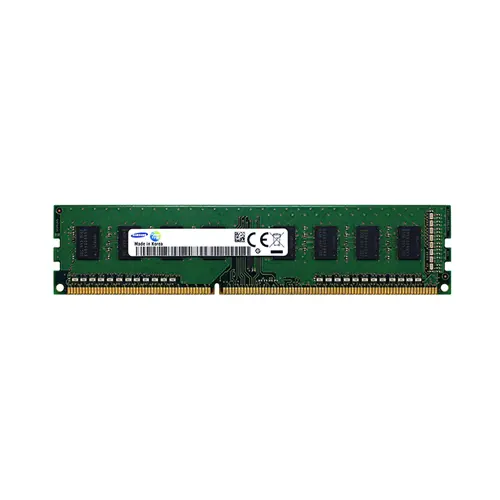
This 16 GB DDR3-1600 VLP RDIMM with ECC and registered signaling is purpose-built for legacy server platforms running virtualization, in-memory databases, and other mission-critical workloads that demand uncompromising data integrity. Its dual-rank x4 organization enhances memory interleaving for improved throughput, while the registered buffer ensures stable signal integrity across fully populated multi-DIMM channels in dense 1U/2U chassis.
1. ECC protection silently detects and corrects single-bit errors, preserving data integrity in financial ledgers and long-running virtualized workloads where an undetected flip could corrupt transactions.
2. Registered buffering isolates the memory controller from electrical loads across large channel populations, enabling reliable operation when scaling DRAM capacity in multi-socket enterprise platforms.
3. The very-low-profile form factor maximizes clearance for front-to-back cooling in dense rack enclosures, helping sustain thermal headroom without escalating fan speeds.
4. Dual-rank x4 organization employs bank interleaving to keep channels saturated, ensuring steady throughput when multiple virtual machines simultaneously hit memory-intensive operations.
5. Generous per-module capacity allows architects to build high total memory footprints with fewer slots occupied, preserving expansion room for memory-hungry containers and in-memory databases.
In data centers running dense virtualization clusters and real-time in-memory databases, the M392B2G70BM0-CK009—a 16GB DDR3-1600 VLP RDIMM—delivers four critical attributes that directly determine service continuity. First, ECC technology actively corrects single-bit memory errors, preventing silent data corruption that silently poisons transactional records or causes hypervisor faults, which means compliance-critical workloads and financial ledgers stay accurate without unexplained crashes. Second, the registered architecture buffers command and address signals, allowing fully populated 24-slot servers to scale beyond 512GB without signal degradation; this stability becomes essential when dozens of virtual machines contend for memory resources simultaneously. Third, the Very Low Profile form factor preserves unobstructed airflow inside 1U rack enclosures, lowering fan power draw and avoiding thermal throttling—a direct response to the pain of overheating nodes in tightly packed clusters. Finally, the dual-rank x4 configuration uses bank interleaving to increase effective throughput, smoothing out latency spikes during massive database joins and analytical queries. This module turns raw specifications into a resilient, cost-effective compute foundation.
General Virtualization
For density-focused virtualization hosts, populate all available channels with these 16 GB RDIMMs to maximize capacity per socket. A dual-socket platform with three DIMMs per channel (3DPC) yields 96 GB to 384 GB, comfortably supporting 20–40 moderate VMs. Stick to identical dual-rank x4 modules to maintain balanced memory interleaving and predictable latency under mixed-workload consolidation.
In-Memory Database
In-memory databases demand low latency and high bandwidth, so install six or twelve identical M392B2G70BM0 modules per processor to populate two DIMMs per channel (2DPC). This configuration runs at the full 1600 MT/s speed without downgrading to 1333 MT/s, delivering 192 GB–384 GB total capacity while preserving the 11-11-11 timings. Keep the memory fully populated in symmetric sets to avoid NUMA imbalances that degrade real-time query performance.
High-Performance Computing
HPC clusters benefit from capacity and bandwidth balance. Configure each compute node with one dual-rank RDIMM per channel (1DPC) to sustain 1600 MT/s and achieve the lowest possible latency. For memory-bound simulations, scale to 2DPC with 16 GB sticks for 128–256 GB per node, but validate that the slight frequency downgrade is offset by reduced disk I/O. Always install modules in identical groups of three or four per CPU to exploit triple-channel or quad-channel architectures fully.
Strictly validated server memory, compatible with Dell R720, HP DL380p Gen8, and IBM x3650 M4.
Q: Can I mix this M392B2G70BM0-CK009 with other memory modules of different brands or speeds?
A: Mixing brands or speeds on a registered ECC server platform is strongly discouraged. Inconsistent timings, ranks, or DRAM loads can cause signal integrity issues and system instability. Uniform configuration using identical M392B2G70BM0-CK009 modules is recommended.
Q: Is this memory compatible with my system?
A: This DDR3-1600 ECC RDIMM is designed for servers and workstations with Intel Xeon E5-2600 v1/v2 or AMD Opteron 6300/4300 series platforms. Please verify that your motherboard or server model supports 1.5V, 240-pin registered DIMMs before purchase.
Q: What is the recommended DIMM population order for optimal performance?
A: Optimal population follows your server board's memory configuration guide. Generally, populate identical modules per channel starting with the slots farthest from the CPU. Maintain balanced configurations across channels to maximize interleaving and throughput.
Q: Does this module support overclocking or XMP profiles?
A: No, this is a JEDEC-standard server memory module built for reliability. It does not support overclocking or XMP profiles. It operates strictly at DDR3-1600 CL11 with the specified 1.5V voltage to ensure 24/7 data integrity.
Q: What warranty and typical failure rate can I expect?
A: This M392B2G70BM0-CK009 module is covered by a one-year warranty. The typical annualized failure rate (AFR) for Samsung server memory is extremely low, around 0.1–0.3% under proper operating conditions, ensuring dependable long-term deployment.