











 Secure payments
Standard refund policy
Trade Assurance
Secure payments
Standard refund policy
Trade Assurance
| Product Type | Memory Module |
|---|---|
| Compliance Standards | |
| Memory Capacity | 16 GB |
| Memory Technology | DDR3 |
| Product Voltage | 1.5 V |
| RAM Speed | 1600 MHz |
| RAM Standard | DDR3-1600/PC3-12800 |
| Error Identifying | ECC |
| Signal Type | Registered |
| Column Access Strobe (CAS) | CL11 |
| Rank | Dual Rank x4 |
| Quantity of Pins | 240-pin |
| RAM Genre | RDIMM |
This DDR3-1600 Registered ECC RDIMM is engineered for server platforms, delivering reliable data integrity and stability for virtualization, in-memory databases, and mission-critical enterprise workloads. Its dual-rank x4 configuration and registered signaling ensure high-capacity scalability with reduced electrical loading, while ECC correction guards against single-bit errors in demanding 24/7 environments.
1. Registered DIMM technology reduces electrical load on the memory controller, enabling high-density server configurations without compromising stability.
2. ECC memory actively corrects single-bit errors, preserving data integrity for long-running enterprise workloads and preventing costly downtime.
3. Dual Rank x4 organization interleaves data across ranks to saturate memory channels, enhancing throughput for virtualized and multi-tenant environments.
4. Generous module capacity allows consolidation of more virtual machines per physical server, optimizing data center footprint and operational costs.
5. Ample memory bandwidth from its speed grade accelerates data-intensive tasks such as large-scale databases and real-time analytics.
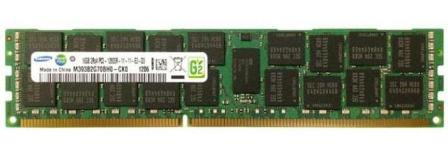
The Samsung M393B2G70BH0-CK0 is a 16GB DDR3-1600 registered DIMM purpose-built for server environments where uptime and data fidelity are non-negotiable. In a virtualized cluster hosting dozens of VMs, a single undetected memory bit-flip can corrupt a database transaction or crash the hypervisor. This module’s ECC engine automatically corrects single-bit errors and detects multi-bit faults, transforming random soft errors into non-events and safeguarding your virtual infrastructure around the clock. Its registered architecture buffers the command and address lines, which stabilizes signal integrity when you fully populate all 24 DIMM slots. That means you can confidently scale to 384GB or more for dense consolidation without the instability that would plague unbuffered memory. For in-memory databases like Redis or SAP HANA, where response times hinge on instantaneous lookups, the dual-rank x4 organization makes a tangible difference. By presenting more independent bank groups, it enables aggressive bank-level parallelism, sustaining higher bandwidth under heavy concurrent access than single-rank alternatives. The resulting smoother throughput directly accelerates real-time analytics and transactional workloads. Together with a 1600MT/s transfer rate, this RDIMM gives you a cost-effective path to extend the life of legacy servers while delivering the reliability and performance that critical enterprise applications demand.
General Virtualization
For a typical virtualization host, populate all available memory channels with identical 16 GB DDR3‑1600 RDIMMs to enable interleaving and maximize bandwidth. A common configuration uses eight modules (128 GB total) on a dual‑socket board, comfortably supporting dozens of mixed‑workload VMs. The ECC Registered design safeguards guest data integrity in shared, always‑on environments.
In‑Memory Database
In‑memory databases demand both capacity and signal stability. Deploy the maximum supported number of 16 GB RDIMMs across all channels—often 256 GB or more—to keep entire datasets in RAM. The Dual Rank x4 organization and 1.5 V ECC operation provide reliable, low‑latency access even under sustained heavy loads, preventing silent data corruption.
High‑Performance Computing (HPC)
HPC nodes require balanced memory bandwidth per core. Install one 16 GB RDIMM per channel (typically eight modules for 128 GB on a dual‑socket server) to achieve full interleaving and peak throughput. ECC registration is critical for long‑running simulations, ensuring that large‑scale calculations complete without bit‑error induced failures.
This server memory has been rigorously tested and is compatible with Dell PowerEdge R720, HP ProLiant DL380p Gen8, and more.
Q: Can I mix this M393B2G70BH0-CK0 with other memory modules of different brands or speeds?
A: Mixing different brands or speeds is not recommended in server environments. Disparate modules may cause signal integrity issues, performance degradation, or system instability. Always use identical, validated modules for guaranteed compatibility and reliability.
Q: Is this memory compatible with my system?
A: This DDR3-1600 Registered ECC RDIMM is designed for dual-socket Intel Xeon E5-2600 v2, AMD Opteron 6300 series, and similar platforms. Please verify your motherboard or server system's qualified vendor list for 1.5V, 240-pin RDIMM support.
Q: What is the recommended DIMM population order for optimal performance?
A: Populate identical DIMMs into corresponding slots per memory channel, typically starting with the farthest DIMM slot from the CPU. Always follow your server motherboard's specific memory configuration guide to maintain balanced interleaving and full bandwidth.
Q: Does this module support overclocking or XMP profiles?
A: No. This is a JEDEC-compliant Registered ECC server memory module running at standard DDR3-1600 specifications. Overclocking and XMP are not supported, as enterprise-grade reliability and data integrity are prioritized over extreme frequency adjustments.
Q: What warranty and typical failure rate can I expect?
A: This product carries a one-year warranty. Typical annualized failure rate (AFR) is below 0.5% under proper operating conditions, reflecting its robust server-grade components, rigorous testing, and enterprise reliability standards.