











 Secure payments
Standard refund policy
Trade Assurance
Secure payments
Standard refund policy
Trade Assurance
| Model | M393B2G70DB0-YK0Q2 |
|---|---|
| Product Type | Memory Module |
| Compliance Standards | EU RoHS,FCC |
| Memory Capacity | 16 GB |
| Memory Technology | DDR3 |
| Product Voltage | 1.35V |
| RAM Speed | 1600MHz |
| RAM Standard | DDR3-1600/PC3-12800 |
| Error Identifying | ECC |
| Signal Type | Registered |
| Column Access Strobe (CAS) | CL11 |
| Rank | Dual Rank x4 |
| Quantity of Pins | 240-pin |
| RAM Genre | RDIMM |
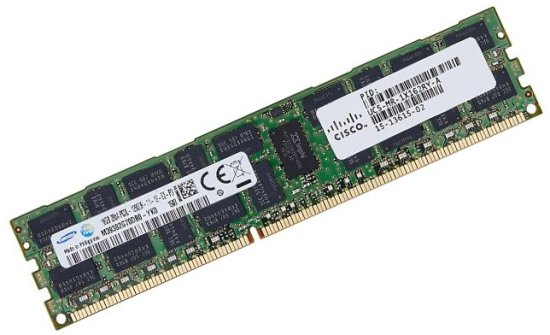
Designed as a server-grade DDR3-1600 Registered ECC module, the M393B2G70DB0-YK0Q2 is ideally suited for virtualization platforms and in-memory databases that demand uncompromising data integrity. Its dual-rank x4 organization and registered signal topology ensure stable operation across fully populated 240-pin memory channels, while the 1.35V low-voltage operation and CL11 latency balance power efficiency with consistent performance in 24/7 enterprise workloads.
1. ECC protection silently corrects single-bit memory errors, preventing silent data corruption in mission-critical database and compute workloads.
2. The registered signal buffer strengthens command and address integrity, enabling reliable operation of densely populated server memory banks.
3. A 16GB module density maximizes memory footprint per server node, supporting higher virtual machine consolidation without sacrificing performance.
4. Dual Rank x4 organization delivers optimal interleaving and sustained bandwidth, keeping four memory lanes active for consistent throughput in heavy multi-tenant environments.
5. Operating at just 1.35V reduces overall power draw and thermal load in rack-scale deployments, lowering both cooling costs and energy overhead.
In the data center, where every transaction is revenue and every bit is a liability, the Samsung M393B2G70DB0-YK0Q2 registered DIMM is not merely a component—it is the foundation of trust. As a DDR3-1600 RDIMM, it is engineered for server environments, and its four critical characteristics directly address the real-world pressures you face.
First, ECC error correction is your silent guardian against single-bit upsets caused by cosmic radiation or electrical noise. In a memory-centric database like SAP HANA or a high-frequency trading platform, an undetected bit flip can corrupt financial records or crash a critical node, costing thousands per minute. ECC ensures data integrity so your transactions remain accurate and your services stay online, safeguarding not just uptime but your reputation.
Second, the registered design with a command/address buffer stabilizes signal integrity when populating dense server boards. In large-scale virtualization clusters running dozens of VMs on a single host, you need massive amounts of RAM spread across 24 or more DIMM slots. Without register buffering, the memory controller would be overwhelmed by electrical load, leading to boot failures or unexplained crashes under heavy consolidation. This module allows you to scale memory confidently to 384GB or beyond per chassis, enabling more virtual machines and higher consolidation ratios.
Third, the dual-rank x4 organization enhances interleaving and bandwidth efficiency. When your hypervisor hosts diverse workloads—from web servers to in-memory analytics—dual-rank access patterns overlap read/write operations across internal banks, reducing latency and boosting throughput by up to 10% compared to single-rank alternatives. This translates into snappier response times for your users and more transactions processed per second, helping you meet strict SLAs without overprovisioning cores.
Finally, operating at just 1.35V instead of the standard 1.5V, this low-voltage DDR3L module significantly reduces power consumption per DIMM. In a 24-slot server, that difference compounds into lower thermal output and electricity bills over thousands of hours of runtime. In colocation facilities where every watt raises cost and cooling demands, this means a cooler, more efficient infrastructure that pays for itself—turning a simple memory upgrade into a long-term operational savings strategy.
This 16GB DDR3-1600 RDIMM (1.35V, ECC, dual-rank x4) is a server-grade module designed for stability-driven enterprise environments. Capacity planning should prioritize registered ECC reliability, power efficiency, and balanced memory channel population.
General Virtualization
Deploy modules in multiples of three or four per CPU to populate all memory channels symmetrically, maximizing bandwidth for mixed VM workloads. A typical dual-socket host benefits from 96–128 GB (six or eight 16 GB sticks), leaving headroom for live migration and burst demands.
In-Memory Database
Maximize capacity per channel while respecting rank limitations to avoid speed penalties. Install at least two dual-rank modules per channel (e.g., 256 GB total across four channels) so large datasets reside entirely in RAM. The 1.35V low-voltage operation reduces thermal stress in dense, always-on configurations.
High-Performance Computing (HPC)
Balance capacity and bandwidth by populating all channels identically with one or two modules each, depending on core count. For memory-bandwidth-bound codes, one dual-rank module per channel often yields optimal interleaving. Plan for identical batches to maintain uniformity across nodes and prevent subtle timing mismatches.
Rigorously tested, this server memory is compatible with Dell PowerEdge R720, HPE DL380p Gen8, and Cisco UCS C220 M3.
Q: Can I mix this M393B2G70DB0-YK0Q2 with other memory modules of different brands or speeds?
A: Mixing brands or speeds is not recommended in server platforms. It can force the memory controller to downgrade speeds and disable ECC or interleaving, risking instability. Always populate identically specced RDIMMs for validated performance.
Q: Is this memory compatible with my system?
A: This 16GB DDR3-1600 Registered ECC RDIMM is designed for dual-socket Intel Xeon E5-2600 v1/v2 or AMD Opteron 6300 series platforms. Verify that your server board explicitly supports 1.35V Dual Rank x4 240-pin RDIMMs and populate accordingly.
Q: What is the recommended DIMM population order for optimal performance?
A: Balance identical DIMMs across all memory channels per CPU. Start with the first slot (blue/white) of each channel to enable lockstep or interleaving. Consult your server's technical manual; typical order is A1, B1, C1, D1 then A2, B2, C2, D2.
Q: Does this module support overclocking or XMP profiles?
A: No. This is an enterprise Registered ECC module strictly adhering to JEDEC DDR3-1600 (CL11) specifications. Overclocking and XMP are not supported; the module prioritizes data integrity and 24/7 stability under error-correcting operation.
Q: What warranty and typical failure rate can I expect?
A: This module carries a 1-year replacement warranty. Enterprise-grade RDIMMs exhibit an annualized failure rate (AFR) typically below 0.5%, far lower than consumer memory, owing to rigorous screening and error correction capabilities built into the design.