











 Secure payments
Standard refund policy
Trade Assurance
Secure payments
Standard refund policy
Trade Assurance
| Model | M393B2G70QH0-CK0Q8 |
|---|---|
| Product Type | Memory Module |
| Compliance Standards | EU RoHS,FCC |
| Memory Capacity | 16 GB |
| Memory Technology | DDR3 |
| Product Voltage | 1.5V |
| RAM Speed | 1600MHz |
| RAM Standard | DDR3-1600/PC3-12800 |
| Error Identifying | ECC |
| Signal Type | Registered |
| Column Access Strobe (CAS) | CL11 |
| Rank | Dual Rank x4 |
| Quantity of Pins | 240-pin |
| RAM Genre | RDIMM |
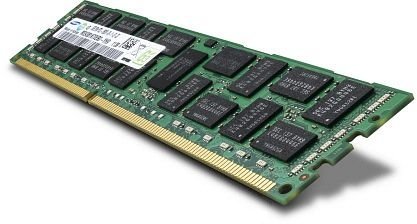
Designed for legacy server platforms, this Samsung M393B2G70QH0-CK0Q8 16GB DDR3-1600 Registered DIMM with ECC is ideally suited for memory-intensive workloads such as virtualization and in-memory databases, where data integrity and system uptime are critical. Its dual-rank x4 organization and registered signal architecture reduce electrical load on the memory bus, enabling higher capacity configurations with stable operation at 1.5V and CL11 timings.
1. ECC error correction silently detects and corrects single-bit memory faults, preserving data integrity around the clock for transactional databases and virtualized workloads that cannot tolerate silent corruption.
2. Registered signal buffering decouples the memory controller from the electrical load of multiple DIMMs, enabling dense memory populations and unwavering stability in multi-socket server deployments.
3. Dual Rank x4 organization maximizes bank-level parallelism, sustaining consistent throughput and I/O efficiency even under heavy mixed read/write traffic from dozens of virtual machines.
4. Ample module capacity provides the headroom to run memory-hungry in-memory caches and a higher number of containers per host, reducing the need to spill over into slower storage.
5. Elevated clock speed delivers robust bandwidth per channel, keeping multi-core server CPUs continuously fed with data during real-time analytics and large-scale query processing.
When you are running a dense virtualization cluster or an in-memory database, every bit of data integrity and every clock cycle counts. The Samsung M393B2G70QH0-CK0Q8 RDIMM is engineered precisely for these unforgiving environments. Its ECC technology actively detects and corrects single-bit memory errors, meaning a cosmic-ray-induced bit flip will not silently corrupt a financial transaction or a virtual machine’s state—your data remains trustworthy without application crashes. The registered signal buffer is equally vital: in a fully loaded 24-slot server, it stabilizes the command and address lines, allowing you to populate all channels with 16 GB modules while maintaining clean, reliable signaling. This directly supports larger, more resilient virtualization hosts. Meanwhile, its dual-rank x4 organization increases bank-level parallelism, so a Redis or SAP HANA instance sees higher sustained throughput because the memory controller can interleave requests across multiple internal banks. Paired with the PC3-12800 bandwidth, this means your in-memory analytics job completes faster, and your hypervisor can schedule more VMs without memory bottlenecks. In short, this module turns raw specs into business continuity, higher consolidation ratios, and predictable latency under heavy load.
Based on the specifications — ECC, Registered, 240-pin DDR3 — this M393B2G70QH0-CK0Q8 is a server memory module. The following capacity planning guidance covers three typical server workloads using this 16GB DDR3-1600 RDIMM.
General Virtualization
Virtualized environments depend on balanced memory across all memory channels to sustain concurrent VMs. Populate each channel identically, ideally one 16GB RDIMM per channel. For a dual-socket server with four channels per CPU, install eight modules (128GB total) to guarantee full bandwidth and leave room for future scaling without creating hot channels.
In-Memory Database
In-memory databases require maximum RAM capacity and can trade some speed for density. Fill all available slots with these 16GB RDIMMs, aiming for a configuration like two DIMMs per channel in a two-socket system (12 modules / 192GB). Be prepared for the memory controller to down-clock from 1600MT/s at 2 DPC, but that capacity payout is essential for large working sets.
High-Performance Computing (HPC)
HPC cares most about sustained memory bandwidth and low latency. Install exactly one 16GB RDIMM per channel to keep the full 1600MHz clock. In a common dual-socket platform with four channels per CPU, eight modules deliver 128GB at peak throughput. If more memory is needed, consider higher-density RDIMMs while maintaining the 1 DPC rule.
Rigorously tested server memory, compatible with Dell PowerEdge R720, HP DL380p Gen8, Lenovo RD630, and more.
Q: Can I mix this M393B2G70QH0-CK0Q8 with other memory modules of different brands or speeds?
A: Mixing this RDIMM with different brands or speeds is not recommended. It may cause system instability or POST failures. For guaranteed compatibility, use identical M393B2G70QH0-CK0Q8 modules in your server.
Q: Is this memory compatible with my system?
A: This DDR3 ECC Registered DIMM is compatible with server platforms supporting 1600MHz RDIMMs, such as Intel Xeon E5-2400/2600 v2 and AMD Opteron 6300 series. Verify your motherboard’s memory QVL list.
Q: What is the recommended DIMM population order for optimal performance?
A: For optimal performance, populate identical DIMMs per channel, balancing across CPU memory controllers. Follow your server’s manual—typically fill blue or black slots first. This maximizes interleaving and bandwidth.
Q: Does this module support overclocking or XMP profiles?
A: No, this server memory does not support overclocking or XMP profiles. It operates at JEDEC standard DDR3-1600 CL11 for utmost reliability and stability in 24/7 enterprise environments.
Q: What warranty and typical failure rate can I expect?
A: This module comes with a 1-year warranty. Typical annualized failure rate (AFR) is very low, around 0.5% or less, reflecting Samsung’s rigorous quality testing for enterprise-grade memory.