











 Secure payments
Standard refund policy
Trade Assurance
Secure payments
Standard refund policy
Trade Assurance
| Product Type | Memory Module |
|---|---|
| Compliance Standards | |
| Memory Capacity | 16 GB |
| Memory Technology | DDR3 |
| Product Voltage | 1.35 V |
| RAM Speed | 1600 MHz |
| RAM Standard | DDR3-1600/PC3-12800 |
| Error Identifying | ECC |
| Signal Type | Registered |
| Column Access Strobe (CAS) | CL11 |
| Rank | Dual Rank x4 |
| Quantity of Pins | 240-pin |
| RAM Genre | RDIMM |
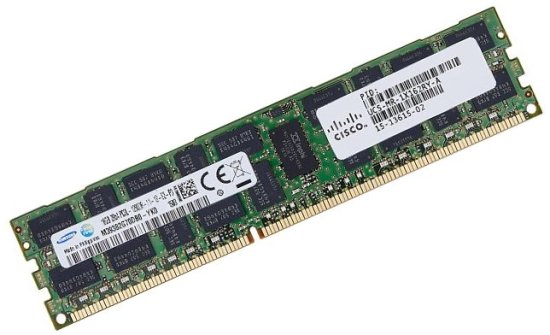
This 16GB DDR3-1600 RDIMM, with its ECC and registered signal type, is engineered for server platforms where data integrity is paramount, ideally suited for memory-intensive workloads such as virtualization, in-memory databases, and enterprise resource planning. The dual-rank x4 organization enhances memory interleaving for improved throughput, while the 1.35V low-voltage operation reduces power consumption without sacrificing the CL11 latency stability critical for sustained 24/7 operation in dense rack environments.
1. 16GB capacity per module enables higher memory density in rack servers, allowing more VMs to be consolidated without degrading database response times.
2. ECC error correction detects and fixes single-bit faults in real time, preserving data accuracy for financial ledgers and virtualized workloads that cannot tolerate silent corruption.
3. Registered buffering decouples the command bus from the memory array, maintaining signal integrity across fully populated 24-slot servers and preventing crashes under heavy load.
4. Dual Rank x4 organization interleaves accesses across internal banks, sustaining channel bandwidth saturation when multiple analytics containers query large in-memory datasets simultaneously.
5. 1.35V low-voltage design cuts DRAM power draw significantly against legacy 1.5V modules, reducing both electricity costs and thermal stress in dense data center aisles.
When you’re running a dense virtualization cluster or an in-memory database, silent data corruption is the enemy of uptime and accurate transactions. The M393B2G70DB0-YK0 is engineered specifically for these mission-critical server environments, and its feature set directly protects your operations. The ECC technology continuously detects and corrects single-bit memory errors, which is vital because a cosmic-ray-induced bit flip in a hypervisor’s memory space can crash dozens of virtual machines or silently corrupt financial records. The registered, or buffered, design stabilizes the electrical load on the memory bus, allowing you to populate all channels with 16 GB RDIMMs without signal degradation—this means you can scale to hundreds of gigabytes of RAM per server for larger VM fleets or massive database caches. The module runs at a low 1.35 V, which in a fully populated rack significantly reduces power consumption and cooling overhead, directly lowering your data center’s operating costs. Finally, the dual-rank x4 organization interleaves memory accesses across two internal ranks, boosting sustained bandwidth and reducing latency under the heavy, concurrent read/write loads typical of analytics and OLTP workloads. For your virtualized infrastructure or Redis and SAP HANA databases, this memory delivers the reliability, density, and performance you can’t afford to compromise.
General Virtualization
For dense virtualization hosts, populate memory channels evenly using multiples of these 16GB RDIMMs to maximize available capacity. A balanced configuration, such as six or eight identical modules per CPU, ensures optimal memory interleaving and avoids performance penalties while supporting dozens of virtual machines on a single hypervisor.
In-Memory Database
In-memory databases like Redis or SAP HANA demand large, contiguous memory pools and strict data integrity. Deploy these low-voltage ECC Registered DIMMs in fully populated channels—up to 24 or more modules per server—to reach 384GB+ capacities, leveraging 1.35V operation to reduce thermal load under sustained high-throughput workloads.
High-Performance Computing
HPC clusters rely on bandwidth-sensitive parallel I/O; install these dual-rank x4 DIMMs in a configuration that occupies all memory channels (e.g., one DIMM per channel) to exploit 1600MT/s throughput. The Registered ECC design guarantees stability during multi-day simulation runs, while the lower voltage helps control power budgets in dense compute nodes.
This server-grade DDR3 RDIMM passed rigorous testing. Compatible with Dell PowerEdge R620/R720, HP ProLiant DL380p Gen8, and more.
Q: Can I mix this M393B2G70DB0-YK0 with other memory modules of different brands or speeds?
A: Mixing is not recommended. Registered ECC memory demands identical part numbers for guaranteed stability. Mismatched ranks, voltages, or speeds can cause POST failures or silent data corruption in server environments.
Q: Is this memory compatible with my system?
A: It suits servers supporting DDR3-1600 Registered ECC RDIMMs at 1.35V. Verify your Intel Xeon E5/E7 or AMD Opteron platform’s QVL, and ensure 240-pin DIMM slots and LRDIMM/RDIMM support.
Q: What is the recommended DIMM population order for optimal performance?
A: Populate identical DIMMs per channel, starting from the farthest slot from the CPU. Balance capacity across memory channels and adhere to your server board’s population guide for symmetric interleaved performance.
Q: Does this module support overclocking or XMP profiles?
A: No. This is a server-class Registered DIMM with fixed JEDEC timings (CL11). Overclocking and XMP are unsupported to ensure 24/7 data integrity and platform stability under ECC operation.
Q: What warranty and typical failure rate can I expect?
A: It includes a 1-year warranty. Enterprise-grade DDR3 RDIMMs like this typically maintain an annualized failure rate (AFR) below 0.5%, ensuring reliable long-term deployment when operated within specifications.