











 Secure payments
Standard refund policy
Trade Assurance
Secure payments
Standard refund policy
Trade Assurance
| Model | M393B2G70QH0-YK0Q8 |
|---|---|
| Product Type | Memory Module |
| Compliance Standards | EU RoHS,FCC |
| Memory Capacity | 16 GB |
| Memory Technology | DDR3 |
| Product Voltage | 1.35V |
| RAM Speed | 1600MHz |
| RAM Standard | DDR3-1600/PC3-12800 |
| Error Identifying | ECC |
| Signal Type | Registered |
| Column Access Strobe (CAS) | CL11 |
| Rank | Dual Rank x4 |
| Quantity of Pins | 240-pin |
| RAM Genre | RDIMM |
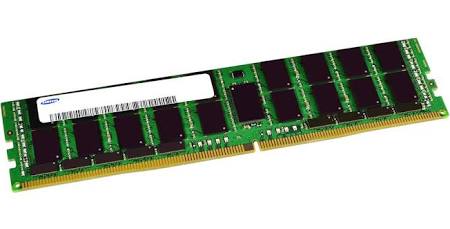
This Samsung 16GB DDR3L-1600 Registered ECC RDIMM is purpose-built for enterprise servers and virtualization platforms, where it ensures data integrity under demanding workloads such as in-memory databases and dense virtual machine deployments. Its dual-rank x4 organization and registered signaling stabilize memory buses across heavy load conditions, while 1.35V low-voltage operation and ECC correction reduce power overhead and eliminate silent data corruption.
1. ECC protection continuously corrects single-bit errors in real time, ensuring transactional databases and financial systems never suffer silent data corruption that could lead to costly service outages.
2. Registered signal buffering stabilizes command and address lines when populating all memory channels, enabling businesses to scale up to massive RAM footprints for heavy in-memory analytics without signal integrity issues.
3. Dual Rank x4 organization interleaves accesses across internal banks, boosting sustained throughput for virtualization hosts where dozens of VMs hammer memory simultaneously with mixed read/write workloads.
4. Sixteen-gigabyte module density maximizes memory slots in dense 2U servers, letting IT architects run larger in-memory caches and more containers per node while leaving room for future expansion.
5. The 1600 MHz clock speed translates to a 12.8 GB/s peak bandwidth, accelerating real-time data processing and reducing latency in high-frequency trading and in-memory database environments.
In modern data centers, the Samsung M393B2G70QH0-YK0Q8 RDIMM is engineered to eliminate the silent killers of server uptime and performance. Its ECC technology automatically detects and corrects single-bit memory errors caused by background radiation, which is non-negotiable when a flipped bit in your financial database or hypervisor can corrupt transactions or bring down an entire virtual machine without warning. The registered signal buffer places minimal electrical load on the memory controller, allowing you to populate all 24 slots of a quad-socket server with 16GB modules and still maintain rock‑solid stability for dense virtualization clusters. With a dual‑rank x4 organization and 1600MHz speed, it unlocks higher bank‑level parallelism, meaning in‑memory analytics platforms like SAP HANA experience noticeably lower latency even under sustained heavy reads and writes. Operating at just 1.35V, it also reduces your energy footprint by roughly 20% over older 1.5V DIMMs, directly cutting power and cooling costs across a fleet of always‑on database nodes. This is the kind of resilience you need when every millisecond of memory access impacts customer experience and revenue.
General Virtualization
This 16GB DDR3-1600 Registered ECC module suits moderate-density server farms. Deploy six to eight modules per dual-socket host (96–128 GB total) to comfortably run 20–30 mixed-role VMs. Populate identical modules across all memory channels for balanced access, and leave room for future growth by using half the available DIMM slots initially.
In-Memory Database
Low-latency, high-integrity datasets demand both error correction and capacity. Install twelve to sixteen of these dual-rank RDIMMs across both sockets in a 2U server, providing 192–256 GB of fully-buffered memory. This configuration keeps an entire Redis or Memcached dataset in RAM while ECC scrubbing prevents silent data corruption—critical for financial or real-time analytics.
High-Performance Computing
HPC nodes need bandwidth as much as capacity. Use eight modules per node in a quad-channel arrangement (four modules per socket) to maximize throughput for tightly-coupled MPI workloads. The 1.35 V low-voltage operation reduces thermals in dense compute clusters, and the registered interface maintains signal integrity under sustained full-load streaming, making it ideal for 24/7 simulation farms.
Rigorously tested, compatible with servers like Dell PowerEdge R720, HP ProLiant DL380p Gen8, and other DDR3 RDIMM platforms.
Q: Can I mix this M393B2G70QH0-YK0Q8 with other memory modules of different brands or speeds?
A: Mixing is not recommended for server environments. Different brands, speeds, or ranks can cause POST failures, ECC errors, or de-rating to the lowest common speed. Identical part numbers ensure validated compatibility.
Q: Is this memory compatible with my system?
A: This 16GB DDR3-1600 Registered ECC RDIMM is designed for dual-socket servers using Intel Xeon E5-2600 v1/v2 or AMD Opteron 6300 series platforms. Verify your board supports 1.35V, 240-pin RDIMMs and check the qualified vendor list.
Q: What is the recommended DIMM population order for optimal performance?
A: Populate identical DIMMs per channel, matching all blue or all black slots first to balance interleaved memory channels. For dual-rank x4 RDIMMs, install three DIMMs per channel for maximum bandwidth on most platforms. Always consult the server's technical manual.
Q: Does this module support overclocking or XMP profiles?
A: No. This is a JEDEC-compliant server memory module built for 24/7 stability. It runs strictly at DDR3-1600 CL11 with no XMP profile or overclocking support, as reliability is critical in enterprise deployments.
Q: What warranty and typical failure rate can I expect?
A: This module is covered by a one-year warranty. It delivers enterprise-grade reliability with an annualized failure rate (AFR) typically below 0.5% under specified operating conditions, backed by rigorous component-level testing and screening.