











 Secure payments
Standard refund policy
Trade Assurance
Secure payments
Standard refund policy
Trade Assurance
| Product Type | Memory Module |
|---|---|
| Compliance Standards | |
| Memory Capacity | 16 GB |
| Memory Technology | DDR3 |
| Product Voltage | 1.35 V |
| RAM Speed | 1600 MHz |
| RAM Standard | DDR3-1600/PC3-12800 |
| Error Identifying | ECC |
| Signal Type | Registered |
| Column Access Strobe (CAS) | CL11 |
| Rank | Dual Rank x4 |
| Quantity of Pins | 240-pin |
| RAM Genre | RDIMM |
This DDR3-1600 RDIMM is optimally engineered for server platforms running virtualization clusters or in-memory databases, where its registered signal type and ECC actively ensure signal integrity and data reliability under heavy, sustained loads. The dual-rank x4 organization combined with low 1.35V operation maximizes memory density and power efficiency per channel, directly boosting throughput in multi-DIMM configurations without sacrificing error correction.
1. Registered signal type buffers the command and address buses, enabling stable operation across fully populated server memory channels without signal degradation.
2. ECC error identification performs real-time single-bit error correction and multi-bit error detection, preserving data integrity for critical enterprise workloads.
3. A 16GB module capacity maximizes memory density per server node, allowing smooth consolidation of numerous virtual machines under heavy hypervisor loads.
4. Dual Rank x4 organization interleaves memory accesses within each DIMM, delivering higher sustained bandwidth for data-intensive analytics and large-scale databases.
5. 1.35V low-voltage operation lowers power draw and thermal output across server farms, directly trimming data center energy costs while maintaining robust performance.
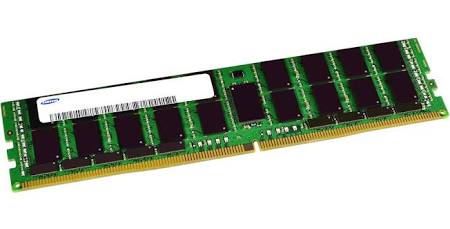
When you deploy the Samsung M393B2G70QH0-YK0, a 16GB DDR3L-1600 Registered DIMM with ECC, you are solving the real pain points of demanding data center workloads instead of merely upgrading memory. In a dense virtualization cluster, every bit matters. The onboard ECC silently corrects single-bit errors caused by cosmic radiation before they corrupt a virtual machine’s state or crash your entire hypervisor, safeguarding dozens of tenants on a single host. The registered buffer re-drives command and address signals, ensuring clean communication across all populated channels; this lets you install six or twelve such dual-rank modules per server without signal degradation, drastically reducing downtime when scaling virtual infrastructure. For an in-memory database like SAP HANA or a high-frequency Redis cache, the dual-rank x4 organization drives internal bank interleaving that sustains higher command rates, directly lowering latency for millions of concurrent transactions. Meanwhile, the 1.35V low-voltage operation cuts power draw and cooling overhead in a filled rack, translating into substantial OpEx savings and greater thermal headroom. This memory module turns fragile theory into predictable, production-grade reliability where your budget and data integrity intersect.
Server Memory Identified
This DDR3-1600 RDIMM with ECC and 1.35V low voltage is a registered server module, designed for stability in multi-slot platforms. Capacity planning must balance channel population, rank count, and power constraints for each workload.
General Virtualization
Populate all memory channels symmetrically with identical 16 GB RDIMMs to maximize bandwidth and reduce NUMA penalties. For a dual-socket server, six or eight modules per CPU (96–128 GB total) deliver solid VM density for mixed workloads while keeping dual-rank loading manageable.
In-Memory Database
Maximize capacity by fully populating every slot with these dual-rank 16 GB DIMMs, reaching 256 GB or more on common two-socket boards. Expect a slight speed drop at maximum ranks, so verify the platform’s support for 2DPC (two DIMMs per channel) at 1600 MT/s and prioritize total memory over peak frequency.
High-Performance Computing
Balance rank count and speed: install one DIMM per channel (1DPC) to sustain 1600 MT/s and exploit all memory channels, achieving high bandwidth with a moderate capacity footprint. For memory-bound HPC jobs, consider populating additional slots only after benchmarking, as adding ranks may force a down-clock to 1333 MT/s and hurt throughput-sensitive workloads.
Rigorously tested server memory compatible with Dell R720, HP DL380p Gen8, Lenovo x3650 M4.
Q: Can I mix this M393B2G70QH0-YK0 with other memory modules of different brands or speeds?
A: Mixing brands or speeds is not recommended for Registered ECC memory. Different ranks or timings may cause signal integrity issues and system instability. Use identical part numbers for guaranteed compatibility.
Q: Is this memory compatible with my system?
A: This DDR3-1600 ECC RDIMM is designed for server platforms such as Intel Xeon E5-2600 v2 or AMD Opteron 6300 series. Verify your motherboard's Qualified Vendor List (QVL) for confirmed support.
Q: What is the recommended DIMM population order for optimal performance?
A: For dual‑processor servers, populate identical modules in the blue slots per channel first to balance memory across CPU memory controllers. Consult your system manual for the exact slot numbering sequence.
Q: Does this module support overclocking or XMP profiles?
A: No. This server‑grade RDIMM adheres strictly to JEDEC timings (CL11). Overclocking and XMP are disabled to ensure data integrity and 24/7 operational stability in enterprise environments.
Q: What warranty and typical failure rate can I expect?
A: This module includes a one‑year warranty. Engineered for enterprise reliability, the typical annualized failure rate (AFR) is well below 0.5%, making it suitable for mission‑critical deployments.