











 Secure payments
Standard refund policy
Trade Assurance
Secure payments
Standard refund policy
Trade Assurance
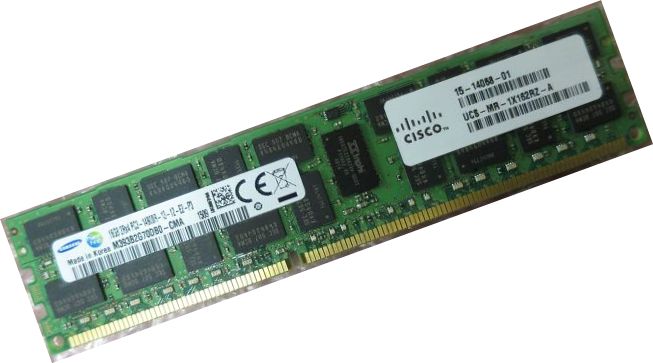
| Model | M393B2G70DB0-CMAQ2 |
|---|---|
| Product Type | Memory Module |
| Compliance Standards | CE,WEEE,RoHS |
| Memory Capacity | 16 GB |
| Memory Technology | DDR3 |
| Product Voltage | 1.5V |
| RAM Speed | 1866MHz |
| RAM Standard | DDR3-1866/PC3-14900 |
| Error Identifying | ECC |
| Signal Type | Registered |
| Column Access Strobe (CAS) | CL13 |
| Rank | Dual Rank x4 |
| Quantity of Pins | 240-pin |
| RAM Genre | RDIMM |
The M393B2G70DB0-CMAQ2 is a server-grade DDR3-1866 registered ECC RDIMM, purpose-built for virtualization, in-memory databases, and latency-sensitive enterprise workloads where data integrity is non-negotiable. Its dual-rank x4 organization combined with registered signaling and CL13 latency delivers robust signal stability and efficient interleaving, ensuring reliable 1.5V operation and single-symbol error correction in high-density memory deployments.
1. ECC memory detects and corrects single-bit errors in real time, preserving data integrity for financial transactions and database queries where even a silent corruption is unacceptable.
2. Registered signal buffering stabilizes command and address signals across fully loaded server boards, enabling seamless scaling to 24 DIMMs per node without compromising reliability.
3. Dual Rank x4 organization delivers sustained bandwidth under mixed workloads, ensuring predictable VM response times when hosting dozens of virtual desktops on a single host.
4. CL13 low latency accelerates in-memory caching operations, reducing the CPU stall cycles that directly impact user-facing application performance in high-frequency trading platforms.
5. 16GB capacity per module strikes an optimal density sweet spot for mid-range virtualization clusters, maximizing memory channels without forcing costly overprovisioning of unused capacity.
The Samsung M393B2G70DB0-CMAQ2 is a 16GB DDR3 Registered ECC DIMM built for server environments, where four characteristics become critical. ECC continuously corrects single-bit errors—in a cluster hosting tens of VMs, this stops silent corruption from escalating into crashes and downtime. The registered clock driver preserves signal quality with fully loaded channels, enabling you to scale to the large capacities needed for dense consolidation or to fit entire in-memory databases like Redis without instability. The dual-rank x4 organization uses rank interleaving to mask precharge delays and boost sustained bandwidth, accelerating database queries and analytics workloads. With an 1866MHz clock and CL13 latency, the module keeps transactional and caching systems responsive. These features deliver hardened data integrity, higher VM density, and low latency—directly improving service uptime and reducing TCO.
General Virtualization
With 16GB RDIMMs running at 1866MHz, a balanced virtualization host benefits from six to eight identical modules per CPU to populate all memory channels, delivering 96–128GB total capacity. This configuration avoids performance penalties from unbalanced DIMM population while leaving room for moderate VM density. Stick to matched kits and verify the server’s population order to maintain Rank Interleaving and maximize throughput for mixed workloads.
In-Memory Database
In-memory databases demand low latency and high reliability, making ECC Registered DIMMs essential. A two-socket server fully loaded with 16GB dual-rank x4 modules—typically 24 DIMMs for 384GB—provides a solid foundation for datasets that must reside entirely in RAM. Prioritize filling all channels with identical, single-vendor modules to guarantee stable 1866MT/s signaling and reduce the risk of silent data corruption under continuous heavy read/write stress.
High-Performance Computing (HPC)
HPC clusters thrive on bandwidth, so install eight or sixteen DIMMs per node to achieve maximum memory bandwidth through full channel population. The CL13 latency and 1866MHz speed offer a deterministic response suitable for tightly coupled MPI workloads. While 16GB per DIMM balances cost and density, plan capacity so that working sets never spill to swap, as disk I/O stalls can cripple scaling efficiency across hundreds of nodes.
This server memory has passed rigorous testing; compatible with Dell PowerEdge R720, HP DL380p Gen8, Lenovo RD630, Cisco C220 M3.
Q: Can I mix this M393B2G70DB0-CMAQ2 with other memory modules of different brands or speeds?
A: Mixing is not recommended. Registered DIMMs require identical ranks, timings, and voltage for stable server operation. Disparate speeds will downclock to the slowest module, often causing POST or reliability issues.
Q: Is this memory compatible with my system?
A: This 16GB DDR3-1866 RDIMM supports Intel Xeon E5 and AMD Opteron 6300 series platforms. Verify your server board accepts 1.5V registered memory with 240-pin configuration before ordering.
Q: What is the recommended DIMM population order for optimal performance?
A: Populate identical DIMMs starting with the first slot of each memory channel, typically slot A1 and B1. Balanced channel loading maximizes bandwidth; consult your server manual for exact sequence.
Q: Does this module support overclocking or XMP profiles?
A: No. As a server-grade registered ECC module, it follows JEDEC standards exclusively for data integrity. XMP and overclocking are not supported to ensure 24/7 stability.
Q: What warranty and typical failure rate can I expect?
A: This module carries a 1-year warranty. Enterprise RDIMMs typically exhibit an annualized failure rate below 0.5%, providing reliable long-term operation in properly cooled server environments.