











 Secure payments
Standard refund policy
Trade Assurance
Secure payments
Standard refund policy
Trade Assurance
| Model | M393B2G70EB0-CMA02 |
|---|---|
| Product Type | Memory Module |
| Compliance Standards | EU RoHS,FCC |
| Memory Capacity | 16 GB |
| Memory Technology | DDR3 |
| Product Voltage | 1.5V |
| RAM Speed | 1866MHz |
| RAM Standard | DDR3-1866/PC3-14900 |
| Error Identifying | ECC |
| Signal Type | Registered |
| Column Access Strobe (CAS) | CL13 |
| Rank | Dual Rank x4 |
| Quantity of Pins | 240-pin |
| RAM Genre | RDIMM |
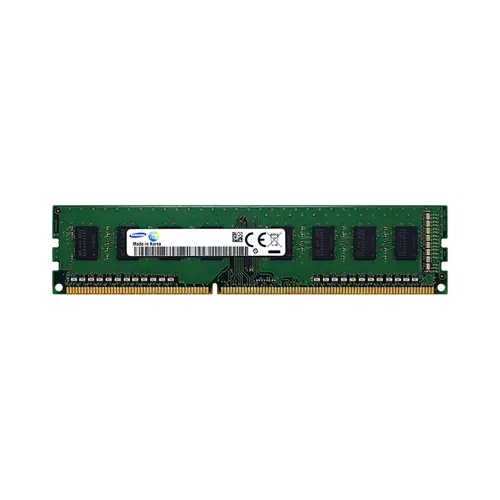
Engineered for server-class deployments, this Samsung M393B2G70EB0-CMA02 16GB DDR3-1866 RDIMM leverages ECC and registered signaling to ensure uncompromised data integrity and signal stability in dense virtualization and in-memory database environments. Its dual-rank x4 organization and CL13 latency optimize interleaved memory access and command efficiency on multi-DIMM channels, making it an ideal fit for platforms that demand consistent throughput under sustained, heavy loads.
1. ECC protection silently corrects single-bit memory errors in real time, safeguarding transactional databases and financial records from silent data corruption that could otherwise crash the entire server.
2. Registered signal buffering stabilizes command and address lines even when all memory slots are populated, enabling dense server configurations without sacrificing signal integrity under sustained load.
3. 16GB capacity per module supports higher virtual machine density, allowing more containers or tenants per physical host and directly reducing data center hardware footprint and licensing costs.
4. 1866MHz speed provides ample memory bandwidth to keep mid-range enterprise applications responsive, preventing memory bottlenecks during peak concurrent access in web and collaboration servers.
5. Dual Rank x4 architecture interleaves memory accesses across two internal ranks, raising sustained throughput and ensuring consistent performance for virtualized workloads running in parallel.
The Samsung M393B2G70EB0-CMA02 is an RDIMM engineered specifically for server environments, where its four defining characteristics translate directly into mission-critical reliability. The module’s ECC technology continuously detects and corrects single-bit memory errors, which is essential for preventing silent data corruption in a virtualized cluster running dozens of VMs—a single flipped bit in a hypervisor’s memory space can crash an entire host or corrupt a financial transaction. Its registered architecture buffers command and address signals, allowing the memory controller to drive far more DIMMs per channel without signal degradation; this stability lets you populate all 24 slots of a dual-socket server with confidence, maximizing capacity for dense consolidation. The dual‑rank x4 organization increases bank‑level parallelism, delivering measurably higher throughput under the random-access patterns of an in‑memory database like Redis or SAP HANA, where latency spikes translate into lost revenue. Finally, the 1866MT/s speed and CL13 latency strike the optimal balance between bandwidth and power in legacy DDR3 platforms, squeezing maximum performance from aging infrastructure without jeopardizing the error correction envelope. In short, this module lets you safely scale virtual machines and keep latency-sensitive applications responsive under load.
General Virtualization
For virtualized environments hosting multiple VMs, populate an even number of identical M393B2G70EB0-CMA02 modules across all memory channels to maintain balanced access and maximize bandwidth. A typical dual-socket server benefits from six or eight 16GB RDIMMs per CPU, delivering 96GB to 128GB per node, which comfortably supports 20–30 light-to-medium VMs. Leave half the DIMM slots free for future scale-out without disrupting existing workloads.
In-Memory Database
In-memory databases like Redis or SAP HANA demand low latency and high capacity, so fully populate all memory channels with these registered DIMMs while respecting the platform’s maximum rank limits. Start with sixteen 16GB modules (256GB) per server to hold sizeable datasets entirely in DRAM, then scale to thirty-two modules (512GB) as data grows. Always configure matching pairs per channel to avoid performance penalties from unbalanced interleaving.
High-Performance Computing
HPC clusters rely on per-core memory bandwidth, so install one M393B2G70EB0-CMA02 per channel—typically eight modules per dual-socket node—to achieve 128GB at peak throughput. This configuration keeps the memory subsystem saturated during large-scale simulations or computational fluid dynamics runs. When job profiles are memory-bound, expand to two DIMMs per channel, carefully monitoring any drop in clock speed, and use dual-rank x4 modules like these to sustain strong signal integrity under heavy load.
Rigorously tested, compatible with Dell PowerEdge R720, HP DL380p Gen8, Lenovo x3650 M4, and similar servers.
Q: Can I mix this M393B2G70EB0-CMA02 with other memory modules of different brands or speeds?
A: Mixing this DDR3 Registered ECC module with different brands or speeds is strongly discouraged. It often leads to signal integrity issues, POST failures, or system instability.
Q: Is this memory compatible with my server platform?
A: It is designed for servers supporting DDR3 Registered ECC memory, typically Intel Xeon 5500/5600 series or AMD Opteron 6100/6200 platforms. Verify your chipset and board qualification list.
Q: What is the recommended DIMM population order for optimal performance?
A: Install identical DIMMs per memory channel, filling the slots farthest from the CPU first. Always follow the server vendor’s specific population guidelines for balanced NUMA configuration.
Q: Does this module support overclocking or XMP profiles?
A: No. As an enterprise DDR3 Registered DIMM, it strictly adheres to JEDEC DDR3-1866 specifications and does not support overclocking or XMP profiles.
Q: What warranty and typical failure rate can I expect?
A: This module includes a 1-year warranty. Enterprise RDIMMs like this are built for 24/7 reliability, exhibiting an extremely low annualized failure rate under normal operating conditions.