











 Secure payments
Standard refund policy
Trade Assurance
Secure payments
Standard refund policy
Trade Assurance
| Model | M393B2G70QH0-CMA09 |
|---|---|
| Product Type | Memory Module |
| Compliance Standards | EU RoHS,FCC |
| Memory Capacity | 16 GB |
| Memory Technology | DDR3 |
| Product Voltage | 1.5V |
| RAM Speed | 1866MHz |
| RAM Standard | DDR3-1866/PC3-14900 |
| Error Identifying | ECC |
| Signal Type | Registered |
| Column Access Strobe (CAS) | CL13 |
| Rank | Dual Rank x4 |
| Quantity of Pins | 240-pin |
| RAM Genre | RDIMM |
Designed for enterprise servers, this 16 GB DDR3-1866 RDIMM with ECC and registered signaling ensures data integrity and stability in memory-intensive workloads like virtualization and in-memory databases. Its dual-rank x4 organization and CL13 latency deliver balanced bandwidth and access efficiency for high-reliability platforms demanding robust error correction.
1. Error-correcting code protection detects and corrects single-bit memory errors in real time, safeguarding transactional databases and preventing silent data corruption in long-running enterprise workloads.
2. The registered buffer stabilizes signal integrity across fully populated server boards, enabling dense memory configurations without compromising uptime in multi-socket virtualization hosts.
3. A dual-rank x4 organization maximizes per-channel bandwidth utilization, ensuring predictable low-latency access patterns even when hosting dozens of memory-intensive virtual machines concurrently.
4. Sixteen-gigabyte module capacity raises the density ceiling per server node, allowing more active containers or VMs to reside in RAM before costly disk swapping degrades service levels.
5. 1866 megatransfers per second delivers ample throughput for legacy DDR3-era platforms, keeping mid-tier ERP and web-serving clusters responsive under steady user concurrency.
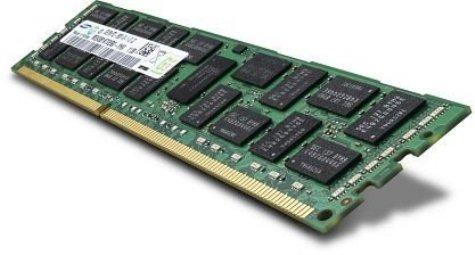
The Samsung M393B2G70QH0-CMA09 is a 16GB DDR3-1866 Registered DIMM purpose-built for server infrastructure, where its four defining engineering choices directly prevent the outages that keep IT administrators awake at night.
ECC error correction silently scrubs single-bit upsets caused by cosmic rays or electrical noise, a necessity when an in‑memory database like SAP HANA caches millions of financial transactions. One flipped bit without ECC could corrupt a balance sheet; with it, your data retains absolute accuracy. Registered signal buffering stabilizes command and address lines across fully loaded memory channels, a design that lets you populate every slot without signal collapse—critical for a VMware ESXi host running 50 virtual machines, where memory instability would cascade into cluster‑wide failures. The dual‑rank x4 organization exploits rank interleaving to hide refresh gaps, dramatically lowering latency under the random I/O storms of a virtualized SQL Server farm. Finally, the 1866MHz clock and tight CL13 latency deliver 14.9 GB/s of consistent bandwidth, so real‑time analytics dashboards render instantly. These characteristics converge into a single truth for data‑center operators: higher VM density, ironclad data integrity, and unwavering uptime.
General Virtualization
For a virtualized host, deploy these 16GB Registered ECC DDR3 modules in balanced configurations that populate all available memory channels—typically one DIMM per channel on quad‑channel platforms. A baseline of 4 x 16GB (64GB) supports moderate VM density with full 1866 MT/s bandwidth. For higher consolidation ratios, scale to 8 x 16GB (128GB) using two DIMMs per channel while observing population order to maintain stable clock speeds; the ECC protection is essential for multi‑tenant reliability.
In‑Memory Database
Memory‑centric databases demand maximum capacity and data integrity without compromising speed. Equip the server with at least eight modules (128GB) spread evenly across channels, and if the platform allows, move to 12 or 16 DIMMs (192‑256GB) by installing two RDIMMs per channel. Always follow the vendor’s slot‑per‑channel rules to keep the 1866 MHz clock and avoid performance‑degrading down‑clocking during heavy in‑memory analytics.
High‑Performance Computing (HPC)
HPC jobs are heavily bandwidth‑bound, making one DIMM per channel the ideal configuration to sustain the full 1866 MT/s data rate. A 4‑module (64GB) setup saturates a quad‑channel memory interface with minimal electrical loading, while doubling to 8 modules (128GB) brings extra capacity for small‑scale parallelism when each channel holds two ranks. The Registered ECC signaling ensures signal integrity across long‑duration simulations and computational workloads.
Rigorously tested server memory compatible with Dell PowerEdge R720, HP DL380p Gen8, IBM x3650 M4.
Q: Can I mix this M393B2G70QH0-CMA09 with other memory modules of different brands or speeds?
A: Mixing this registered DDR3 RDIMM with modules of different brands or speeds is not recommended. Inconsistent ranks, timings, or voltages can compromise signal integrity, trigger system instability, and degrade ECC effectiveness.
Q: Is this memory compatible with my Intel Xeon E5 or AMD Opteron server platform?
A: This DDR3-1866 registered ECC RDIMM is compatible with platforms supporting Intel Xeon E5-2600 v2 series or AMD Opteron 6300 series processors. Confirm your board manual lists support for 1.5V, dual-rank x4, 16GB RDIMMs with CL13.
Q: What is the recommended DIMM population order for optimal performance with this M393B2G70QH0-CMA09?
A: Install in matched sets per channel, starting with blue slots farthest from the CPU. Populate identical dual-rank x4 modules symmetrically across memory channels to maximize interleaving and maintain balanced loads for optimal server throughput.
Q: Does this Samsung server module support overclocking or XMP profiles?
A: No. This JEDEC-compliant registered server DIMM has no XMP profile. Overclocking is unsupported and would violate platform RAS requirements, potentially causing silent data corruption and voiding the one-year warranty.
Q: What warranty and typical failure rate can I expect with this PC3-14900 RDIMM?
A: The module includes a one-year warranty. As a Samsung enterprise-grade component with stringent EU RoHS/FCC compliance, its annualized failure rate (AFR) is typically below 0.5% under specified operating conditions, ensuring minimal downtime.