











 Secure payments
Standard refund policy
Trade Assurance
Secure payments
Standard refund policy
Trade Assurance
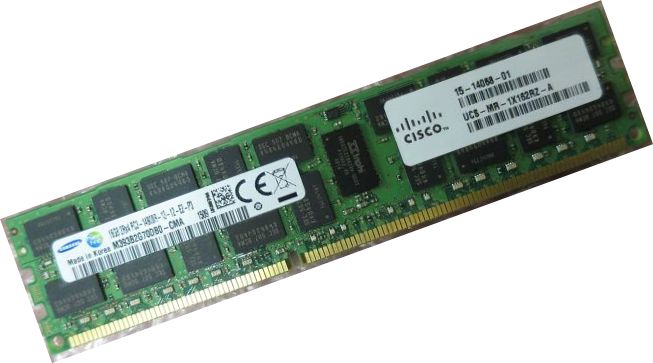
| Model | M393B2G70DB0-CMAQ2M |
|---|---|
| Product Type | Memory Module |
| Compliance Standards | EU RoHS,FCC |
| Memory Capacity | 16 GB |
| Memory Technology | DDR3 |
| Product Voltage | 1.5V |
| RAM Speed | 1866MHz |
| RAM Standard | DDR3-1866/PC3-14900 |
| Error Identifying | ECC |
| Signal Type | Registered |
| Column Access Strobe (CAS) | CL13 |
| Rank | Dual Rank x4 |
| Quantity of Pins | 240-pin |
| RAM Genre | RDIMM |
This DDR3-1866 RDIMM with ECC and registered signaling is purpose-built for legacy server platforms, excelling in virtualization, in-memory databases, and other data-integrity-critical workloads. Its dual-rank x4 configuration enables higher memory density and sustained bandwidth, while the Registered buffer and CL13 latency ensure stable command/address integrity under heavy multi-DIMM loads.
1. ECC memory ensures single-bit errors are detected and corrected in real time, preventing silent data corruption that could crash financial transactions or database queries in a mission-critical server.
2. Registered signal buffering stabilizes the command and address buses, enabling this RDIMM to scale reliably across densely populated server boards without sacrificing signal integrity.
3. 1866 MT/s data rate delivers the bandwidth necessary to feed multiple virtual machines simultaneously, reducing memory-side latency during peak consolidation workloads.
4. 16 GB capacity per module allows a 2U dual-socket server to host dozens of enterprise VMs with ample headroom for in-memory caches and large SQL datasets.
5. Dual Rank x4 organization interleaves accesses across internal banks, maximizing channel utilization and yielding consistent throughput under heavy, mixed-workload data-center conditions.
The Samsung M393B2G70DB0-CMAQ2M is a 16GB DDR3 Registered ECC DIMM purpose-built for enterprise servers, where its four defining characteristics directly solve real-world data center challenges. In a virtualized cluster hosting dozens of VMs, ECC is non-negotiable – a single cosmic-ray-induced bit flip can silently corrupt hypervisor memory or a guest database, leading to unexplained crashes and transaction loss. This module detects and corrects those errors instantly, preserving uptime. The registered buffer reduces the electrical load on the memory controller, enabling you to populate all DIMM slots across multiple channels without signal degradation; this allows dense server consolidation with hundreds of gigabytes of stable RAM. For in-memory databases like Redis or SAP HANA, the dual-rank x4 organization interleaves access across internal banks, hiding refresh cycles and boosting effective bandwidth so your application serves more queries per second. Complementing this, the DDR3-1866 speed with CL13 latency delivers consistent throughput, ensuring real-time analytics never stall waiting for data. Together, these attributes mean your critical workloads achieve uncompromising data integrity and the resilient performance your business demands.
General Virtualization
When deploying this 16GB DDR3-1866 Registered DIMM in a virtualization host, populate at least six identical modules for a total of 96GB to comfortably support 20–30 average VMs. Configure them in a balanced memory-channel layout (e.g., 2 DIMMs per channel on a dual-socket server) to maintain memory bandwidth and VM responsiveness.
In-Memory Database
For memory-resident workloads like Redis or SAP HANA, maximize capacity within your server’s budget: install 12 or more of these 16GB RDIMMs to reach 192GB+, enabling larger datasets to stay fully in RAM. Strictly adhere to the platform’s population order (typically fill all channels symmetrically) because registered ECC reduces bit errors that could corrupt critical in-memory structures.
High-Performance Computing
HPC jobs demand both capacity and throughput, so install four or eight modules per socket to saturate all memory channels. The dual-rank x4 design at 1866MHz delivers higher bandwidth than single-rank alternatives, making it suitable for MPI clusters or simulation codes that stream large arrays. Pair it with CPUs that support DDR3-1866 natively to avoid down-clocking and preserve the 14.9 GB/s peak per channel.
Server-grade memory rigorously tested. Compatible with Dell PowerEdge R720, HP ProLiant DL380p Gen8, Lenovo ThinkServer RD630.
Q: Can I mix this M393B2G70DB0-CMAQ2M with other memory modules of different brands or speeds?
A: Mixing is not recommended for server environments. Use identical modules with the same part number, speed, rank, and timings to avoid POST failures, instability, or data corruption, and to maintain full ECC protection.
Q: Is this memory compatible with my Intel Xeon E5 or AMD Opteron server platform?
A: This DDR3-1866 Registered ECC RDIMM targets dual-processor platforms like Intel Xeon E5-2600 v2 or AMD Opteron 6300 series. Confirm your board supports 1.5V, dual-rank x4, 240-pin modules with 16GB capacity per DIMM.
Q: What is the recommended DIMM population order for optimal performance in my server?
A: Follow your motherboard manual. Typically, populate identically per channel starting with the slot farthest from the CPU. Balance capacity evenly across memory channels to achieve maximum interleaving and consistent low latency.
Q: Does this module support overclocking or XMP profiles?
A: No. As enterprise server memory, it adheres strictly to JEDEC DDR3-1866 CL13 specifications. It does not support XMP or overclocking, ensuring 24/7 operational stability and reliable ECC error correction under constant workloads.
Q: What warranty and typical failure rate can I expect with this module?
A: It includes a 1-year warranty. In properly cooled data centers, the annualized failure rate is typically under 0.5%, reflecting enterprise-grade reliability, rigorous testing, and the inherent fault-tolerance of Registered ECC memory.