











 Secure payments
Standard refund policy
Trade Assurance
Secure payments
Standard refund policy
Trade Assurance
| Model | M393B2G70EB0-CMA |
|---|---|
| Product Type | Memory Module |
| Compliance Standards | EU RoHS,FCC |
| Memory Capacity | 16 GB |
| Memory Technology | DDR3 |
| Product Voltage | 1.5V |
| RAM Speed | 1866MHz |
| RAM Standard | DDR3-1866/PC3-14900 |
| Error Identifying | ECC |
| Signal Type | Registered |
| Column Access Strobe (CAS) | CL13 |
| Rank | Dual Rank x4 |
| Quantity of Pins | 240-pin |
| RAM Genre | RDIMM |
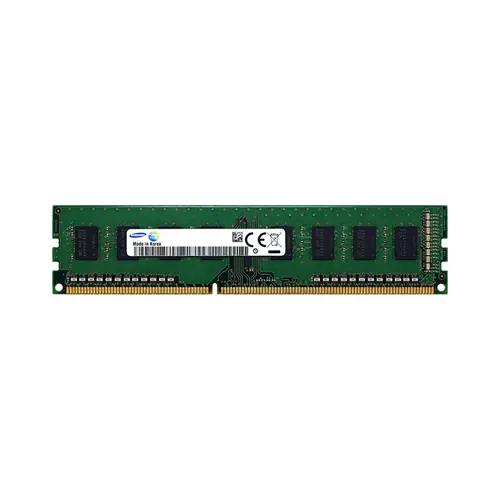
This Samsung M393B2G70EB0-CMA is a 16GB DDR3-1866 Registered ECC RDIMM designed specifically for enterprise servers, making it ideal for memory-intensive workloads such as virtualization, in-memory databases, and data analytics where data integrity is non-negotiable. Its dual-rank configuration and registered signal buffering ensure stable operation at 1866MHz with CL13 latency, delivering both the reliability and the consistent throughput required in multi-DIMM server deployments.
1. Registered signal type buffers command and address lines, enabling large-scale server deployments to populate all DIMM slots without compromising signal integrity or system stability.
2. ECC error identification actively corrects single-bit memory faults, preserving data integrity in financial transactions and mission-critical databases where even silent corruption is unacceptable.
3. The 16 GB capacity per module allows dense memory configurations, maximizing the number of virtual machines that can co-reside on a single physical host without oversubscribing resources.
4. 1866 MHz speed delivers strong memory bandwidth that accelerates in-memory analytics and database caching, reducing query latency for concurrent enterprise workloads.
5. Dual Rank x4 architecture interleaves access across internal memory banks, keeping server memory channels fully utilized and improving throughput for bandwidth-hungry applications like real-time data streaming.
Based on its form factor and signaling, the M393B2G70EB0-CMA is unequivocally a server-class RDIMM. When you are running a dense virtualization cluster where dozens of VMs compete for resources, a single uncorrected bit-flip in the hypervisor layer can cascade into guest crashes or silent data corruption. That is why this module’s ECC engine is non-negotiable: it detects and corrects single-bit errors in real time, directly preserving transactional integrity and uptime. In large in-memory databases, the combination of Registered logic and Dual Rank x4 organization becomes a lifeline. The register buffers the command and address buses, stabilizing signal quality so your server can reliably populate all 24 DIMM slots without timing failures—meaning you scale to 384 GB or more without random reboots. Meanwhile, the dual-rank design interleaves memory banks, boosting bandwidth for massive table scans. With an 1866 MHz clock and a tight CL13 latency, analytical queries complete faster, and virtual machines boot quickly even under peak load. That 1.5V operating voltage keeps thermals manageable in densely packed racks, so cooling overhead does not eat into your OpEx. Crucially, this is not just a spec sheet; it is assurance that your financial transactions commit accurately, your ERP reports render on time, and your hypervisor migration completes without a silent memory error forcing a rollback. Every parameter translates directly to reliability and performance that your users feel.
General Virtualization
For a typical hypervisor hosting multiple VMs, total capacity trumps raw speed. Populate all available DIMM slots with these 16GB RDIMMs to maximize memory density per server, aiming for at least 256GB for moderate consolidation ratios. Balance channels per CPU to maintain bandwidth, and always install identical modules in matched sets to guarantee ECC integrity.
In-Memory Database
Latency-sensitive databases like Redis or SAP HANA demand both capacity and reliability. Deploy six or more of these 16GB dual-rank DIMMs per socket to reach the 128–256GB range, using a balanced memory configuration across all memory channels. Mission-critical instances benefit from sparing or mirroring modes, so provision extra modules for RAS features while keeping thermal headroom in mind.
High-Performance Computing
HPC workloads prize memory bandwidth over bare capacity. Install one 16GB RDIMM per channel in a fully populated configuration to saturate memory controllers and deliver peak throughput. For dual-socket systems, symmetric population ensures uniform NUMA access; the 1866MT/s speed and CL13 latency offer a solid balance, but verify BIOS settings lock the rated speed under full load.
Rigorously tested and compatible with servers: Dell PowerEdge R720, R620, HPE DL380p Gen8.
Q: Can I mix this M393B2G70EB0-CMA with other memory modules of different brands or speeds?
A: Mixing different brands or speeds is not recommended. Registered ECC server memory requires identical specifications for stable operation. Homogeneity ensures data integrity and prevents unexpected downtime in mission-critical environments.
Q: Is this memory compatible with my system?
A: This module supports Intel Xeon E5 v2/v3 and AMD Opteron platforms using DDR3 ECC Registered memory. Please verify your motherboard's QVL list and ensure it supports 240-pin RDIMMs with 1.5V voltage.
Q: What is the recommended DIMM population order for optimal performance?
A: Follow the server motherboard's population guide. Typically, install identical modules in the first slot of each memory channel. For this dual‑rank x4 RDIMM, balanced channel loading maximizes bandwidth and error correction efficiency.
Q: Does this module support overclocking or XMP profiles?
A: No. This is a JEDEC‑standard registered ECC module running at fixed DDR3‑1866. It does not support overclocking or XMP profiles, as server memory prioritizes stability and error‑free data integrity.
Q: What warranty and typical failure rate can I expect?
A: This module includes a one‑year warranty. The typical annualized failure rate is below 1%, consistent with enterprise‑grade registered memory, ensuring reliable operation under continuous 24/7 workloads.